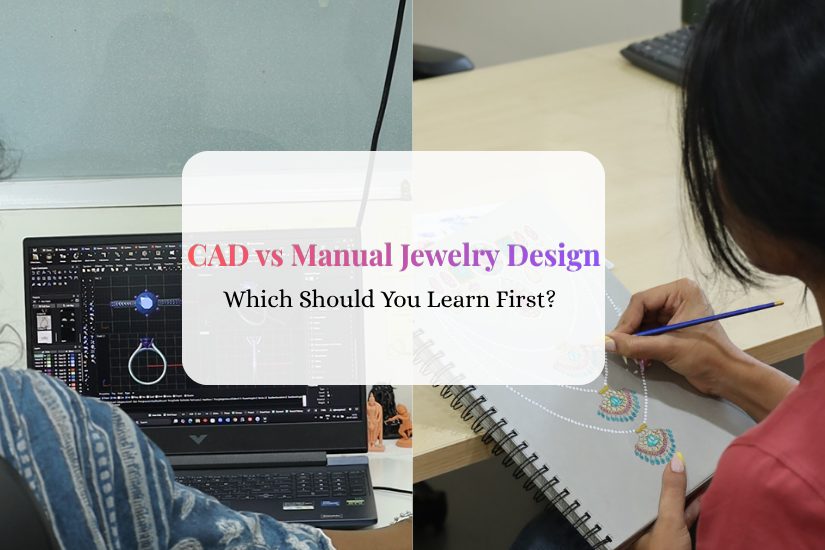
If you are thinking about jewelry designing, one question comes up almost immediately: Should you focus on CAD vs manual jewelry design, or do you need to learn both? It is one of the most common questions new students face, and the answer matters more than most people realise, because the path you choose first shapes the way you think as a designer.
Both approaches are genuinely valuable. Manual jewelry design builds the artistic instincts and material understanding that make a great designer. CAD jewellery design gives you the precision, speed, and production capabilities that modern industry relies on. This guide breaks down what each one teaches you, where each one falls short, and which you should learn first.
What Is Manual Jewelry Design?
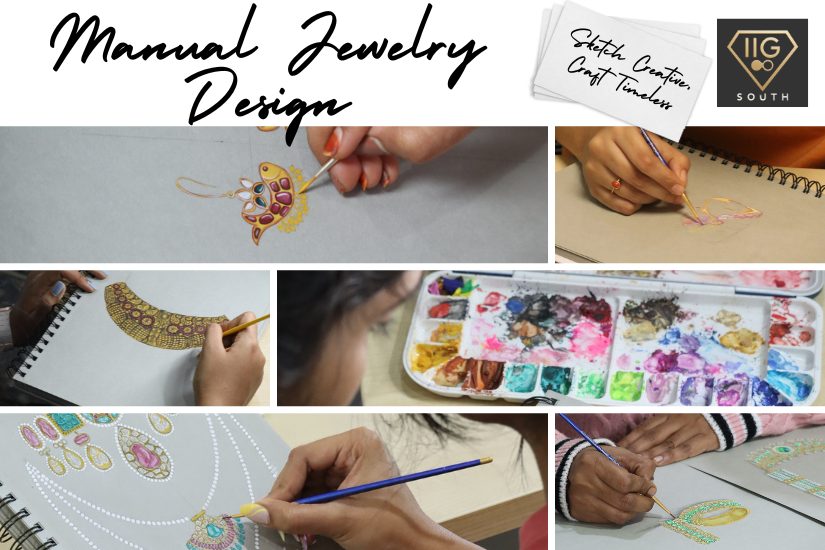
Manual jewelry design covers everything a designer does by hand, from the first pencil sketch on paper to detailed technical drawings and hand-rendered colour visualisations. Before digital tools existed, this was the only way to design jewelry, and it remains a core skill in training programmes and craft-focused studios worldwide.
A manual jewelry designer works with tools such as sketch paper, proportional dividers, and tracing sheets. The process is slow and deliberate, and that slowness is part of what makes it effective. Every line drawn by hand forces you to think about scale, wearability, and proportion in a way that dragging a slider on screen does not.
What Manual Jewelry Design Typically Covers
- Freehand sketching: Proportional drawing of rings, pendants, earrings, and bangles
- Technical rendering: Tone, Shadow, and Material representation on paper
- Material awareness: How metal, gemstones, and setting types behave in real life
- Design principles: Balance, Symmetry, visual weight, and wearability
What Is CAD Jewelry Design?
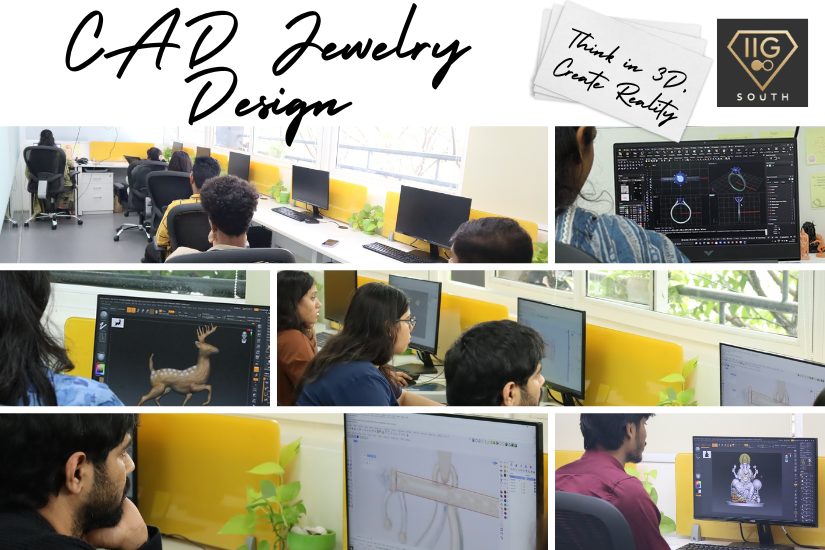
CAD jewelry design uses specialised software to create precise, three-dimensional digital models of jewelry pieces. These models can be sent directly to a 3D printer, used for lost-wax casting, or fed into a CNC machine for manufacturing. The most widely used tools in the Indian jewelry industry are Rhino 3D, Matrix Gold, and ZBrush, each serving a different stage of the design and production process.
CAD is now the professional standard in jewelry manufacturing, retail, and custom design studios. Clients expect photorealistic renders of their commissions before the piece is made. Studios expect designers who can produce print-ready files. For students aiming for industry employment, CAD proficiency is increasingly non-negotiable.
What CAD Jewelry Design Typically Covers
- 3D modelling in Rhino 3D: The foundational platform for jewelry CAD
- Gemstone placement, ring sizing, and parametric design in Matrix Gold or RhinoGold
- Organic and sculptural work in ZBrush, ideal for temple jewelry and heritage designs
- Photorealistic rendering using KeyShot for client presentations
- Production outputs: STL files for 3D printing, STEP files for CNC manufacturing
Manual vs CAD Jewelry Design – Pros and Cons
Before deciding which to learn first, it helps to see both approaches side by side:
| Manual Jewelry Design | CAD Jewelry Design |
| Pros | Pros |
| Builds foundational design eye (Proportion, Scale, Balance) | Precise dimensions output directly to 3D printing and CNC |
| Deep understanding of materials and wearability | Edit and revise in seconds without starting over |
| No software dependency, can be created anywhere, any time | Photorealistic renders help clients visualise the final piece |
| Faster for early-stage ideation and conceptualisation | Scales easily (resize, restyle, and batch-produce efficiently) |
| Appreciated in studios that value traditional craftsmanship | Industry standard in manufacturing, retail, and export studios |
| Directly tied to jewelry manufacturing intuition | Parametric tools handle complex gem settings automatically |
| Cons | Cons |
| Hard to communicate precise dimensions to manufacturers | Without design fundamentals, CAD produces generic, lifeless work |
| Revisions are time-consuming (redraw from scratch) | Software licences are expensive (Rhino, Matrix Gold) |
| Not suitable for complex repeatable geometries at scale | Steep learning curve, especially with no prior 3D experience |
| Clients increasingly expect 3D renders, not hand sketches | Over-reliance on CAD can limit creative thinking |
CAD vs Manual Jewelry Design: Which Should You Learn First?
The short answer, for most students: learn manual jewelry design first.
This is not because manual is more important than CAD in the long run, it is not. CAD is the industry standard, and you will absolutely need it. But manual design develops something that software cannot give you, i.e. design thinking. The ability to look at a piece and know instinctively whether the proportions are right, whether the stone will overwhelm the setting, whether the shank is too thin for the ring’s visual weight. These judgements come from training your eye by hand.
Students who jump straight into CAD without manual foundations often produce technically correct but aesthetically flat work. The software can draw perfect circles and precise prong settings, but it cannot tell you whether the piece is actually beautiful. That judgment comes from you, and it is built through manual training.
That said, there are situations where starting with CAD first makes sense, particularly for students who already have a strong visual arts or product design background, or who are joining a programme specifically focused on digital manufacturing.
Do You Need to Learn Both Manual and CAD Jewelry Design?
For most career paths in jewelry design, it’s a yes. The industry is not a choice between manual and CAD. It is manual and CAD, used at different stages of the same design process.
A typical workflow in a professional jewelry studio today looks like this: a designer sketches initial concepts by hand to explore the idea freely, refines the proportions with detailed technical drawings, and then builds the production model in Rhino 3D or Matrix Gold. The final render goes to the client. The file goes to manufacturing. Manual and CAD are not competitors, they are partners.
The designers who stand out in the jewelry industry are those who are fluent in both. They can sketch an idea in a client meeting and produce a 3D render before the next one. That combination is what employers across Bangalore, Surat, Mumbai, and Jaipur are looking for.
How IIG South Structures Jewelry Design Learning
At IIG South, the jewellery design curriculum is built around exactly this sequence: manual foundations first, CAD proficiency next, with the flexibility to specialise based on where you want to go.
Students who enrol in the Jewellery Design Manual Professional course develop their sketching, rendering, and material awareness before touching any software. Those who join the Jewellery Design CAD Professional course build their digital modelling skills on Rhino 3D with structured, industry-aligned briefs.
For students who want the complete picture, manual, CAD, and manufacturing, the Master’s in Jewellery Design & Manufacturing programme covers all three stages in a single comprehensive course, delivered with real industry exposure and placement support.
If you’re looking for a full undergraduate qualification rather than a short-term course, IIG South’s BSc in Jewellery Design covers this same manual-to-CAD progression, plus Gemology, diamond grading, and manufacturing, across a UGC-recognised 3-year degree.
Frequently Asked Questions
Yes, absolutely. Manual jewelry design remains relevant as a foundational skill and as a primary approach in artisanal, traditional, and craft-focused studios.
Yes. Jewelry design is a learnable skill, not a born talent. Most jewelry design institutes, including IIG South, offer courses specifically designed for students with no prior design experience.
With structured classroom instruction, most students reach working proficiency in Rhino 3D within three to six months. A full jewellery design CAD course covering modelling, gem setting, rendering, and production outputs typically spans six months to a year.
Employers look for Rhino 3D and Matrix Gold proficiency for production and manufacturing roles, and strong manual sketching skills for design development and client-facing positions. ZBrush is increasingly valued in studios that produce temple jewellery, bridal collections, and sculptural pieces.
Online resources can introduce you to jewelry design concepts, but hands-on training under experienced instructors produces significantly better results, particularly for manual skills, which require physical practice, correction, and material handling that a screen cannot replicate.
Yes. IIG South’s BSc in Jewellery Design (BSc in Gems & Jewellery) is a 3-year, UGC-recognised degree that teaches manual design fundamentals in the early semesters before progressing into CAD, Gemology, and manufacturing. qualification rather than a standalone course.
| Start Your Jewelry Design Journey at IIG South. Whether you want to start with manual jewelry design, or dive straight into CAD, or pursue our full BSc in Jewellery Design degree, IIG South has a structured course for where you are right now. Industry-backed education in Bangalore since 1965. Call us at: +91 70196 99357. Explore All Our Jewelry Design Courses |