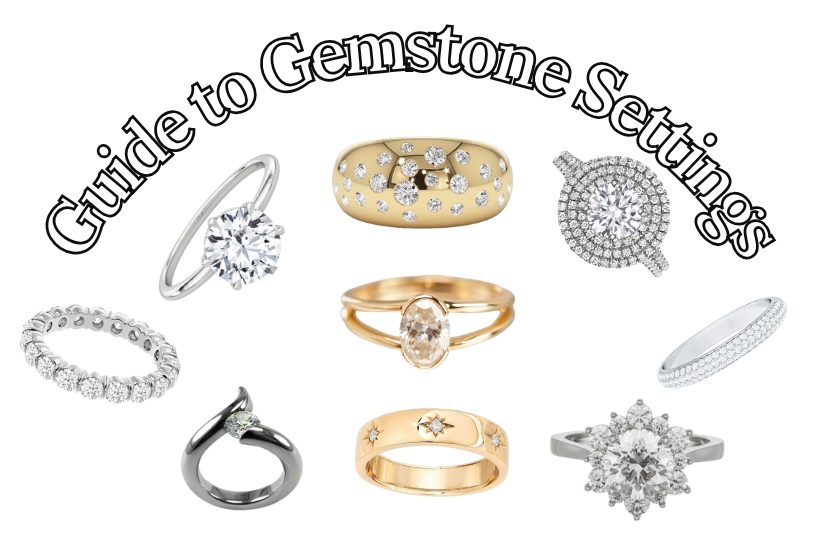
You’ve found the perfect gemstone, but now comes an equally important decision: how will it be set? The gemstone settings isn’t just about aesthetics; it affects how secure your stone is, how much it sparkles, and how well it fits your lifestyle.
Whether you’re shopping for an engagement ring, upgrading a family heirloom, or simply curious about jewelry design, this guide breaks down everything you need to know about gemstone settings.
What Is a Stone Setting?
Stone setting is the method used to secure a gemstone in a piece of jewellery, such as a ring, necklace, earrings, or bracelet, so the stone remains firmly in place while also looking beautiful.
The Foundation Settings: Where It All Begins
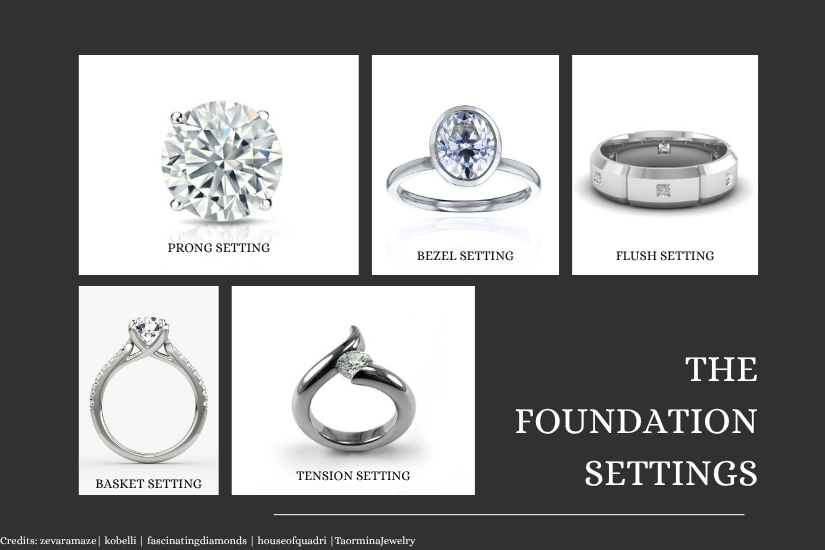
PRONG SETTING (CLAW SETTING)
The most popular and versatile setting type, using metal claws to grip and secure the stone from above, allowing maximum light to flood in from all angles. The most common setting uses metal claws (usually 4-6) to hold the stone.
Types
- 4-Prong: Minimal metal coverage, allowing maximum light entry, can create a square or compass-point orientation, and can make round stones appear slightly square.
- 6-Prong: More secure than 4-prong, makes round stones appear rounder, has even weight distribution, and is often used for solitaires.
- 8-Prong & More: Used for larger stones (2+ carats) or fancy shapes; provides maximum security; more metal visible; can slightly reduce brilliance.
- Double Prong: Two thin prongs placed closely together at each position, creating 8 contact points with 4 prong positions, adding extra security.
Prong Styles:
- Round/Claw Prongs: Most common, Minimal metal visibility, easy to repair/retip
- Flat Tab Prongs: Wide, flat metal tabs, More metal visible, but better stone protection
- V-Prongs: Specially shaped to protect pointed corners, especially for princess, marquise, pear, and heart shapes, preventing chipping at vulnerable points.
- Double Claw/Split Prongs: Each prong splits into two at the top, creating 8 contact points with the stone.
Best For: Anyone seeking maximum brilliance and comfortable with occasional prong maintenance.
BEZEL SETTING
A bezel setting wraps a metal rim (collar) completely (or partially) around your stone’s edge.
Types:
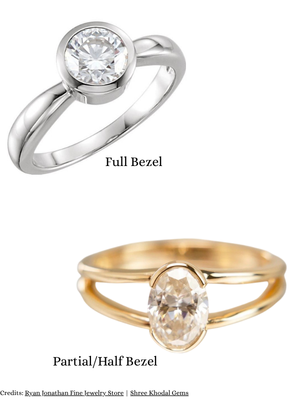
Full Bezel: Metal completely encircles the stone 360°, providing maximum protection and security.
Partial/Half Bezel: Metal covers only a portion of the stone (usually 25-75%), giving you protection where you need it while allowing more light in.
Best For: Active lifestyles, nurses, teachers, and anyone who works with their hands. Also perfect for a contemporary, minimalist aesthetic.
FLUSH/GYPSY SETTING
In a flush setting, the stone sits embedded directly into the metal band, creating a smooth, low-profile look. The stone appears to be part of the metal itself.
Types & Variations:
True Flush Setting: Stone table completely level with the metal surface, making it appear embedded in metal.
Star/Engraved Flush: Decorative engraving around flush-set stone (Victorian and Edwardian jewelry)
Cluster Flush: Multiple flush-set stones in patterns, creating flowers, geometric patterns.
Scattered Flush (Étoile/Starlight): Random placement of flush-set stones creates a constellation or starry sky effect.
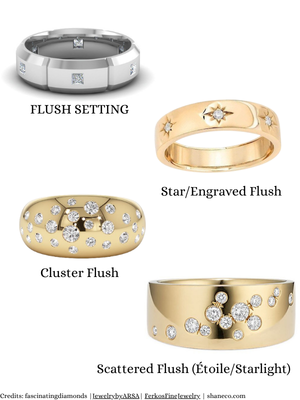
Best For: Men’s rings, people who want ultra-low profile jewelry, or anyone seeking a subtle, sophisticated look.
BASKET SETTING
Prong setting with horizontal metal framework connecting prongs below the stone, creating a basket-like support.
Variations:
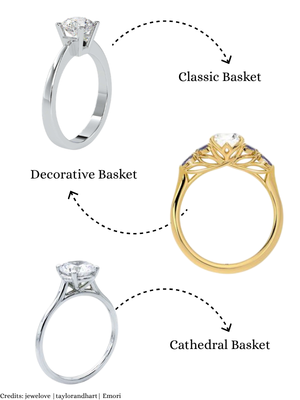
Classic Basket: Four prongs connected by horizontal wires.
Decorative Basket: Ornate gallery work beneath stone (Filigree, scrollwork, or geometric patterns)
Cathedral Basket: Combines a basket with cathedral arches.
TENSION SETTING
One of the most modern and dramatic settings where the stone appears to be suspended in mid-air, held by pressure from the metal band ends. Developed by Steven Kretchmer in 1969; popularised in the 1990s. Creates a floating effect with modern appeal.
Design Variations:
Vertical Tension: Stone held between the top and bottom of the band, creating vertical orientation.
Horizontal Tension: Most common orientation, Stone suspended left-right.
Partial Tension: One side tension, the other side has prongs or bezel.
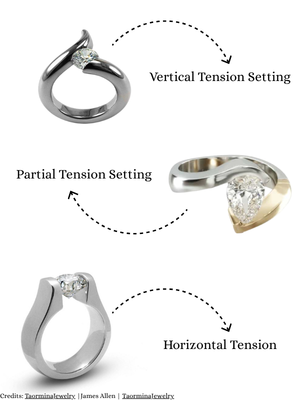
Best For: Modern aesthetics, those who want a conversation-starter piece. Note: requires careful handling and professional maintenance.
Want to learn how to design and craft rings using these techniques? Explore our Jewellery Design Courses
Linear & Surface Settings: Creating Continuous Sparkle
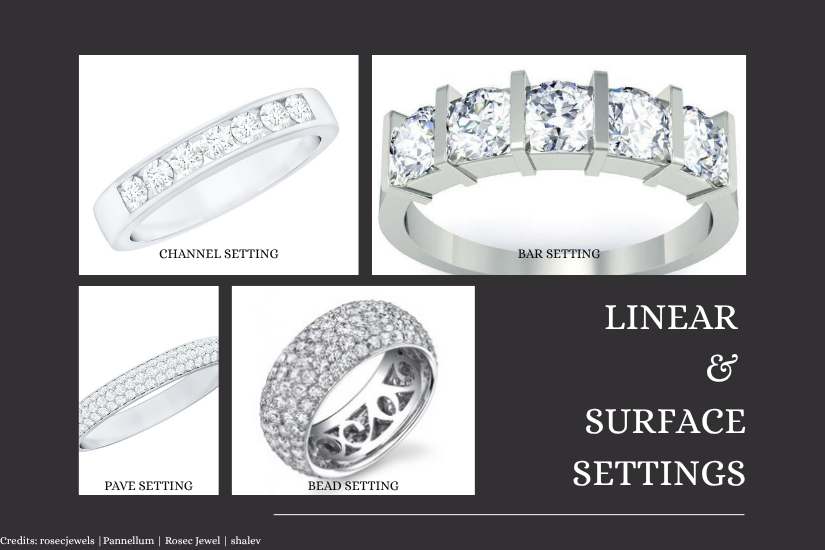
CHANNEL SETTING
Stones set in a groove (channel) cut into metal, held securely by metal walls on both sides. No prongs or beads visible. Creates a clean, continuous line of stones.
Types & Variations:
- Standard Channel: Stones set in a straight row, Metal on both sides, same height.
- Flush Channel: Metal walls flush with stone tables.
- Raised Channel: Channel raised above the band surface, creating a dimensional effect.
- Half-Channel/Partial Channel: Channel on part of the band (not fully around)
- Tapered Channel: Channel width varies (narrows or widens)
- Multi-Row Channel: Multiple parallel channels, Two or more rows of stones
- Mixed Metal Channel: Channel walls with a different metal from the base
Best For: Wedding bands, eternity rings, and anyone who wants sparkle without snags. Perfect for pairing with engagement rings.
BAR SETTING
A bar setting is a type of stone setting where gemstones are held in place by vertical metal bars placed between each stone.
Instead of continuous walls (like a channel), individual bars separate and secure each stone.
Types:
- Standard Bar Setting: Single row of stones with bars between, and Bars connect to the band top and bottom.
- Double Bar Setting: Two bars between each stone (one on each side)
- Partial Bar Setting: Bars don’t extend the full height of the stones and can be top-only or bottom-only
- Mixed Bar Setting: Alternating bar widths creates rhythm and pattern.
Best For: Modern designs, those who want something between the openness of prong settings and the security of channel settings.
PAVÉ SETTINGS
Very small diamonds (melee) are set closely together using tiny prongs or beads of metal, creating a seamless “paved” effect. The French term pavé (pronounced: pa-vay) means “paved” or “pavement,” reflecting the continuous, glittering surface formed by multiple small stones placed side by side with minimal visible metal.
Types & Variations:
- Traditional Pavé: Small diamonds (typically 1-2mm, 0.01-0.03ct each), Set in rows, 2-4 beads per stone, V-shaped bright cuts between stones
- Micro-Pavé: Extremely small diamonds (under 1mm, 0.005ct or less), Ultra-small diamonds, delicate work, diamond-dust appearance. Set with minimal visible metal.
- French Pavé (Fishtail Pavé): V-shaped cuts between rows create a fishtail pattern
- Scalloped Pavé: Metal between stones shaped into decorative scallops, and each section resembles a flower petal.
- Shared Prong Pavé: Single prongs positioned between stones, and each prong holds two adjacent stones.
- U-Cut Pavé: U-shaped channels cut between stone rows while the stones sit in grooves.
Best For: Adding maximum sparkle to bands, halos, or any surface. Creates that “wow factor” everyone notices.
BEAD SETTING (GRAIN SETTING)
Individual stones, each secured by small metal beads raised from the surrounding surface. Similar to pavé but with more spacing and larger, more prominent beads.
Best For: Vintage-inspired designs, those who want texture and dimension along with sparkle.
Curious about the grading and evaluation of the diamonds and gemstones used in these settings? Read: Natural, Synthetic & Simulated Gemstones: What’s the Difference?
Compound Settings: Amplifying Beauty
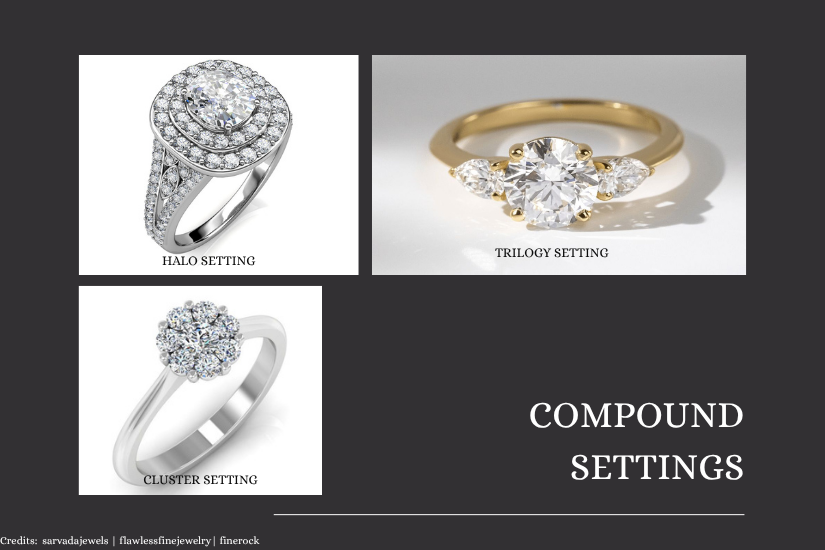
HALO SETTING
A center stone is surrounded by a ring (halo) of smaller accent stones, making the center stone appear larger and adding extra sparkle. Enhances the size and brilliance of the center stone, popular for engagement rings. Can be single or multiple halos.
Types & Variations:
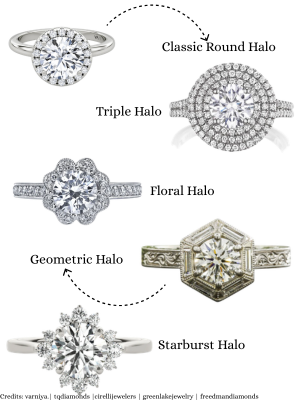
Classic Round Halo: Circular halo surrounding a round center stone, Uniform appearance.
Hidden Halo: A ring of diamonds positioned underneath the center stone, not visible from above, but creates a brilliant surprise from the side.
Double/Triple Halo: Multiple concentric rings for maximum drama.
Floral/Petal Halo: Halo stones arranged in a flower petal pattern.
Hexagonal/Geometric Halo: Non-circular halos following geometric shapes like hexagon, octagon, square, etc..
Starburst/Spike Halo: Elongated stones radiating from the centre.
Best For: Making a smaller center stone appear larger, maximising sparkle, creating a vintage or glamorous look.
CLUSTER SETTING
Multiple stones are grouped to create the appearance of one larger stone or decorative pattern. Can create floral designs, geometric shapes, or abstract arrangements.
Types & Variations:
- Floral/Flower Cluster: Center stone surrounded by “petals” (smaller stones) creating a flower appearance.
- Starburst Cluster: Elongated stones radiating from center, creating a sun or star effect.
- Geometric Cluster: Stones arranged in geometric patterns like Hexagons, triangles, squares etc.,
- Random/Organic Cluster: Asymmetrical stone arrangement with Natural, organic appearance.
- Bypass/Crossover Cluster: Two clusters on bypassing bands
- Tiered/Domed Cluster: 3d, raised cluster, Stones set at different heights creating a dome or pyramid.
- Navette/Marquise Cluster: Oval or marquise outline created by cluster.
- Target/Bullseye Cluster: Concentric circles of stones with alternating stone sizes or colors
Best For: Budget-conscious shoppers (smaller stones cost less than one large stone), vintage aesthetics, and unique artistic designs.
THREE-STONE/TRILOGY SETTING
Three stones set in a row, typically with a larger center stone flanked by two smaller side stones. Symbolises past, present, and future.
Design Variations:
- Traditional Three-Stone: Graduated sizing (center largest)
- Equal-Size Three-Stone: All three stones are same size, creating a balanced, symmetrical look.
- Mixed Shape Three-Stone: The center stone is of a different shape than the side stones
- Colored Stone Three-Stone: Side stones are of a different color than the center one.
Symbolic Meaning:
- Past, present, future
- Love’s journey
- Anniversary gift (past years, current, future together)
Best For: Anniversary gifts, those who love symbolic jewelry, and creating a balanced yet distinctive look.
Structural Design Elements: Architectural Beauty
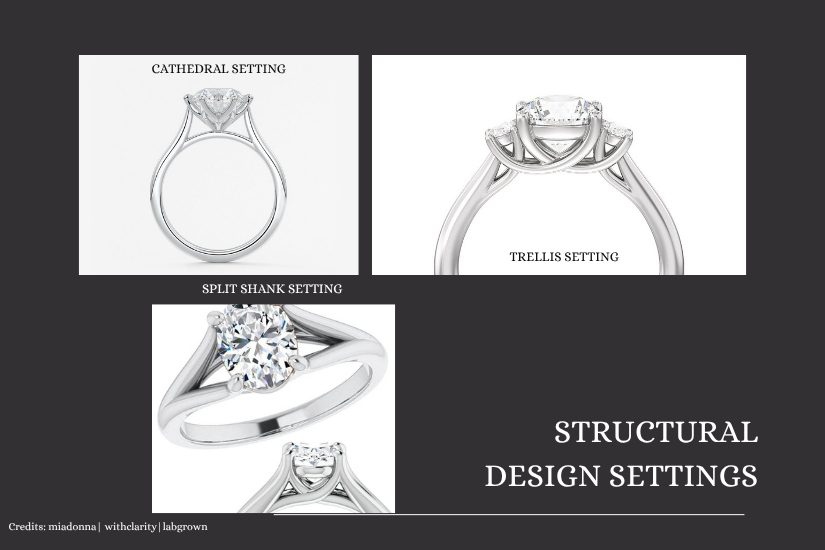
CATHEDRAL SETTING
Arches of metal rise from the band to support the center stone, resembling cathedral architecture.
Variations:
- Classic Cathedral: Two symmetrical arches, Clean, simple lines
- Double Cathedral: Multiple tiers of arches, more dramatic height
- Pavé Cathedral: Arches covered in pavé diamonds, Maximum sparkle.
- Split Cathedral: Combines cathedral with split shank, four arches instead of two.
SPLIT SHANK SETTING
The band splits into two or more separate bands as it approaches the centre stone. Creates distinctive, open appearance and adds visual interest.
Types:
- Simple Split Shank: Two plain bands split from main shank.
- Pavé Split Shank: Split bands covered in pavé diamonds.
- Twisted/Braided Split Shank: Strands twist around each other, Creates rope or braid effect.
- Bypass Split: Strands don’t meet at center, Wrap around stone.
- Multi-Split: More than two strands
Best For: Adding uniqueness to classic styles, those who want their ring to look different from every angle.
TRELLIS SETTING
Prongs arranged in a crisscross or lattice pattern resembling a garden trellis. Creates an open, airy appearance with geometric elegance.
Best For: Nature lovers, those seeking vintage charm with a geometric twist.
Modern & Specialty Settings
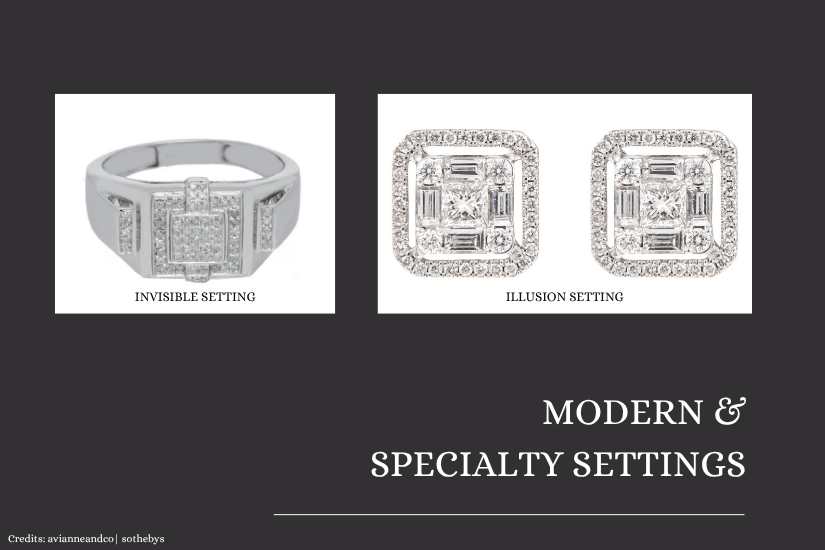
INVISIBLE SETTING (MYSTERY SETTING)
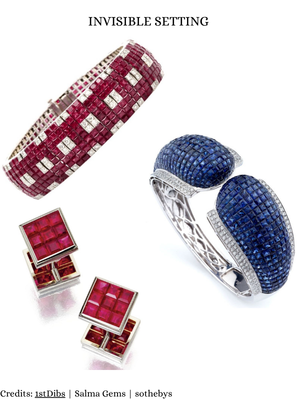
An invisible setting is a technique where stones are set without any visible prongs, beads, or metal from the top. The result is a seamless surface of stones giving a “floating” together effect. Each stone is grooved from the bottom (not visible from the top), and these grooves slide into a metal grid/rail framework underneath. Stones lock together like a puzzle system. The holding structure is hidden below the surface. Patented by Van Cleef & Arpels in 1933 as “Serti Mysterieux”.
Best For: High-end pieces, those who want the ultimate in seamless sparkle. Note: requires master craftsmanship and significant investment.
ILLUSION SETTING
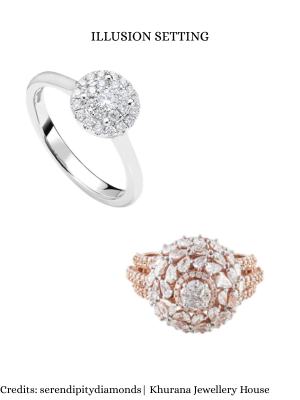
Metal is polished and designed to create an optical illusion so that the stone appears larger than its actual size. Uses metalwork to make a stone look larger than it is.
Each setting type offers unique advantages, and the best choice depends on personal preferences, lifestyle, budget, and the stone being set. The setting should enhance the stone while meeting practical needs for durability and maintenance.
Best For: Maximising the appearance of smaller stones, vintage-inspired designs, and budget-conscious buyers wanting a big impact.
Choosing Your Perfect Gemstone Setting: Quick Decision Guide
- For Active Lifestyles: Bezel, flush, or channel settings
- For Maximum Sparkle: Prong, pavé, or halo settings
- For Modern Aesthetics: Tension, bezel, or bar settings
- For Vintage Vibes: Cathedral, cluster, or trellis settings
- For Security: Bezel, channel, or 6-prong settings
- For Budget-Friendly Size: Halo, cluster, or illusion settings
The perfect gemstone setting enhances your stone while reflecting your personal style and lifestyle needs. There’s no single “best” setting, only the best setting for you.
Ready to turn this knowledge into a career? At IIG South, we offer industry-backed courses in Jewellery Design, Gemology, and Diamond Grading — with practical training and real-world exposure since 1965.
Explore All Our Courses. Download Our Free e-Brochure.
Call Us: +91 70196 99357 Email: bengaluru@iigsouth.com