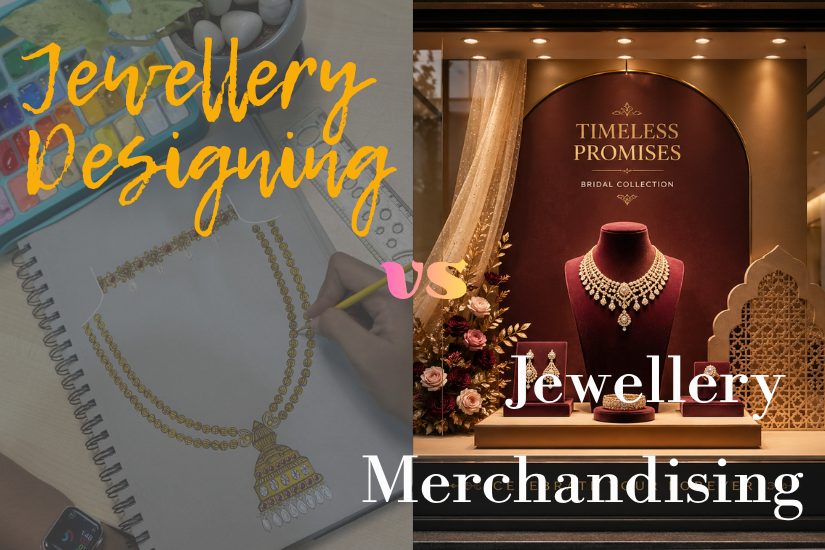
If you are exploring a career in the jewellery industry, you have probably come across two terms that often get used interchangeably: jewellery designing and jewellery merchandising. They both sit within the gems and jewellery world, and yet they describe two very different career tracks, skill sets, and professional outcomes.
Understanding the difference between jewellery designing and merchandising is not just useful for choosing a course. It is the first step toward making a decision that genuinely matches your strengths, interests, and long-term career goals.
In this guide, we break down exactly what each field involves, where they overlap and what the career outcomes will be.
What Is Jewellery Designing?
Jewellery design is the creative and technical process of conceptualising, sketching, and developing jewellery pieces, from the initial idea to the finished visual blueprint.
A jewellery designer works at the intersection of art, material science, and craftsmanship. Their job is to imagine what a piece of jewellery could be, then communicate that vision clearly enough for a manufacturer or goldsmith to bring it to life.
Core Skills in Jewellery Designing
Jewellery designers develop expertise across both creative and technical domains:
- Freehand sketching and technical drawing: Translating ideas into accurate proportions and views.
- CAD (Computer-Aided Design): Using software like Rhino, Matrix, or ZBrush to build precise 3D models.
- Digital illustrations: Tools like Procreate are increasingly used for concept rendering and client presentations.
- Gemstone and material knowledge: Understanding gem shapes, cuts, settings, and how different metals behave.
- Aesthetic sensibility: Staying current with global trends in luxury, bridal, fashion, and heritage jewellery.
What Does a Jewellery Designer Actually Do?
In practice, jewellery designers:
- Study consumer trends and design briefs from brands or clients
- Create hand-drawn or digital concept sketches
- Develop 3D CAD models with accurate dimensions and gemstone placements
- Collaborate with manufacturers and gemstone buyers to finalise designs
- Build collections for retail launches, exhibitions, or custom orders
Career Paths in Jewellery Designing
Graduates of a jewellery designing course can pursue careers as:
- Jewellery Designer (in-house at brands or as a freelancer)
- CAD Specialist and 3D Visualiser
- Design Consultant for manufacturing units
- Product Development Lead at jewellery export houses
- Entrepreneur and independent jewellery brand founder
What Is Jewellery Merchandising?
Jewellery merchandising is the business-facing discipline that bridges the gap between the jewellery that is designed and manufactured, and the customer who ultimately buys it.
Where a jewellery designer focuses on creating a product, a jewellery merchandiser focuses on positioning and selling it. The merchandiser’s world is one of retail strategy, consumer psychology, product assortment planning, and visual presentation.
Core Skills in Jewellery Merchandising
Jewellery merchandisers work at the intersection of product knowledge and business strategy:
- Product knowledge: Deep familiarity with gemstones, metals, manufacturing processes, and quality standards.
- Consumer behaviour and market research: Understanding who buys jewellery, why, and how buying decisions are made.
- Retail planning and assortment management: Deciding which products to stock, in what quantities, and at what price points.
- Visual merchandising: Arranging jewellery displays in-store and online to maximise visual impact and conversion.
- Buying and vendor management: Sourcing products, negotiating with suppliers, and managing inventory.
- Marketing and brand communication: Understanding how to present a jewellery collection to the right audience.
What Does a Jewellery Merchandiser Actually Do?
A jewellery merchandiser’s day-to-day responsibilities include:
- Analysing sales data to understand which categories and styles are performing.
- Planning seasonal product ranges in line with market trends and demand forecasts.
- Working with design and manufacturing teams to align product development with commercial goals.
- Designing showroom or counter layouts to optimise the customer experience.
- Training retail sales teams on product knowledge and selling techniques.
- Managing relationships with vendors, buyers, and retail partners.
Career Paths in Jewellery Merchandising
A jewellery merchandising course opens doors to roles such as:
- Jewellery Merchandiser at retail brands and luxury chains.
- Product Manager or Buying Manager at jewellery export houses.
- Visual Merchandising Manager.
- Category Manager at e-commerce platforms (Tanishq, Caratlane, Bluestone, etc.)
- Brand Manager or Marketing Executive in the jewellery space.
- Retail Operations Manager.
Where Jewellery Design and Merchandising Overlap
Although jewellery designing and merchandising are distinct disciplines, they are deeply interconnected in the real industry. Understanding both makes you a far more valuable professional.
Here is where the two fields converge:
1. Gemstone and Product Knowledge: Both designers and merchandisers must understand gemstones, their quality, grading, visual characteristics, and value. A designer needs this knowledge to select the right stone for a setting. A merchandiser needs it to assess product quality, communicate value to customers, and make informed buying decisions. Gemology education, therefore, is a shared foundation.
2. Trend Awareness: Jewellery designers study trends to inform their creative decisions. Merchandisers study the same trends to decide which designs will sell and how they should be presented. They often work together closely to ensure that what is designed is also commercially viable.
3. Collaboration in the Supply Chain: In most jewellery brands, the design team and the merchandising team work hand in hand. Designers pitch new collections; merchandisers assess their commercial viability, suggest modifications, and plan how to take those collections to market. Students who understand both sides of this relationship are highly sought after by employers.
4. Retail and Brand Building: Many jewellery designers eventually move toward building their own brand, which requires merchandising skills. Similarly, many merchandisers develop deep design iteracy over time, allowing them to contribute meaningfully to product development discussions.
Both Paths Lead to a Thriving Industry
The jewellery industry in India is growing at a remarkable pace. With India now among the world’s largest jewellery markets, career opportunities in both jewellery designing and merchandising have never been stronger. Whether you choose the creative path or the commercial one, both roads lead to a dynamic, global industry with enormous scope. What matters most is choosing the path that genuinely aligns with who you are and how you want to work, and then getting the right education to pursue it with confidence.
In the jewellery industry, the best professionals are those who understand the full pipeline, from concept sketch to retail counter. At IIG South, you do not have to figure that out alone. Our counsellors work with every prospective student to understand their background, their goals, and their strengths, and guide them toward the course that will take them furthest.
Ready to take the next step? Explore our Jewellery Design Courses, Our B.Sc in Jewellery Design program, Jewellery Merchandising Professional programme, and the full range of Gemology Courses or speak to our team directly and find the course that is right for you. Call us: +91 70196 99357