From gemstone grading to jewellery design, AI is no longer a future concept — it’s already on the workbench.
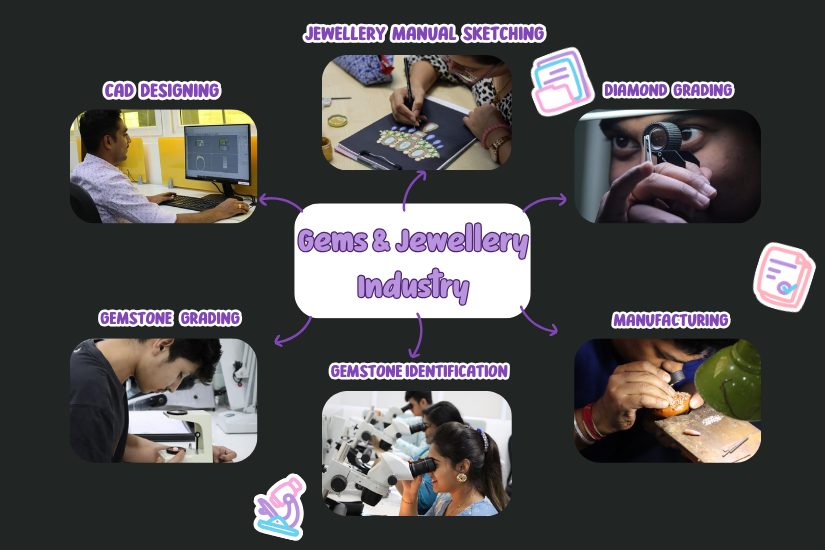
The gems and jewellery industry has always been a blend of art, science, and skill. Gemologists spend years training their eyes to identify inclusions. Designers sketch and refine concepts by hand before bringing them to life. Diamond graders work under precise lighting, applying rigorous international standards. These skills are deeply human, and they remain irreplaceable.
But something significant is happening alongside all of this. Artificial Intelligence(AI) is entering the industry, not to replace expertise, but to sharpen it. For students training in gemology, jewellery design, and diamond grading today, understanding how AI is being applied is no longer optional; it’s part of being industry-ready.
1. AI in Gemstone Identification and Grading
One of the most labour-intensive tasks in gemology is accurately identifying and grading gemstones. Traditionally, this requires a trained eye, a loupe, spectroscopic instruments, and years of hands-on experience. AI is now augmenting this process in meaningful ways.
Machine learning models trained on thousands of gemstone samples can now analyse spectral data and microscopic imagery to assist in identifying stone type, origin, and quality characteristics. Companies like Gübelin Gem Lab have been exploring AI-assisted tools that help detect lab-grown versus natural stones, a distinction that has become critically important as lab-grown diamonds flood the market.
The foundational skills the gemology students learn, like understanding refractive indices, specific gravity, inclusions, and optical phenomena, remain essential. AI tools work with this knowledge, not instead of it. A gemologist who also understands AI-assisted analysis will be a far more valuable professional.
2. AI-Powered Diamond Grading
Diamond grading is perhaps the area where AI is making the most immediate impact. Grading a diamond for cut, colour, clarity, and carat weight requires consistency, something human graders, despite their training, can vary slightly across long working sessions.
Many new companies have developed AI-powered diamond grading systems that analyse cut quality and light performance with machine-level precision. These systems generate detailed light performance reports, including parameters such as brilliance, fire, scintillation, and symmetry, with speed and consistency that supplement traditional grading.
Several large diamond trading centres now use a combination of AI-assisted pre-screening and expert human grading, with the AI flagging borderline cases or anomalies for closer inspection by a trained grader.
The Four Cs remain the global language of diamonds. What changes is that graders who can interpret AI-generated reports and understand their limitations will be better equipped for modern lab environments.
3. AI in Jewellery Design — CAD Meets Generative Design
Jewellery design has already moved significantly toward CAD (Computer-Aided Design) tools like Rhino 3D, ZBrush and Matrix. The next step is generative AI design, where designers input parameters like stone size, style, metal type, and occasion, and the AI generates multiple design concepts within seconds. To master the CAD tools, enrol in our Master’s in Jewellery Design course.
Jewellery designers are using tools like Adobe Firefly, Midjourney, and dedicated platforms such as Jewelflow and Pictofit to generate concept visuals, explore design iterations, and present clients with realistic renders before they pour a single gram of metal.
For custom jewellery studios, this dramatically shortens the design consultation process. For design students, it means that learning to work alongside generative tools, while maintaining a strong aesthetic sensibility and technical foundation, is a core career skill.
4. AI in Jewellery Retail and Customer Experience
On the consumer-facing side, AI is reshaping how people buy jewellery. Virtual try-on tools powered by augmented reality and AI allow customers to see how a ring, necklace, or earring looks on them before purchase, directly on a mobile app or on a website.
Tanishq, CaratLane, and several international brands now use AI-driven recommendation engines that suggest jewellery based on customer purchase history, browsing patterns, occasion, and budget. Chatbots handle enquiries, and AI-driven inventory management helps retailers predict which designs will sell in which markets.
For students pursuing careers in jewellery merchandising or retail management, understanding how these tools influence buying behaviour gives a meaningful edge.
5. AI in Fraud Detection and Ethical Sourcing
Two of the biggest concerns in the gems and jewellery industry, gemstone fraud and ethical sourcing, are also being addressed through AI.
Blockchain combined with AI is being used to track gemstones from mine to market, creating an auditable chain of custody. This is particularly relevant for diamonds, where conflict-free certification is a commercial and ethical necessity. AI tools can cross-verify provenance documentation and flag inconsistencies in supply chain records.
Lab technicians and trade professionals are also deploying AI spectrometers to detect synthetic or treated stones that sellers might misrepresent as natural, protecting buyers and the integrity of the market.
6. What AI Cannot Replace?
With all of this said, there is a clear and important boundary. AI in the gems and jewellery industry functions as a powerful assistant, not an authority.
A machine can measure light performance, but it cannot assess the emotional significance of a piece. It can flag a spectral anomaly, but it takes a trained gemologist to understand the geological story behind a Kashmir sapphire’s silky inclusions. It can generate design concepts, but it cannot develop the relationship with a client that turns a custom piece into something truly personal.
The jewellery industry is rooted in trust, beauty, and craftsmanship. Those qualities come from people, from trained, knowledgeable, passionate professionals.
Building a Career in an AI-Augmented Industry
For students at IIG South, whether you’re pursuing gemology, diamond grading, or jewellery design, the right approach to AI is neither fear nor uncritical enthusiasm. It is curiosity paired with a strong technical foundation.
The professionals who will thrive in the next decade are those who understand their craft deeply and can work fluently alongside the tools that are reshaping it. A gemologist who can interpret an AI-assisted origin report. A designer who can direct a generative AI tool toward a vision rather than accept whatever it produces. A diamond grader who understands the limits of machine analysis.
That combination of traditional expertise and technological fluency is precisely what industry-focused education is designed to build.
Interested in building a career in the gems and jewellery industry? Explore IIG South’s courses in Gemology, Diamond Grading, and Jewellery Design, and become the professional the modern industry needs.