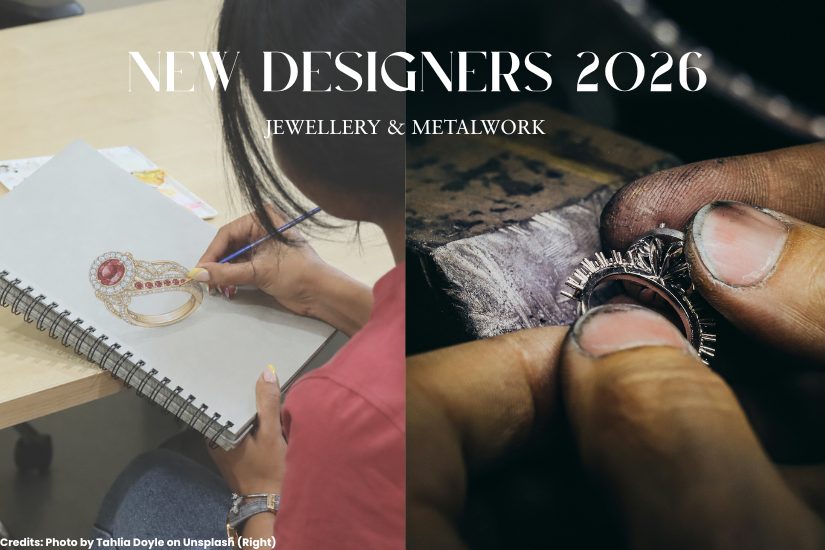
Every July, the Business Design Centre in London turns into one of the world’s biggest stages for graduate design talent. New Designers 2026, running from 1 to 4 July, brought together over 2,500 designers across every design discipline, from textiles and furniture to ceramics and game design. Tucked among them was a section that matters a great deal if you’re studying jewellery design in India: Jewellery & Metalwork.
You didn’t need a ticket to London to benefit from what came out of it. The ideas on display there, how a new generation of designers is thinking about materials, technique, and meaning, are the same conversations happening in design studios and classrooms everywhere, including here at IIG South. Here’s what the show revealed, and how you can put it to work in your own portfolio.
What Is New Designers?
New Designers is an annual UK exhibition where final-year and recently graduated students from design courses across the country present their work to the public, industry buyers, and potential employers. It isn’t a jewellery trade show; it covers everything from fashion to product design, but its Jewellery & Metalwork section has built a reputation of its own, supported over the years by respected names in British jewellery such as Stephen Webster, Hockley Mint, and Diana Porter.
Think of it less as an event to attend and more as a snapshot: a curated look at what jewellery design education is producing right now, at some of the world’s leading art and design schools.
Jewellery & Metalwork Takes Center Stage
The jewellery and metalwork featured this year spanned an unusually wide range – from minimalist, wearable pieces to sculptural statement jewellery that blurred the line between adornment and fine art. What stood out wasn’t any single style, but a set of shared instincts running through the collections. Designers were drawing heavily on personal identity and cultural heritage to shape their work, treating each piece less as decoration and more as a story told in metal and stone.
That instinct of using jewellery to say something, not just to shine, is worth sitting with as a student. It’s a reminder that technical skill and concept need to grow together, not one before the other.
5 Trends Shaping the Future of Jewellery Design
1. Sustainability Is No Longer Optional
Recycled metals, ethically sourced stones, and low-impact production methods showed up again and again in the graduate work on display. This mirrors exactly where the wider gems and jewellery industry is heading — buyers and retailers increasingly expect designers to know the provenance of their materials, not just their properties.
2. Craftsmanship Meets Digital Fabrication
Traditional hand skills — fabrication, stone setting, casting, engraving — remain the backbone of the discipline. But they’re now sitting comfortably alongside 3D printing and laser cutting. The strongest work wasn’t necessarily the most technologically advanced; it was the work that used digital tools deliberately, to achieve something hand skills alone couldn’t.
3. Jewellery as Storytelling and Identity
A recurring theme was designers using their own cultural background or personal history as the starting point for a collection. This is a natural strength for Indian jewellery design students — the country’s craft traditions, regional motifs, and gemstone heritage offer source material that’s genuinely distinctive on a global stage.
4. Sculptural, Statement Silhouettes
Several standout pieces treated jewellery almost as wearable sculpture — bold forms that push past “pretty” into “thought-provoking.” It’s a useful reminder that a strong graduate or student portfolio benefits from at least one piece that takes a risk, rather than being uniformly commercial.
5. Real Industry Pathways, Not Just Awards
The presence of established jewellery names as mentors and award partners at New Designers reflects something worth noting: the industry is actively looking at graduate work as a talent pipeline, not just applauding it politely. The same is increasingly true in India, where design competitions and industry showcases are becoming genuine entry points into careers.
What This Means for Jewellery Design Students in India
None of these trends requires a London postcode to act on. If you’re currently pursuing a Diploma or B.Sc in Jewellery Design, here’s how to translate them into your own coursework and portfolio:
- Research your materials, not just your design. Being able to explain where a stone or metal comes from, and why you chose it, is as important as the design itself.
- Learn the digital tools alongside the hand skills. CAD and basic 3D modelling are no longer “extra”; they’re an expected part of a well-rounded jewellery designer’s toolkit.
- Mine your own context for concepts. Indian textile patterns, temple jewellery traditions, regional stone-setting techniques, or family heirloom pieces can all be legitimate, powerful starting points for a concept-led collection.
- Enter competitions and showcases whenever you can. Graduate shows exist precisely to connect student work with industry eyes; the earlier you get comfortable presenting your work publicly, the better.
Building a Portfolio That Stands Out
A few practical takeaways from what tends to separate memorable graduate work from the rest:
1. Lead with a concept, not just a collection. Every piece should answer “why,” not just “how.”
2. Document your process. Sketches, material tests, and failed prototypes show your thinking. Juries and recruiters value this as much as the final photograph.
3. Photograph jewellery like it matters. Even a strong design can be undersold by weak photography. Invest time in proper lighting and styling for your final shots.
4. Know your materials story. Be ready to speak about sourcing, sustainability, and technique in one or two sentences; it’s increasingly part of how work gets evaluated.
Frequently Asked Questions
New Designers is an annual UK graduate design exhibition held at the Business Design Centre in London, showcasing final-year student work across disciplines including jewellery and metalwork.
While the exhibition itself is UK-based, the design trends it surfaces each year — sustainability, digital fabrication, identity-led design — reflect broader shifts in global jewellery education and industry expectations.
Courses typically combine traditional craftsmanship (hand fabrication, stone setting, casting) with modern skills such as CAD, gemology fundamentals, and increasingly, sustainable sourcing practices.
Focus on a clear design concept, document your creative process, invest in good photography, and be able to speak confidently about your material choices.
| Ready to build a portfolio that gets noticed? |
| Enroll in IIG South’s Diploma or B.Sc. programmes in Gems & Jewellery Design, which combine traditional craftsmanship with the CAD, gemology, and sustainable design thinking the industry now expects. |