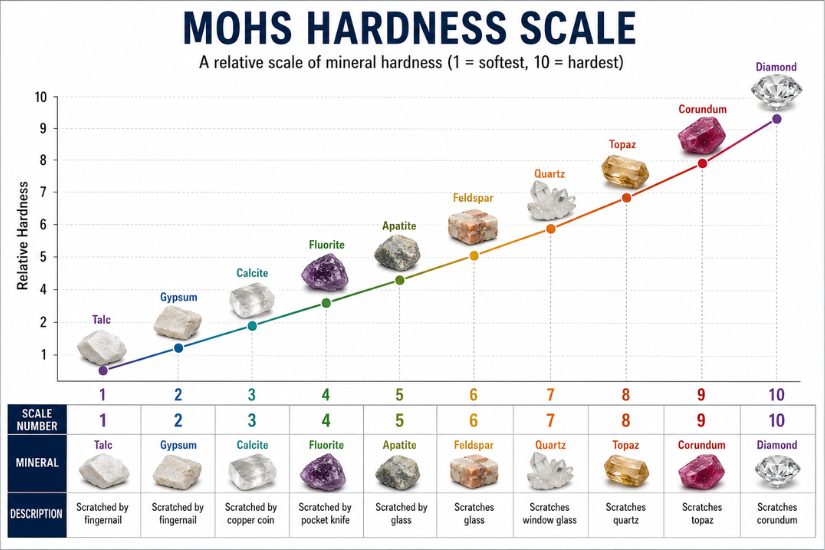
If you are studying gemology or working in the jewellery industry, the Mohs Hardness Scale is one of the first tools you will encounter. It is a simple yet powerful system that helps gemologists, jewellery designers, and gem traders assess a stone’s durability, suitability for setting, and resistance to wear. Whether you are a beginner just starting your journey or a seasoned professional brushing up on fundamentals, understanding the Mohs Hardness Scale is essential to working confidently with gemstones.
What Is the Mohs Hardness Scale?
The Mohs Hardness Scale is a qualitative ordinal scale that ranks minerals and gemstones by their resistance to scratching. Introduced in 1812 by the German mineralogist Friedrich Mohs, the scale assigns a hardness value from 1 to 10, with 1 being the softest mineral (talc) and 10 being the hardest naturally occurring substance known (diamond).
A key principle of the scale is that a mineral with a higher hardness rating will scratch one with a lower rating. For instance, a piece of quartz (hardness 7) will leave a visible scratch on feldspar (hardness 6), but it cannot scratch topaz (hardness 8). This relative comparison method makes the scale a practical, hands-on tool, ideal for field identification and laboratory work alike.
The 10 Reference Minerals of the Mohs Hardness Scale
| Mohs Rating | Reference Mineral | Everyday Equivalent |
| 1 | Talc | Can be scratched by a fingernail |
| 2 | Gypsum | Just scratched by a fingernail |
| 3 | Calcite | Scratched by a copper coin |
| 4 | Fluorite | Scratched easily by a steel file |
| 5 | Apatite | Scratched by a steel knife |
| 6 | Orthoclase Feldspar | Scratches window glass |
| 7 | Quartz | Scratches steel |
| 8 | Topaz | Scratches quartz easily |
| 9 | Corundum (Ruby/Sapphire) | Scratches topaz |
| 10 | Diamond | Scratches all other minerals |
Each step on the scale represents a relative increase in hardness, but not a uniform one. Diamond (10) is roughly 1,600 times harder than corundum (9) when measured by absolute hardness.
Gemstone Hardness: Where Do Popular Gems Rank?
Understanding gemstone hardness helps you make informed decisions about everything from jewellery design to storage and care recommendations. Here is how some of the most well-known gemstones rank on the Mohs Hardness Scale.
Hardest Gemstones (Mohs 8 – 10)
These stones are the most suitable for everyday jewellery, particularly rings and bracelets that experience regular surface contact.
- Diamond – 10: The hardest known natural substance, diamond is the gold standard of durability. It is the most popular choice for engagement rings precisely because of its scratch resistance.
- Ruby & Sapphire (Corundum) – 9: Both ruby and sapphire are varieties of the mineral corundum. Their exceptional hardness makes them ideal for rings, pendants, and everyday jewellery pieces.
- Alexandrite, Chrysoberyl – 8.5: These rare gems are highly durable and well-suited for all types of jewellery settings.
- Topaz – 8: Despite a hardness of 8, topaz has perfect cleavage, which means it can split along crystal planes if struck sharply.
- Spinel – 8: Spinel is both hard and tough, making it an excellent alternative to ruby in high-durability designs.
- Aquamarine & Emerald (Beryl) – 7.5–8: Aquamarine is more durable than emerald because emerald typically contains inclusions that reduce its toughness despite the same mineral hardness.
Medium Hardness Gemstones (Mohs 5 – 7.5)
Stones in this range require more thoughtful setting choices and protective ring designs.
- Quartz (Amethyst, Citrine, Rose Quartz) – 7: Quartz family stones are versatile and reasonably durable for most jewellery types, though harder gems can scratch them.
- Tanzanite – 6.5–7: Tanzanite’s vivid blue-violet colour is breathtaking, but its moderate hardness makes it better suited for pendants, earrings, and low-impact settings.
- Peridot – 6.5–7: A vibrant green gemstone that is suitable for most jewellery but benefits from protective bezel settings in rings.
- Opal – 5.5–6.5: Opal’s play-of-colour makes it one of the most visually stunning gemstones. However, its relatively low hardness means it scratches easily and requires careful handling.
- Moonstone – 6–6.5: Moonstone’s adularescence is magical, but its hardness demands gentle care and protective settings.
Softer Gemstones (Mohs Below 5)
These stones are best reserved for statement pieces, earrings, and pendants, where they are less exposed to abrasion.
- Apatite – 5: Apatite comes in beautiful colours but is rarely used in jewellery due to its low hardness and brittleness.
- Fluorite – 4: Too soft for most jewellery use.
- Coral & Pearl – 3–4: Organic gems that require very special care. They can be damaged by household cleaners, acids, and even perfume.
- Amber – 2–2.5: Extremely soft and warm to the touch. Best set in protective frames for necklaces and brooches.
Why Gemstone Hardness Matters in Jewellery
Knowing where a gemstone sits on the Mohs Hardness Scale has real, practical implications; not just for gem identification, but for every stage of the jewellery lifecycle.
- Durability and Wearability: A gemstone intended for a ring should ideally have a hardness of 7.5 or above. Rings endure more daily wear and contact than earrings or pendants. Therefore, using a soft stone like opal or moonstone in a prong-set ring exposes it to a much higher risk of scratching and chipping.
- Gemstone Care and Maintenance: Hardness also determines how a gem should be cleaned and stored. Softer stones should never be stored alongside harder ones; a loose diamond in a jewellery box can scratch a pearl or opal sitting next to it.
- Jewellery Design Considerations: For jewellery designers, gemstone hardness influences setting choices, metal thickness, and overall construction. Bezel settings offer more protection for softer gems than prong settings, which leave the stone more exposed. This is a design decision that starts with understanding Mohs hardness values. Explore how IIG South’s Jewellery Design Courses teach students to make these precise, practical decisions.
Hardness vs. Toughness: A Distinction Every Gemologist Must Know

This is one of the most important and most frequently misunderstood concepts in gemology. Hardness and toughness are not the same thing.
- Hardness (measured by the Mohs scale) refers to a mineral’s resistance to scratching.
- Toughness refers to a mineral’s resistance to breaking, chipping, or fracturing when struck.
A gemstone can be very hard but not very tough. Topaz is a perfect example: it has a Mohs hardness of 8, yet it has perfect cleavage that makes it vulnerable to splitting under a sharp blow. Diamond, while the hardest mineral known, can still chip if struck at the right angle along its cleavage planes.
Understanding both properties together allows gemologists and designers to select the right stone for the right purpose. This is precisely the kind of nuanced, industry-ready knowledge that forms the backbone of IIG South’s Gemology Courses.
How to Test Gemstone Hardness
In the laboratory and during gem identification, hardness testing is a standard diagnostic tool. Here are the common methods:
- Scratch Test: Using reference minerals or standard hardness testing tools (hardness picks), you scratch the surface of an unknown gemstone and compare the result to known standards.
- Fingernail Test: A fingernail has a hardness of approximately 2.5. If you can scratch a stone with your fingernail, the stone is softer than 2.5 on the Mohs scale.
- Steel File Test: A standard steel file has a hardness of roughly 6.5. If the file scratches the stone, the stone’s hardness is below 6.5.
- Penknife/Steel Blade Test: A steel penknife sits at around 5.5. Useful for distinguishing apatite from quartz.
What Gemology Students Learn at IIG South
At IIG South, one of South India’s most respected gems and jewellery education institutes, gemstone hardness is not just a textbook topic; it is a hands-on, practical skill developed from day one.
Students enrolled in the Gemology Courses and the B.Sc. in Gemology & Jewellery (Gems and Jewellery) programme learn to work with reference mineral sets, perform systematic hardness tests, and apply this knowledge to real gem identification scenarios. Combined with refractometer readings, specific gravity measurements, and spectroscopic analysis, hardness testing forms part of a comprehensive, multi-method approach to gemological identification.
IIG South’s curriculum is designed in alignment with industry expectations, ensuring that graduates are not just knowledgeable but also they are job-ready.
Hardness Is the Foundation of Gem Knowledge
The Mohs Hardness Scale is more than a numbered list on a classroom wall. It is a living, working tool that influences how gems are selected, set, cared for, and identified across the entire jewellery industry. For gemology students, mastering the Mohs scale, along with understanding the crucial difference between hardness and toughness, is a foundational step toward becoming a confident, skilled professional.
Whether you are aspiring to become a certified gemologist, a jewellery designer, or a gem trader, the right education makes all the difference.
Start your journey with IIG South today. Explore our Gemology Courses, Diamond Courses, Jewellery Design Courses, and the B.Sc. in Gems & Jewellery degree programme, and build a career as enduring as a diamond.
Call us: +91 70196 99357