In June 2026, the Swiss Gemmological Institute (SSEF), one of the most respected gem-testing laboratories on earth, issued something it doesn’t hand out lightly: a formal trade alert. The subject was emeralds. Specifically, a fraud that has resurfaced in the coloured gemstone trade, one that turns a completely legal and centuries-old practice into a tool for deception.
For most people in the jewellery business, this is a cautionary headline. For gemology students, it’s something more valuable: a live case study in exactly why gem testing exists, and exactly what a well-trained gemologist is paid to catch.
Here’s what happened, how the scam works, and “more importantly“, how you’d learn to spot it.
What Exactly Did SSEF Flag?
Nearly every emerald mined on earth contains fissures. It’s simply how the stone forms. For decades, the trade has filled these fissures with colourless substances, mainly to reduce their visibility and improve the stone’s apparent clarity. This is called clarity enhancement, and on its own, it isn’t fraud. It’s standard practice, provided it’s disclosed.
That last part, “disclosure“, is where SSEF says some sellers are cutting corners.
The Mechanics of the Fraud
The scheme SSEF documented unfolds in a specific sequence:
- An emerald previously treated with artificial resin is chemically cleaned with strong solvents, stripping out the filler and reopening the fissures.
- The now-untreated-looking stone is submitted for lab testing. Because the filler is genuinely gone at that moment, the report accurately states “no” or only “minor” clarity modification.
- After certification, the fissures are quietly refilled with oil or resin, restoring the stone’s improved appearance.
- The emerald is then sold alongside the original report, which buyers naturally assume still describes the stone in front of them. It doesn’t. The result is a gemstone that looks cleaner than it is, backed by a certificate that’s technically genuine but practically obsolete.
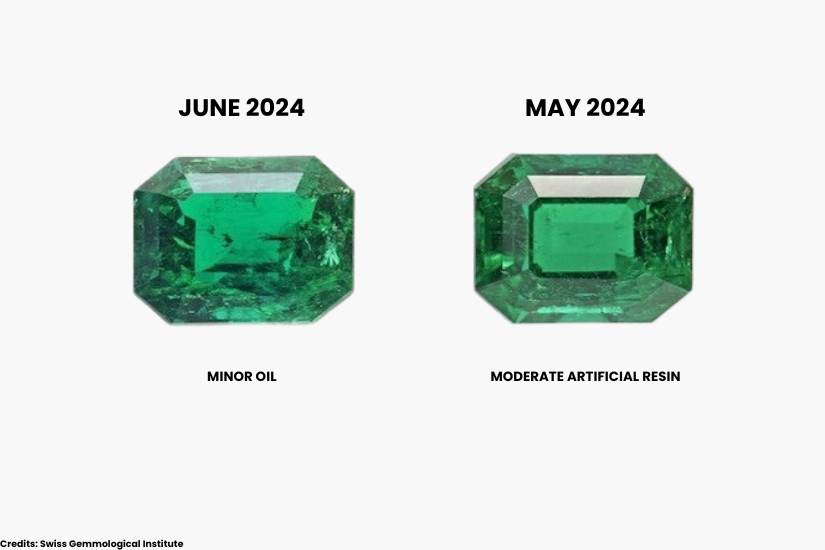
SSEF illustrated this with photographs of the same stone tested in 2024 and again in 2026, visibly clean at first testing, visibly re-filled with artificial resin two years later.
Why Rubies and Other Fissured Gems Are at Risk Too
SSEF was clear that this isn’t an emerald-only problem. Any gemstone with surface-reaching fissures, rubies being the most notable example, is vulnerable to the same treat-test-retreat cycle. If you’re building a career around any fissured coloured stone, this is a pattern worth internalising early, not just for emeralds.
Why Clarity Enhancement Itself Isn’t the Problem — Disclosure Is.
This is the distinction that trips up many newcomers to gemology, so it’s worth stating plainly: oiling an emerald is neither illegal nor unethical. Selling it without disclosing that the treatment is.
LMHC Guidelines: The Global Standard Gemologists Must Know
The Laboratory Manual Harmonisation Committee (LMHC), a coalition of major international gem labs including SSEF, GIA, and Gübelin, sets the shared standard for disclosing treatments. LMHC guidelines require labs to state any filler in an emerald, and the extent of that treatment on the report, because it directly affects the stone’s market value. A heavily resin-filled emerald and a minimally-oiled one of identical size and colour can carry very different price tags.
A proper gemology curriculum covers this in its opening modules, including ours at IIG South, and for good reason: it marks the line between professional grading and misrepresentation.
SSEF’s Own Safeguard: “Condition at Time of Testing“
Every SSEF report includes language making clear that its findings describe the gemstone’s condition only at the moment of testing, not a permanent guarantee. That single clause is doing a lot of work here. It’s the lab’s built-in defence against exactly this kind of after-the-fact tampering, and it’s a detail every working gemologist needs to understand when reading (or explaining) a certificate to a client.
How Trained Gemologists Detect Re–Filled and Re–Treated Emeralds
This is where classroom gemology becomes a genuinely marketable skill. Detecting fissure filling isn’t guesswork, it follows a defined process.
Microscopic Examination
Under magnification with proper lighting (darkfield and brightfield techniques), a trained eye can identify surface-reaching fissures, flash effects from filler substances, and trapped gas bubbles within a fissure, all signs that a filler is present, even when the stone looks “clean” to the naked eye.
Refractive Index and Spectroscopy
Different fillers have distinct optical signatures. Because their refractive index rarely matches the emerald’s own RI (roughly 1.565–1.590) exactly, fillers create visible flashes of colour called the “flash effect” under the microscope. Advanced labs use infrared spectroscopy to positively identify the specific filler substance, a technique that is now standard in serious gem-testing labs.
| Filler Type | Approx. Refractive Index | Durability | Detectability |
| Cedarwood oil (traditional) | ~1.51–1.52 | Low — can seep out over time, needs reapplication | Moderate under magnification |
| Colourless mineral/palm oils | ~1.47–1.53 | Low to moderate | Moderate |
| Natural resins (e.g., Canada balsam | ~1.52–1.54 | Moderate | Moderate to high |
| Synthetic/artificial resin (e.g., hardened epoxy) | ~1.57 | High — can persist and pass casual inspection for years | Difficult without solvent testing or spectroscopy |
This is exactly the kind of table that separates a stone labs describes as having “no clarity modification” from one a seller has carefully engineered to look that way.
Re-Testing Protocol: The Trade’s Best Defence
SSEF’s own recommendation to the industry is straightforward: never circulate an old report on a stone that’s been cleaned, re-filled, or otherwise altered. Buyers should re-test any fissured emerald immediately before a transaction, particularly if the existing report isn’t recent or the stone looks unusually clean relative to the fissures visible in it. Handlers should also treat cleaned or heavily fissured emeralds with extra care, since they’re more fragile and prone to chipping.
What This Fraud Alert Means for Gemology Students and Aspiring Gemologists
It’s easy to read a story like this as “industry drama.” For anyone building a career in gems and jewellery, it’s closer to a job description.
Gem Testing and Treatment Detection Is a Core Employability Skill
Labs, retailers, exporters, and appraisers all need people who can look at a coloured stone and correctly answer one question: is this what the paperwork says it is? Fraud cases like this one are precisely why that skill is in demand and precisely why it doesn’t come from watching a YouTube video. It comes from structured, hands-on training with real gemological instruments.
Career Opportunities This Opens
Professionals who can confidently identify treatments and disclosure gaps qualify for roles as:
- Gem testing laboratory analysts
- Independent gemologists and appraisers
- Quality control specialists for jewellery exporters
- Buying and merchandising roles at retail and wholesale houses
- Coloured stone specialists and consultants
India’s gem and jewellery export sector, in particular, relies heavily on professionals who can catch exactly this kind of issue before it becomes a compliance or reputational problem for a business.
How IIG South‘s Gemology Programmes Build This Skill
A structured gemology education covers precisely this terrain, the treatment identification, instrument-based testing, and international disclosure standards precisely aren’t optional footnotes; they’re core curriculum. If this article made you want to actually be the person who catches a re-filled emerald before it reaches a client, IIG South’s Master’s in Gemology and Gemology Graduate programmes in Bengaluru build exactly that skill set, both putting you through the kind of practical, lab-based testing this exact scenario demands.
FAQs
No. Filling fissures with oil, wax, or resin is a long-accepted, legal practice. It becomes a problem only when sellers fail to disclose the treatment to buyers, which violates international lab standards such as the LMHC guidelines.
The Laboratory Manual Harmonisation Committee is a group of leading international gem laboratories, including SSEF, that agree on shared standards for how gemstone treatments must be reported and disclosed.
Yes. SSEF specifically noted that any gemstone with fissures like rubies being a prominent example, is vulnerable to the same treat-test-retreat pattern.
They differ mainly in refractive index, durability, and how easily they can be detected. Traditional oils are less durable and easier to spot changing over time; hardened synthetic resins can persist for years and are harder to detect without specialised testing.
A structured, lab-based gemology programme, covering gem identification, treatment detection, and international grading standards, is the standard path. IIG South offers such programmes from its Bengaluru campus for students starting from beginner to advanced levels.
| Want to be the gemologist who catches this before it reaches a client? Explore IIG South’s Master’s in Gemology programmes in Bengaluru, hands-on, lab-based training in gem identification, treatment detection, and international grading standards, taught by industry practitioners. |