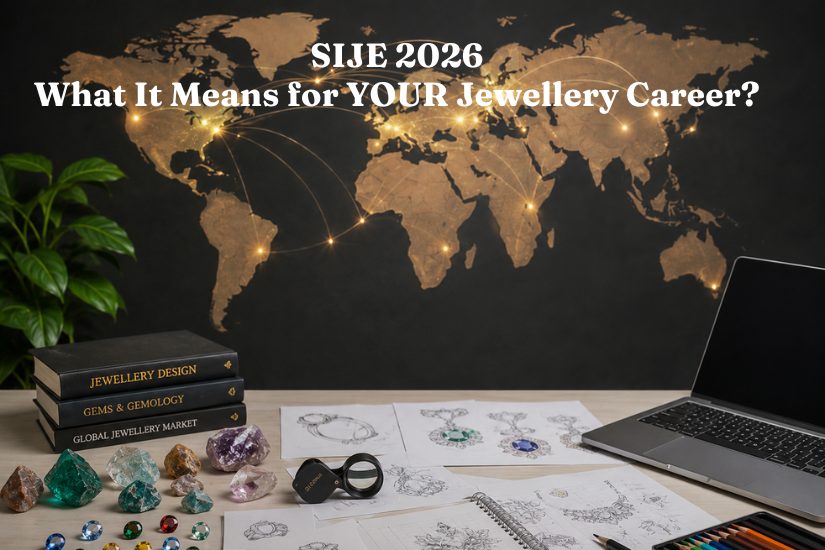
This week, Marina Bay Sands in Singapore is once again the centre of gravity for Asia’s jewellery trade. The Singapore International Jewellery Expo (SIJE) 2026 is running from 9 to 12 July, and if you’re a gemology or jewellery design student in Bengaluru, it’s easy to assume a show like this has nothing to do with you.
It has everything to do with you.
SIJE isn’t a retail exhibition where people browse and buy. It’s a working demonstration of how the gems and jewellery industry actually earns its money, through export, sourcing, certification, and international design collaboration. Understanding how a show like this operates is one of the fastest ways to understand where your career could go beyond the neighbourhood showroom.
What Is the Singapore International Jewellery Expo (SIJE)?
SIJE was established in 2005 and has grown into one of Southeast Asia’s longest-running and most prestigious jewellery trade fairs. The 2026 edition runs at the Sands Expo & Convention Centre as part of Singapore Diamond & Jewellery Week (SDJW), a citywide series of trade events, retail showcases, and industry conferences.
Coming off a record-breaking 2025 edition that brought together 414 exhibiting brands from 26 countries and showcased jewellery worth more than USD 250 million, SIJE has also been deepening its B2B focus through a collaboration with Vicenzaoro, the Italian Exhibition Group’s flagship jewellery trade platform. That shift matters; it signals that even a historically consumer-facing show is repositioning around trade, sourcing, and export relationships.
Why a Bengaluru Jewellery Institute Cares About a Singapore Trade Show
Here’s the part most students don’t connect: your future employer’s revenue may depend far more on Dubai, Hong Kong, or Singapore than on the local market you can see from your classroom window.
India’s gem and jewellery exports for FY 2025–26 stood at approximately USD 27.72 billion, according to the Gem & Jewellery Export Promotion Council (GJEPC). Cut and polished diamonds alone made up close to 44% of that basket. And the geography of that trade is shifting fast; the UAE has now overtaken the United States as India’s largest gem and jewellery export destination, growing over 10% year-on-year, while shipments to Hong Kong, Australia, and France have also posted strong double-digit growth as exporters diversify beyond any single market.
The Government of India has set a long-term export target of USD 75 billion by 2030 and USD 100 billion by 2047. Numbers at that scale don’t move on their own; they need gemologists who can grade to international standards, designers who understand global taste, and merchandisers who can manage buyers, certifications, and shipping timelines across borders.
This is the real takeaway from a show like SIJE: it’s a live rehearsal of the international buyer relationships, certification standards, and design trends that will define the next two decades of jewellery careers.
What Students Should Actually Learn From Watching a Show Like SIJE
1. Global buyers trust certification, not claims
At an international show, a stone or a piece doesn’t sell on a compelling story alone; it sells because its grading, hallmarking, or certification can be verified. This is exactly why gemology training that emphasises internationally recognised grading methodology (not just theory) is non-negotiable for anyone aiming at export-facing roles.
2. Export markets reward specialists, not generalists
A show floor with 400+ brands isn’t won by people who know “a bit of everything.” Buyers gravitate toward exhibitors and professionals who are visibly expert in one category, likely coloured gemstones, bridal gold, lab-grown diamonds, or design-led studded jewellery. Choosing a specialisation early and going deep is a genuine career advantage.
3. Trend cycles start on the show floor
The jewellery a consumer buys next year was often previewed at a trade show first. Designers and merchandisers who attend or track shows like SIJE are seeing tomorrow’s retail trends months before they hit the shop window, a genuine professional edge for anyone in design or merchandising.
4. Networking has no minimum age
Trade shows are where relationships between designers, gemologists, and international buyers actually begin, often years before a formal job offer follows. Students who start following industry events, exhibitor lists, and trade press while still studying build a mental map of the industry that classroom learning alone can’t give them.
5. Trade vocabulary is a professional skill, not a footnote
Terms like FOB pricing, Kimberley Process certification, HS codes, and B2B vs. B2C positioning aren’t optional jargon for export-facing careers; they’re daily working language. Building familiarity with this vocabulary during your course puts you ahead of graduates who only learn it on the job.
How IIG South Prepares Students for This Global Stage
This is precisely why our curriculum is structured the way it is. Whether you’re pursuing our B.Sc. in Jewellery Design, a specialised Gemology Professional certification, Diamond Courses, or the Jewellery Merchandising Professional programme, the objective is the same: prepare you to walk onto a show floor, in Bengaluru, Mumbai, or Singapore, and be taken seriously by an international buyer or employer.
Our students also get direct exposure to this world through industrial visits, guest lectures from industry professionals, and documented participation in major exhibitions, because reading about a trade show and understanding how one actually works are two very different kinds of learning.
FAQ:
SIJE (Singapore International Jewellery Expo) is one of Asia’s longest-running jewellery trade fairs, held annually at Marina Bay Sands. It matters for students because it’s a working example of how gemology, design, and merchandising skills translate into international, export-facing careers rather than only local retail roles.
Yes. Roles like gem grading for international labs, export merchandising, and international jewellery design all connect directly to the buyer and certification standards visible at shows like SIJE. The starting point is building strong, internationally recognised gemology or design fundamentals, not attending the show itself as a first step.
A domestic career typically involves local retail, manufacturing, or design for the Indian market. An export-oriented career involves working with international buyers, certification standards, sourcing networks, and cross-border logistics, often through merchandising, trading, or international design roles.
Several paths apply depending on interest: the Jewellery Merchandising Professional course for sourcing and buyer-facing roles, Gemology and Diamond courses for grading and trading roles, and Jewellery Design courses (manual and CAD) for international design work.
Yes. India’s gem and jewellery exports were valued at approximately USD 27.72 billion in FY 2025–26, with the government targeting USD 75 billion by 2030. Export markets are also diversifying rapidly, with the UAE, Hong Kong, and Australia showing particularly strong growth, all of which point to sustained demand for trained professionals in this space.
Ready to Build a Career That Isn’t Limited by Geography?
Explore IIG South’s Gemology, Diamond, Jewellery Design, and Merchandising programmes and start building the credentials international buyers and employers actually look for. Browse our courses or get in touch with our admissions team to find the right starting point for your career goals.