
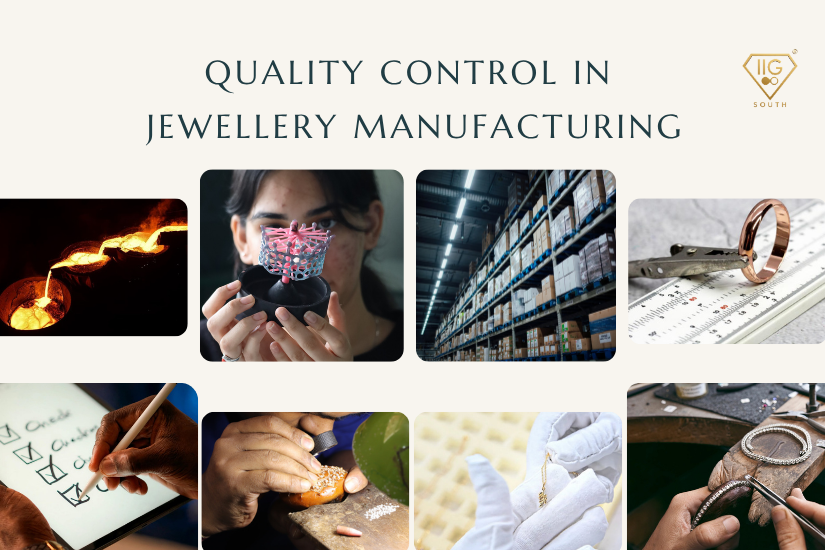
A beautiful design means nothing if the final piece doesn’t hold up structurally, aesthetically, or to purity standards. That’s why quality control (QC) is built into every stage of professional jewellery manufacturing, not just checked at the end.
1. Raw Material Inspection
Raw Material Inspection is the first quality control step in jewellery manufacturing. It involves checking all materials received before production to ensure they meet the required quality, quantity, purity, dimensions, and specifications. This helps prevent defects, production losses, and costly rework at later stages.
Key checks include:
- Gold & precious metals: Purity, karat, weight, alloy composition, and physical condition.
- Diamonds: Carat weight, colour, clarity, cut, measurements, and matching with the order.
- Gemstones: Type, colour, clarity, size, treatments, and any cracks or damage.
- Documentation: Material quantity, batch details, supplier information, and specifications are verified against the purchase order.
2. Casting Quality Control
Casting Quality Control is the process of inspecting jewellery pieces after casting to ensure they are accurately formed, free from defects, and meet the required design and quality standards. It helps identify jewellery casting problems before the jewellery moves to filing, setting, polishing, or finishing.
Key checks include:
- Shape & dimensions: Ensuring the cast piece matches the approved design, measurements, and specifications.
- Surface defects: Checking for porosity, cracks, pits, scratches, incomplete filling, and rough surfaces.
- Details & features: Verifying that fine design elements, prongs, channels, and settings are properly formed.
- Weight: Comparing the actual cast weight with the expected production weight.
- Metal quality: Checking for contamination, improper alloying, or other metal-related defects.
- Rejection & rework: Defective castings are identified and either repaired or sent for remelting and recasting.
3. Dimensional & Design Accuracy
Dimensional & Design Accuracy is the quality control process of checking whether the finished or semi-finished jewellery piece matches the approved design, measurements, proportions, and technical specifications. It ensures that the jewellery is made exactly as intended and that all components fit and function properly.
Key checks include:
- Measurements: Checking length, width, thickness, diameter, and other specified dimensions.
- Design matching: Comparing the jewellery with the approved CAD design, drawing, or sample.
- Proportions: Ensuring elements such as stones, prongs, bezels, and patterns are correctly positioned and proportioned.
- Stone & setting dimensions: Verifying that stone seats, prongs, and settings are accurately sized for proper fitting.
- Symmetry & alignment: Checking that both sides, patterns, and design elements are properly aligned and balanced.
- Tolerance: Ensuring measurements remain within the permitted manufacturing tolerance.
4. Polishing & Finishing Inspection
Polishing & Finishing Inspection is the quality control process of checking the jewellery after polishing and finishing to ensure it has a smooth surface, uniform shine, clean edges, and the required final appearance. It ensures that the jewellery looks premium and is free from visible finishing defects before it moves to final inspection and dispatch.
Key checks include:
- Surface finish: Checking for scratches, dents, pits, marks, or uneven surfaces.
- Polish quality: Ensuring the required level of shine, brightness, and smoothness is achieved.
- Edges & details: Checking that edges, grooves, patterns, and fine details remain sharp and properly defined.
- Consistency: Ensuring the finish is uniform across the entire jewellery piece.
- Plating/colour finish: Checking for even colour, coverage, and adhesion where plating or surface treatment is used.
- Cleanliness: Ensuring there is no polishing compound, dust, residue, or unwanted material left on the jewellery.
5. Stone Setting Inspection
Stone Setting Inspection is the process of checking gemstones or diamonds after they are set into jewellery to ensure they are securely fitted, correctly positioned, and free from damage. It ensures that the stones meet the design requirements and will remain safely in place during normal use.
Key checks include:
- Stone security: Ensuring every stone is firmly held and does not move or rattle.
- Position & alignment: Checking that stones are correctly placed, centred, and aligned according to the design.
- Prongs & settings: Inspecting prongs, bezels, channels, and other setting methods for proper formation and security.
- Stone condition: Checking for chips, cracks, scratches, or damage caused during setting.
- Height & uniformity: Ensuring stones sit at the correct height and have a consistent appearance.
- Cleanliness: Checking that no metal particles, polishing compound, or debris remain around the stones.
6. Soldering & Assembly Check
Soldering & Assembly Check is the quality control process of inspecting jewellery after different components have been joined or assembled to ensure the connections are strong, clean, correctly aligned, and securely finished. It helps prevent weak joints, loose components, visible solder marks, and assembly-related defects.
Key checks include:
- Solder joints: Checking that joints are strong, properly filled, and securely connected.
- Alignment: Ensuring components such as shanks, bezels, links, hooks, and clasps are correctly positioned.
- Solder quality: Checking for excess solder, visible solder lines, pits, cracks, or incomplete joints.
- Component security: Ensuring parts such as clasps, hinges, chains, and earring components function properly.
- Heat damage: Inspecting for discolouration, melting, distortion, or damage caused during soldering.
- Final appearance: Ensuring soldered and assembled areas are properly cleaned, filed, and polished without visible defects.
7. Final Visual Inspection
Final Visual Inspection is the last quality control stage before jewellery is packed and dispatched. It involves carefully examining the completed jewellery piece to ensure that it meets the approved design, workmanship, appearance, and overall quality standards. The aim is to make sure the customer receives a flawless and properly finished product.
Key checks include:
- Overall appearance: Checking the jewellery for a clean, attractive, and uniform finish.
- Design accuracy: Ensuring the finished piece matches the approved design or sample.
- Surface defects: Checking for scratches, dents, marks, uneven polish, or visible manufacturing defects.
- Stone quality & security: Ensuring all stones are present, correctly positioned, undamaged, and securely set.
- Assembly & functionality: Checking clasps, hinges, hooks, links, and other moving components.
- Cleanliness: Ensuring the jewellery is free from dust, polishing residue, fingerprints, or other contaminants.
- Final approval: Pieces that pass inspection are approved for packaging, documentation, and dispatch.
8. Weight & Purity Verification
Weight & Purity Verification is the quality control process of checking the actual weight and precious-metal purity of jewellery against the required specifications. It ensures that the correct amount and quality of gold, silver, or platinum has been used and that the finished piece meets the stated standards.
Key checks include:
- Weight: Measuring the jewellery accurately and comparing it with the specified or expected weight.
- Metal purity: Verifying the karat or fineness of gold, silver, or platinum.
- Net metal weight: Separating the metal weight from the weight of diamonds, gemstones, or other non-metal components where required.
- Alloy composition: Checking that the metal contains the correct proportion of precious metal and alloying elements.
- Documentation: Recording the verified weight and purity for production records, pricing, and compliance.
- Final verification: Ensuring the jewellery matches the required specifications before it is approved for sale or dispatch.
9. Packaging & Dispatch QC
Packaging & Dispatch QC is the final quality control process carried out before jewellery is sent to the customer, retailer, or showroom. It ensures that the correct jewellery, documentation, packaging, and quantity are properly checked, protected, and prepared for safe delivery.
Key checks include:
- Product verification: Ensuring the correct jewellery piece, design, size, and quantity are being dispatched.
- Final quality: Confirming the jewellery has passed all required inspections and has no visible defects.
- Documentation: Checking invoices, product details, certificates, tags, and other required documents.
- Packaging: Ensuring the jewellery is securely packed to prevent scratches, damage, or movement during transportation.
- Labelling: Verifying product codes, descriptions, weights, and other details on the package.
- Dispatch security: Checking that packages are properly sealed, recorded, and handed over for safe delivery.
Why QC Is a Career Skill, Not Just a Checklist.
Quality control touches every department of a jewellery manufacturing business, namely design, casting, finishing, and sales. For students, understanding QC standards isn’t just about catching mistakes; it’s about building quality into every step of the process from the start, which is exactly what employers look for in trained jewellery professionals.
| Every workshop wants people who can both craft the piece and catch what’s wrong with it. IIG South’s Jewellery Manufacturing Techniques course trains you in the full process of casting, setting, polishing, and finishing, plus the QC standards that keep every piece flawless. Seats for the next batch are filling up. Enrol Now. |
