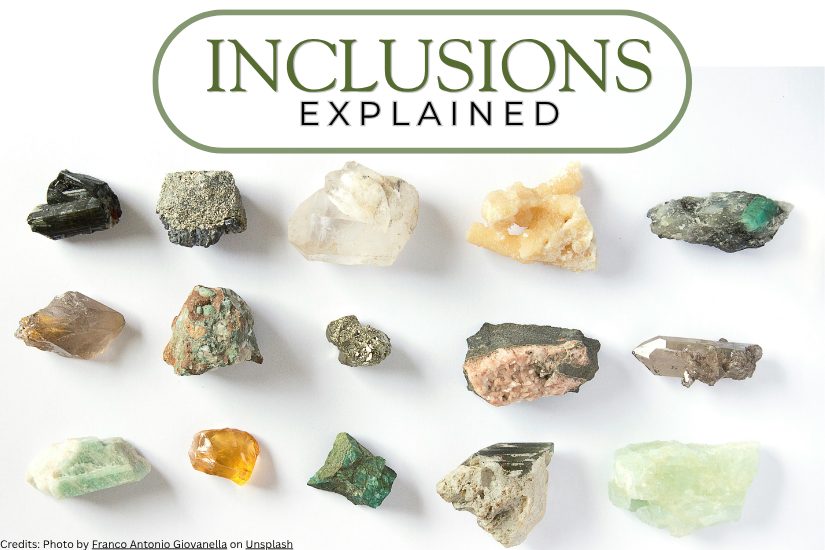
What are Inclusions?
Pick up any natural gemstone and hold it under a loupe. Chances are, you will find something inside it, a tiny crystal, a wispy fracture, a bubble of ancient fluid. These internal features are called inclusions.
In gemology, an inclusion is any material or structural irregularity that is trapped or formed within a gemstone. The term comes from the Latin includere, meaning to enclose or shut in, which is precisely what happens: during the slow growth of a crystal deep within the Earth, foreign matter gets locked inside, preserved for millions (sometimes billions) of years.
“Every inclusion is a letter from the Earth — written in mineral, fluid, and gas, sealed inside a crystal, and addressed to whoever takes the time to look.”
Inclusions are different from blemishes, which are surface features such as scratches, pits, or nicks. Inclusions are entirely internal (or at least partially internal), while blemishes sit on the surface of the stone.
In popular culture, inclusions are often seen as flaws; imperfections that reduce a gemstone’s worth. The reality, as any trained gemologist will tell you, is far more nuanced. Inclusions are the very proof that a gem is natural. They reveal where in the world a stone was mined, whether it has been heat-treated, and they contain some of the most detailed geological information available to scientists anywhere on Earth.
How inclusions form
Inclusions form as a gemstone grows within the Earth’s crust or mantle. When a gemstone is forming, foreign minerals, fluids, or gases in the surrounding environment can become enclosed and trapped within the crystal structure. Their presence reflects the temperature, pressure, and chemical conditions of the growth environment. For instance, rapid cooling of mineral-bearing fluids tends to result in gems with many inclusions, while slow cooling produces clearer stones.
When They Are Formed
Gemologists classify inclusions by when they formed relative to the host crystal:
Protogenetic inclusions
Pre-existing minerals that were already present in the geological environment when the host crystal began to grow were engulfed as growth proceeded around them.
Syngenetic Inclusions
These form simultaneously with the host gem and are trapped on growing crystal faces. They often reveal the crystallisation conditions present during growth.
Epigenetic inclusions
Formed after the host crystal by later geological or chemical processes. For instance, when alteration products crystallise within pre-existing cavities or along fracture planes.
Different Types of Inclusions
Gemologists classify inclusions based on physical features (What the Inclusion Is)
One of the most fundamental ways gemologists classify inclusions is by their physical nature, specifically the phase of matter present within the inclusion cavity. These may consist of a single phase or a combination of multiple phases coexisting within the same microscopic space. This classification is extremely important, as it helps in identifying a gemstone’s origin, formation conditions, and authenticity.
Single-Phase Inclusions
They contain only one state of matter, making them relatively simple in structure yet highly informative.
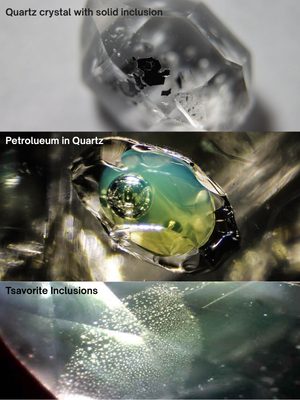
1. Solid inclusions consist of a completely formed mineral crystal trapped within the host gemstone. These are among the most commonly observed and can include examples such as garnet crystals in tanzanite or tourmaline needles in quartz.
2. Liquid inclusions are cavities filled with fluid, such as water, saline solutions, or hydrothermal fluids, without any gas bubbles present. These are comparatively rare and are typically seen in certain varieties of quartz and beryl.
3. Vapour (gas) inclusions are voids filled exclusively with gas, indicating formation under high-temperature and low-pressure conditions or rapid crystal growth environments. They are often associated with volcanic or pegmatitic gemstones.
Two-Phase Inclusions
These are the most common and easily recognisable types found in gemstones.
- These inclusions contain both liquid and gas, typically appearing as a fluid-filled cavity with a visible, movable gas bubble.
- The movement of the bubble when the gemstone is tilted is a key identifying feature, making them easily detectable even under a simple loupe.
- They are frequently observed in gemstones such as quartz, topaz, and beryl, and play a significant role in gem identification.
Three-Phase Inclusions
These are more complex and hold high diagnostic value in gemology.
- They consist of a liquid, a gas bubble, and a solid crystal coexisting within a single cavity.
- These are especially significant in emeralds from Colombia, where they are considered strong evidence of origin, particularly from renowned mines such as Muzo and Chivor.
Multiphase Inclusions
- These contain four or more phases, which may include multiple immiscible liquids, gas bubbles, and several solid crystals.
- They form under highly specialized geological conditions, often in complex hydrothermal environments.
- Due to their intricate nature, they are typically studied using advanced analytical techniques such as Raman spectroscopy, providing deep insights into the gemstone’s geological history.
Gemologists classify inclusions based on their appearance
Beyond phase, inclusions are also described by their appearance under magnification. Here are the most important forms a gemology student or buyer is likely to encounter:
Silk
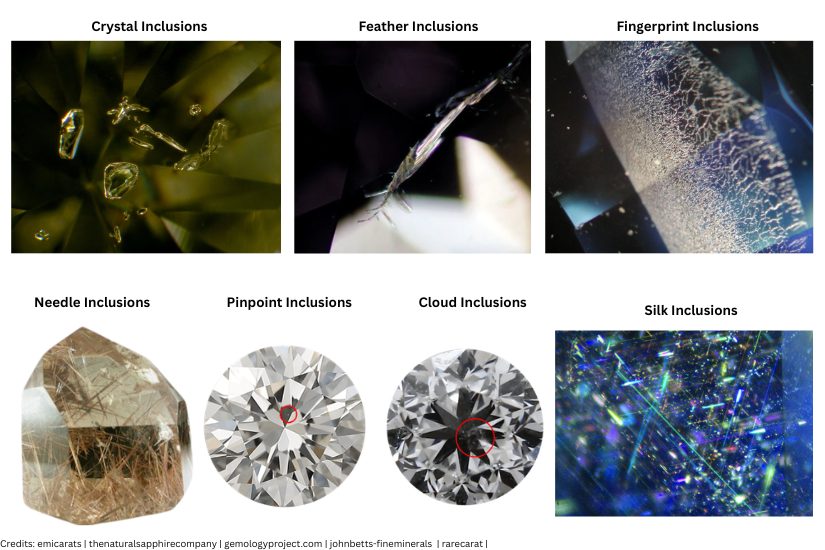
Fine, parallel or intersecting needle-shaped inclusions of minerals such as rutile, ilmenite, or boehmite. In sapphires and rubies, silk appears as a whitish, shimmering haze. Kashmir sapphires are celebrated for their dense, fine silk that scatters light and produces the legendary “velvety” or “sleepy” quality that commands premium prices. When silk is oriented in three intersecting directions at 120°, it diffracts light into a six-rayed star; the phenomenon behind star sapphires and star rubies.
Feather
A fracture or cleavage within the stone that appears as a wispy, reflective plane under magnification; reminiscent of the vane of a feather. Feathers can be internal (fully enclosed and stable) or surface-reaching, in which case they are a durability concern. In diamond grading, a large feather near the girdle or table is one of the most significant clarity characteristics a grader will note. In coloured stones, feathers are extremely common and are sometimes treated with oils or resins to reduce their visibility.
Fingerprint
Healed fractures filled with fluid inclusions arranged along the old fracture plane, creating a pattern under magnification that genuinely resembles a human fingerprint. Very common in sapphires, rubies, and chrysoberyl, and is often used alongside other features in origin determination.
Cloud
A cluster of many microscopic pinpoints so densely packed that they create a hazy, milky zone within the stone. Light, wispy clouds may have little visible impact; dense clouds can make a stone appear foggy even to the naked eye.
Needle
A single, elongated, thin crystal, thicker and more distinct than silk. Famous examples include golden rutile needles creating the visual spectacle of “rutilated quartz.”
Crystal
A recognisable mineral crystal trapped within the host stone. These range from microscopic to eye-visible. A ruby inside a sapphire, a spinel within a corundum, and a diamond crystal within a diamond are some of the examples. One of the most celebrated crystal inclusions is the horsetail, a radiating cluster of chrysotile fibres found almost exclusively in demantoid garnets from Russia’s Ural Mountains. Far from reducing value, a clear horsetail inclusion is proof of prestigious Ural origin and actively increases a demantoid’s desirability.
Pinpoint
A single, very small mineral crystal appearing as a tiny dot. Pinpoints are among the most common and least impactful inclusions when isolated, but many together form a cloud.
Why inclusions matter
To a trained gemologist, inclusions are far more interesting than the word “flaw” suggests. Here is why they are central to the science of gemology:
- Authenticity: Natural inclusions confirm a stone is genuine. Synthetic gems can also have inclusions, but they look very different.
- Geographic origin: Specific inclusion assemblages are diagnostic of mining locality. Three-phase inclusions in emerald = Colombia. Fine, dense silk in sapphire = possible Kashmir. Horsetail inclusions in demantoid = Russian Ural. Origin significantly affects market value for fine gems.
- Treatment detection: Heat treatment, fracture filling, and beryllium diffusion, each alter inclusions in characteristic ways. A ruby heated to high temperatures shows “burnt” or feathery fractures and dissolved silk. A fracture-filled stone shows a distinctive “flash effect” when rotated.
- Scientific value: Fluid inclusions preserve samples of ancient geological fluids. By studying them, scientists can reconstruct the temperature, pressure, and chemistry at which a mineral formed.
Inclusions that add value to the gemstone
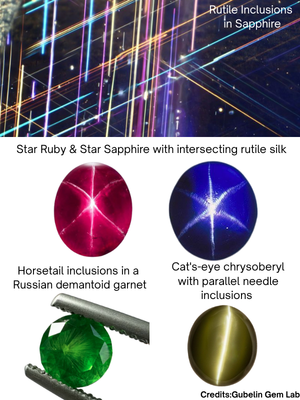
The dense silk in a Kashmir sapphire creates its coveted velvety appearance; a stone without it may actually be worth less to a connoisseur.
The star in a star sapphire or star ruby is caused entirely by intersecting rutile silk.
Horsetail inclusions in a Russian demantoid garnet are sought after, not avoided.
Cat’s-eye chrysoberyl owes its chatoyant effect to parallel needle inclusions that reflect light into a single band.
The type, location, size, and number of inclusions all matter and sometimes what looks like a flaw is actually the source of a gem’s most distinctive beauty.
Understanding inclusions is one of the foundational skills of gemology. Whether you are grading diamonds, identifying coloured stones, assessing whether a ruby has been heat-treated, or determining if a sapphire’s origin justifies a premium price, inclusions are always part of the answer.
Want to learn what’s inside a gemstone? At IIG South, our Gemology and Diamond courses teach you to identify, grade, and evaluate gems at a professional level, with hands-on access to a wide variety of real gemstones and the instruments used in the trade. Explore our Gemology Courses. Enroll now, admissions open for 2026.