Choosing the right diamond cut is one of the most important decisions in buying a diamond. The cut determines how light moves through a stone, affecting its brilliance, fire, and overall beauty. This complete guide covers every major diamond cut, from the timeless Round Brilliant to rare antique and speciality cuts.
What Is a Diamond Cut?
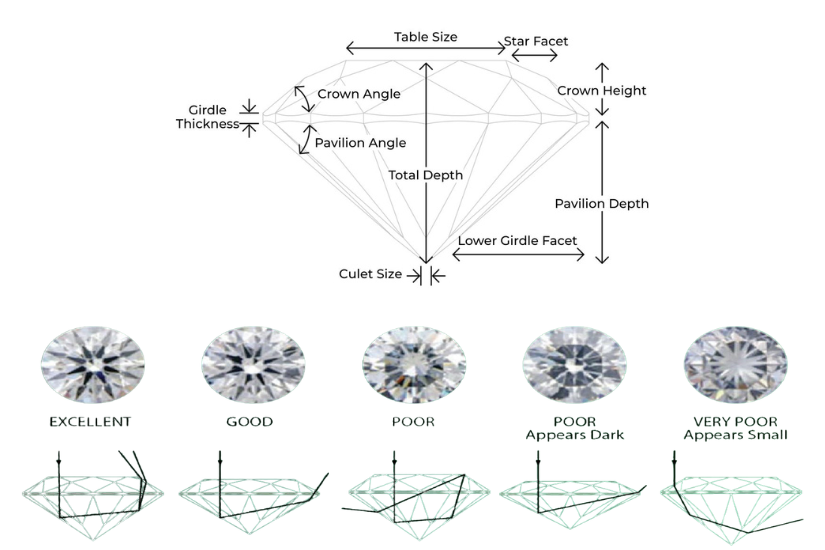
A diamond cut refers to the shape and facet arrangement of a polished diamond, not to be confused with its shape alone. Cut quality governs how well a diamond reflects light. Even a flawless diamond will look dull if it is poorly cut.
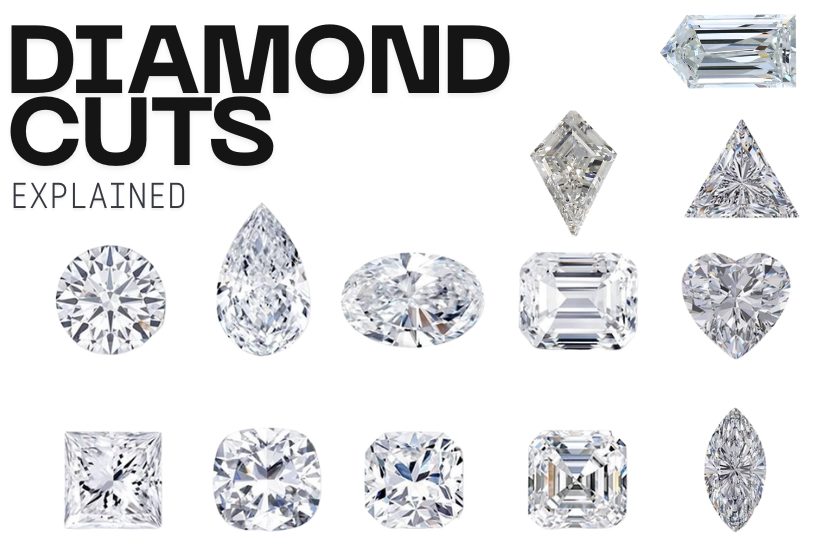
Diamond cuts fall into two broad categories:
- Round Brilliant Cut: The classic, most popular cut worldwide.
- Fancy Cuts: All non-round shapes, including princess, emerald, oval, pear, marquise, and many more.
Want to go beyond reading about diamonds? Enroll in IIG South’s Diamond Graduate Programme and learn to grade and evaluate diamonds like an industry professional. Explore the Diamond Graduate Programme.
Round Brilliant Cut
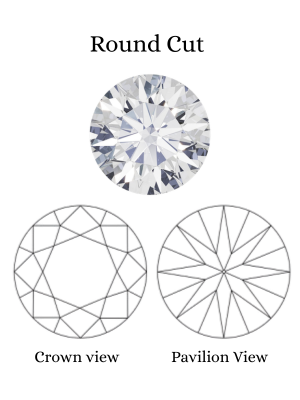
The Round Brilliant is the world’s most popular diamond cut, accounting for roughly 75% of all diamonds sold. It was perfected in 1919 by Marcel Tolkowsky using mathematical principles to maximise light return.
Structure: 58 facets total — 33 on the crown and 25 on the pavilion. Key proportions include a table size of 53–58%, total depth of 59–62.6%, a crown angle of 34–35°, and a pavilion angle of 40.6–41°.
Delivers the highest levels of brilliance (white light return), fire (coloured light dispersion), and scintillation (sparkle) of any cut. Light enters through the table, reflects off the pavilion facets, and exits through the top of the stone.
Best for: Classic engagement rings, solitaires, and anyone who wants maximum sparkle.
Fancy Cuts (Non-Round Diamond Shapes)
Princess Cut
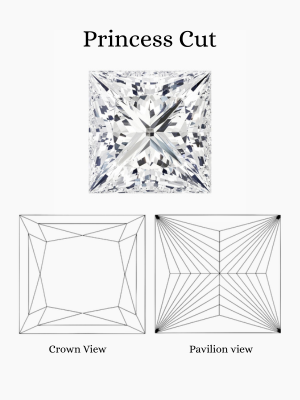
Developed in the 1980s by Betzalel Ambar and Israel Itzkowitz, the Princess Cut is the second most popular cut worldwide. It was designed to retain more of the rough diamond while still producing excellent brilliance.
Structure: Typically 50–58 facets, but the exact number depends on how many “chevron” facets are cut into the pavilion (the bottom half of the stone). Square or rectangular outline with four sharp, pointed corners. The pavilion features a distinctive chevron pattern radiating from the centre point, creating unique light play.
Excellent brilliance nearly matching the Round Brilliant.
Cushion Cut (Pillow Cut)
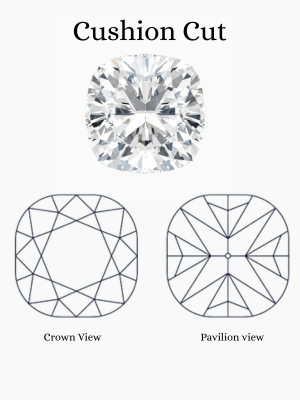
One of the oldest diamond cuts, the Cushion dominated for nearly 200 years before the Round Brilliant took over. It combines a square or rectangular shape with softly rounded corners and curved sides.
Structure: 58–64 facets in the traditional version, or more in modified cushion cuts. Two distinct styles exist: the Standard (Chunky) Cushion, which produces broad flashes of light and a vintage appearance, and the Modified Brilliant Cushion, which adds an extra row of pavilion facets for finer, more intense sparkle.
Creates either a “crushed ice” appearance or broader light flashes depending on the cut style.
Emerald Cut
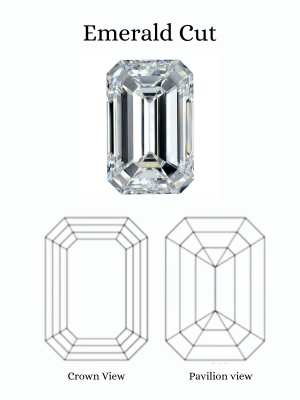
Originally developed in the 1500s for cutting emerald gemstones, this cut was adapted for diamonds during the Art Deco period of the 1920s and 1930s.
Structure: 57–58 facets. Rectangular with cropped corners (giving an octagonal outline). Step-cut faceting, long, parallel facets arranged in concentric rows on both the crown and pavilion, creating the signature “hall of mirrors” effect.
Asscher Cut
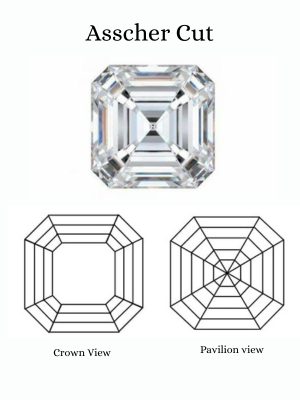
Created in 1902 by Joseph Asscher of the Royal Asscher Diamond Company. This cut gained widespread popularity during the Art Deco era. A modified version, the Royal Asscher Cut, was introduced in 2001 with 74 facets.
Structure: 58 facets (original) or 74 facets (Royal Asscher). Square step cut with deeply cropped corners, a smaller table, and a higher crown than the emerald cut.
Step cuts demand exceptional clarity, and so does a career in gemology. Learn professional gemstone identification and grading with IIG South’s Gemology courses.
Oval Cut
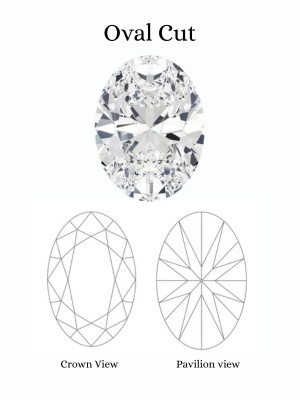
The modern oval brilliant cut was developed by Lazare Kaplan in 1957, though oval diamonds existed long before. It has surged in popularity in recent years.
Structure: 57–58 facets, following the same brilliant facet arrangement as the round cut. Symmetry is critical; an uneven oval will display an undesirable bow-tie shadow across its centre.
Brilliance nearly equal to the round brilliant. The elongated shape can make the diamond appear larger than a round of the same carat weight.
Marquise Cut
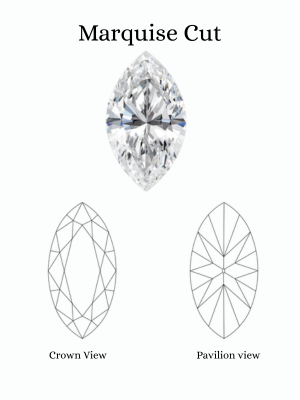
Commissioned by King Louis XIV of France in the 18th century and also called the “navette” (meaning little boat), the marquise has an elongated shape with two pointed ends.
Structure: 56–58 facets. Modified brilliant cut. Perfect symmetry between both halves is essential; any asymmetry is immediately visible.
The elongated shape makes the diamond look significantly larger than its carat weight suggests.
Pear Cut (Teardrop)
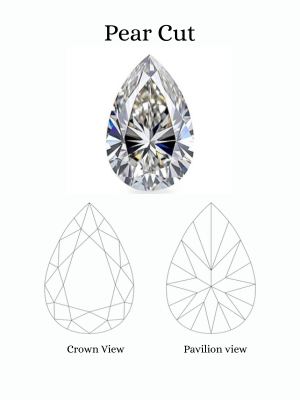
A pear cut diamond, often called a teardrop or pendeloque cut, is hybrid that combines the rounded end of oval and pointed tip of marquise.
Structure: 58 facets. Modified brilliant cut. Perfect symmetry along the centre axis is essential. Optimal length-to-width ratio: 1.45–1.75.
Excellent brilliance and fire. Worn with the point facing toward the fingertip, it creates a slimming, elongating effect on the finger. The pointed tip is vulnerable to chipping.
Radiant Cut
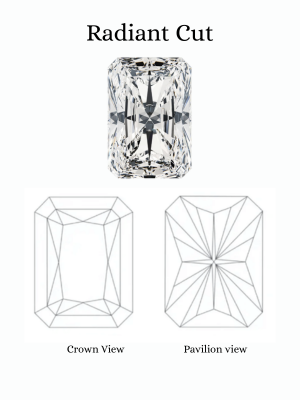
Created in 1977 by Henry Grossbard.
Structure: 70 facets. Rectangular or square with trimmed corners (which also reduce chipping risk). Hybrid faceting combining the outline of an emerald cut with the facet arrangement of a brilliant cut.
Excellent brilliance and fire. The numerous facets also hide inclusions more effectively than step cuts.
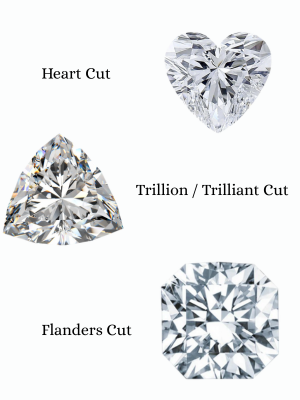
Heart Cut
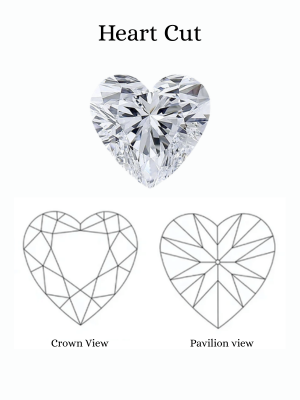
One of the most complex shapes to cut, the heart requires exceptional skill and symmetry. It is most recognisable in sizes of 0.5 carats or larger.
Structure: 56–58 facets. The stone must have a clearly defined cleft and two perfectly symmetrical lobes. Poorly cut hearts can look like a round stone with a notch rather than a recognisable heart shape.
Step Cuts: Speciality Shapes
Baguette Cut
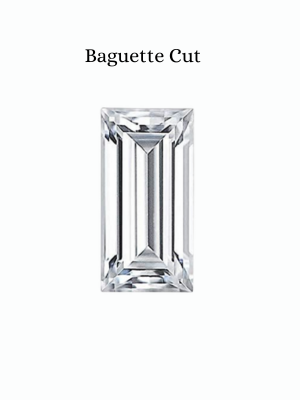
A long, thin rectangular step cut with 14–20 facets and straight, sharp edges. It is used almost exclusively as an accent or side stone in channel settings, eternity bands, and three-stone rings. Due to their open, flat “table” (top surface) and few facets, inclusions (internal flaws) are much easier to see than in other cuts.
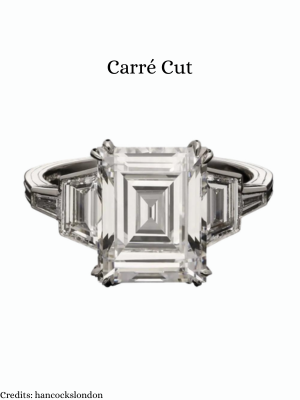
Carré Cut
A simple square-shaped vintage step cut, similar to a small Asscher but with fewer facets and no cropped corners. Typically used as a side stone or in geometric jewellery designs.
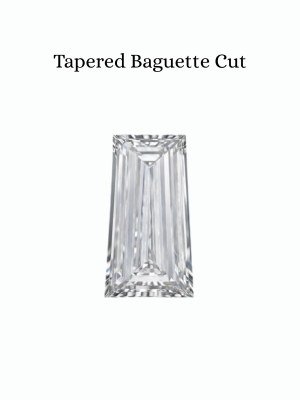
Trapezoid / Tapered Baguette Cut
A four-sided step cut with two parallel sides and two angled sides that taper inward. Commonly used to flank emerald and radiant centre stones, where the tapered shape creates a clean, architectural transition.
Brilliant Fancy Cuts
Heart Cut
Trillion / Trilliant Cut
A triangular brilliant cut developed by the Henry Meyer Diamond Company and later trademarked as the “Trilliant.” It features 31–50 facets, typically with either straight or slightly curved sides.
Excellent brilliance and fire. The triangular form produces dramatic, geometric light patterns.
Flanders Cut
A modified brilliant cut with 61 facets designed for maximum brilliance. A patented square-shaped brilliant cut with rounded corners.
Antique and Vintage Diamond Cuts
Old Mine Cut
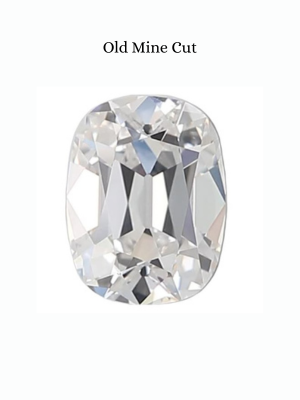
The dominant cut from the early 1700s to the late 1800s. Hand-cut and polished, each stone is unique. Features a cushion-shaped design, high crown, small table, large culet and broad facets that enhances the sparkle under candlelight.
Old European Cut
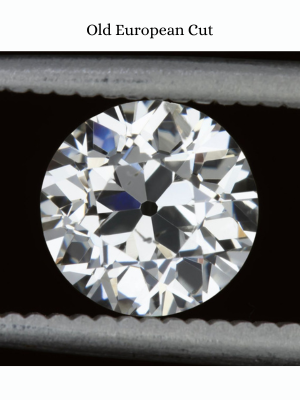
Popular from the 1890s through the 1930s. More circular in outline than the Old Mine, with 58 facets, a very small table, steep crown angles, and a large, visible culet that creates a characteristic “donut” or open circle effect when viewed through the table.
Rose Cut
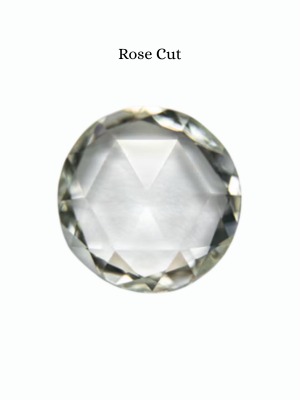
Originating in 16th-century India and popular throughout the Georgian and Victorian eras, the rose cut is experiencing a strong modern revival in bohemian and vintage-inspired designs.
Structure: The Rose cut diamond has a flat bottom with a domed shape, and several facets ranging from 3 to 24.
Briolette Cut
One of the oldest known diamond cuts, dating to 12th-century India. Popular in the Victorian and Edwardian eras and experiencing a modern revival in high-end jewellery.
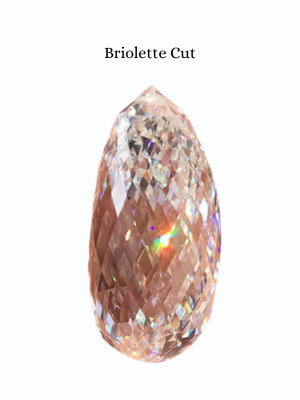
Structure: 84 or more triangular facets covering the entire surface. Elongated teardrop shape with no table, no girdle, and no flat base, fully faceted all around. Drilled at the top for use as a pendant or earring drop.
Light enters from all directions, producing constant brilliance with movement. Used exclusively for pendants, earrings, and drop jewellery.
Modern Speciality and Geometric Cuts
These cuts are less common but increasingly popular in designer and bespoke jewellery:
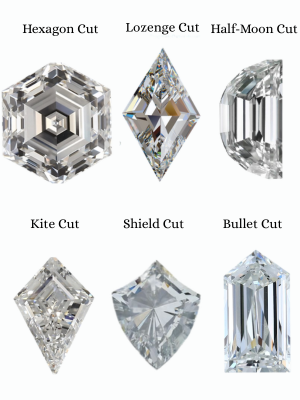
- Hexagon Cut: Six-sided shape with a modern, honeycomb aesthetic.
- Lozenge Cut: Rhombus (diamond-shaped) with four equal sides.
- Half-Moon Cut: Semi-circular with a straight edge and a curved edge. Used almost exclusively as side stones flanking emerald, radiant, or oval centres.
- Kite Cut: Four-sided, elongated kite or arrowhead shape. Used in modern designer jewellery and geometric settings.
- Shield Cut: Five-sided, resembling a shield.
- Bullet Cut: Elongated and tapered at one end, resembling a bullet. Step-cut faceting. Used as a side stone.
Proprietary and Patented Diamond Cuts
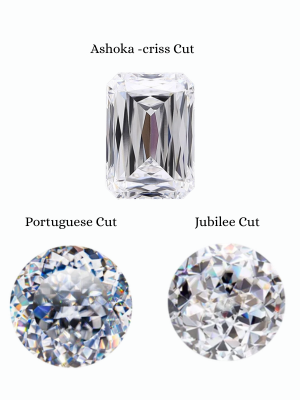
Ashoka Cut
Patented by William Goldberg. A rectangular shape with softly rounded corners and 62 facets, optimised for both brilliance and an elongated elegance. Appears larger than its carat weight and commands premium pricing.
Portuguese Cut
Is a rare, highly complex style featuring an exceptional facet count, typically ranging from 161 to over 200. This design creates intense brilliance and a floral-like sparkle pattern due to numerous rows of triangular and kite-shaped facets arranged around the crown and pavilion.
Jubilee Cut
Is an antique-style, often table-less, brilliant cut featuring 88 facets arranged in a domed, floral pattern that creates intense scintillation.
Cut Quality: What to Look For
Regardless of shape, the quality of a diamond’s cut is graded on three key criteria:
- Proportions: The ratios between depth, table size, and crown and pavilion angles. These determine how efficiently the stone handles light. Even a few degrees off can cause light to leak out of the bottom rather than return through the top.
- Symmetry: The precise alignment and placement of facets relative to one another. Poor symmetry causes uneven light distribution.
- Polish: The quality of the surface finish. Microscopic scratches or rough facet edges can reduce brilliance.
Choosing the Right Diamond Cut
The best diamond cut depends on your priorities:
- Maximum brilliance: Round Brilliant, Princess, Radiant
- Elegant and understated: Emerald, Asscher, Baguette
- Vintage and romantic: Old Mine, Old European, Rose, Cushion
- Appears largest for the carat weight: Oval, Marquise, Pear
- Unique and modern: Hexagon, Kite, Trillion, Criss Cut
- Symbolic: Heart Cut
- Accent and side stones: Baguette, Trapezoid, Half-Moon, Kite, Shield, Bullet
Understanding how each cut handles light and how its proportions, symmetry, and polish affect the final appearance will help one make a confident, informed choice.
Turn your passion for diamonds into a career, enrol in our Master’s In Diamonds Course.