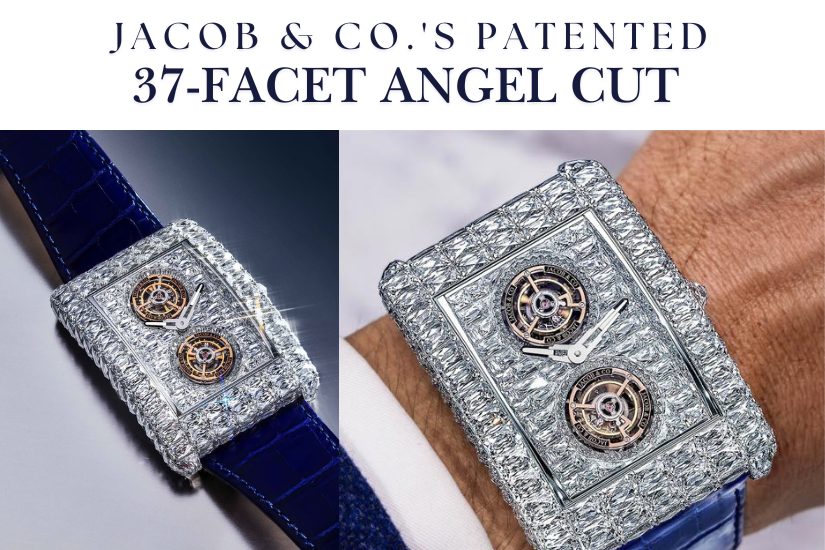
The Angel Cut diamond is a patented, 37-facet diamond cut developed entirely in-house by luxury watch and jewellery house Jacob & Co. Introduced in 2026 as the centrepiece of the Billionaire Double Tourbillon Angel Cut timepiece, it represents one of the rare occasions in modern jewellery where a maison has created a genuinely new cutting geometry, not simply a marketing variation on an existing form. For diamond students and gemology enthusiasts, it offers a compelling case study in the trade-offs between optical performance, rough yield, and the unique demands of gem-set horology.
What Is the Angel Cut Diamond?
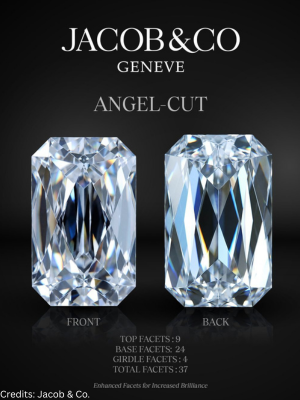
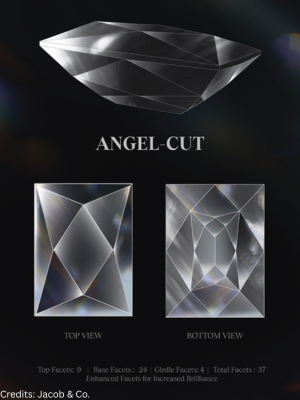
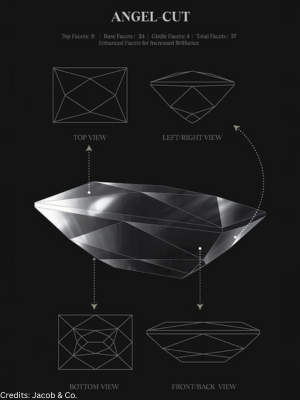
The Angel Cut is a proprietary, patented diamond cut featuring 37 facets, arranged around a lozenge-shaped (diamond-shaped) table set within a stepped rectangular outline with cut corners. It was developed over two years by Jacob & Co.’s in-house team and received a patent before its 2026 debut.
The name carries personal significance: it is named for Angela, Jacob Arabo’s wife, and the 37-facet count corresponds to the couple’s 37 years of marriage at the time the cut was developed. While this backstory is undeniably romantic, the cut’s design rationale is grounded in applied gemology rather than sentiment alone. Arabo and his team were not simply marking an anniversary; they were solving a technical problem that had long challenged gem-set watchmaking.
The Challenge of Cutting Diamonds for Watches
Gem-set watchmaking represents one of the most demanding disciplines in applied gemology. A gem-set watch case requires hundreds of precisely matched stones set into a rigid structure that must withstand vibration, temperature change, and mechanical stress; demands far exceeding those of conventional jewellery.
The Billionaire Double Tourbillon Angel Cut’s case alone contains 98 White Angel Cut diamonds totalling 51.13 carats and 1 White Rose-Cut Diamond (1 carat). The dial adds 88 more White Angel Cut stones (~11 carats) alongside 80 Emerald-cut diamonds (~1.14 carats). The clasp contributes a further 30 Angel Cut stones (~15.72 carats). In total, 216 of the watch’s 298 diamonds are Angel Cuts, each one requiring not only precise cutting but precise matching to its neighbours in a setting where any deviation in dimension creates a visible misalignment.
The invisible setting technique used on the dial, where stones are set without visible prongs or beads, held in place by internal rails cut into their girdles, adds further complexity. This technique, known in French as “serti invisible,” is notoriously demanding even with conventional rectangular cuts. Applying it to a new proprietary cut with a non-standard table geometry represents a significant setters’ challenge.
Angel Cut Specifications at a Glance
| SPECIFICATION | DETAIL |
| Facet Count | 37 precisely engineered facets |
| Table Shape | Lozenge (diamond-shaped) |
| Outline | Stepped rectangular with cut corners |
| Optical Goal | Even light distribution; continuous glow, reduced extinction |
| Development Time | Two years (in-house) |
| Patent Status | Patented by Jacob & Co. |
| Named After | Angela Arabo (wife of founder Jacob Arabo) |
| Predecessor Cut | 288-facet Jacob Cut (2012) |
| Debut Vehicle | Billionaire Double Tourbillon Angel Cut |
| Stones on Debut Watch | 298 white diamonds (~79 carats total) |
What Gemology Students Can Learn from the Angel Cut
The Angel Cut is valuable as a case study for several reasons:
- The trade-off between facet count and optical efficiency: More facets do not always produce better light performance. The Angel Cut illustrates a core principle of applied gemology: it is the angles and proportions of facets that determine optical behaviour, not their quantity alone.
- The importance of the cutting environment: The Angel Cut’s optimisation for upward light return in a constrained setting environment illustrates how gemological decisions are always contextual. A cut that performs brilliantly in a jeweller’s display case may look flat in a watch.
- Proprietary cuts as brand equity: The trend of luxury houses developing proprietary cuts from Tiffany’s Lucida to Harry Winston’s Ashoka to Jacob & Co.’s own Jacob Cut reflects a broader commercial reality: the diamond industry rewards differentiation. Gemology students entering the trade increasingly need to understand how cuts are patented, marketed, and evaluated.
- The gemology of invisible setting: The Angel Cut’s use in invisibly set configurations on the watch dial is a practical reminder that setting technique and cut geometry must be co-designed. Students interested in high jewellery will benefit from understanding how invisible setting requirements constrain and shape cutting decisions.
Ready to deepen your knowledge of diamonds and the different cuts? Explore IIG South’s diamond courses.