Many people use the terms “precious” and “semi-precious” without fully understanding what they mean or whether the distinction even matters anymore. If you’ve ever wondered what separates a diamond from a tourmaline, or why some “semi-precious” gems cost more than so-called precious ones, this guide breaks it all down.
A Classification Born From Marketing, Not Science
The division between precious and semi-precious gemstones dates back to the mid-19th century. It was introduced largely as a commercial strategy to identify stones that were scarce, visually striking, and in high demand. From a gemological standpoint, however, the distinction is widely considered arbitrary.
Interestingly, amethyst was once classified as precious until large deposits were discovered in South America in the early 1800s, which drastically reduced its rarity and removed it from that category. Pearl and opal were also previously included among precious stones. This history alone reveals how fluid and market-driven the classification has always been.
Want to understand gemstone science more deeply? Explore our Gemology Courses to learn how professionals evaluate and classify stones.
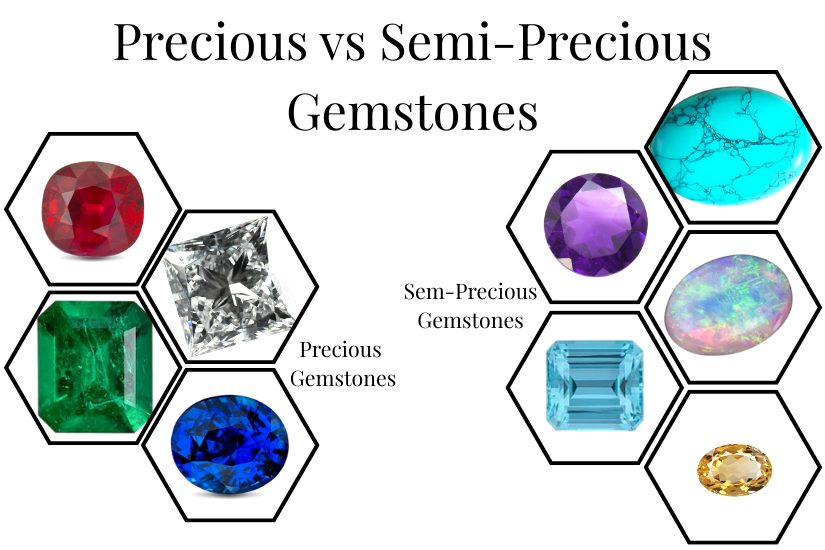
The “Big Four”: Precious Gemstones
Only four gemstones hold the title of “precious” today. They share a reputation for exceptional hardness, brilliance, and deep historical ties to royalty and power.
Diamond: Composed entirely of carbon,diamond is the hardest natural substance on Earth, scoring a perfect 10 on the Mohs hardness scale. Its unmatched durability and light dispersion make it the world’s most recognised gemstone. Learn to grade diamonds professionally with our Diamond Courses.
Ruby: A variety of the mineral corundum, ruby gets its iconic deep red colour from traces of chromium. It scores 9 on the Mohs scale and has long been associated with passion and power. Fine rubies from Myanmar are among the most valuable gemstones by weight.
Sapphire: Also a form of corundum, sapphire comes in virtually every colour except red (which is classified as ruby). The deep blue variety is most prized, though collectors equally seek after pink, yellow, and padparadscha sapphires.
Emerald: A member of the beryl mineral family, emerald is celebrated for its rich green hue. Its colour comes from trace amounts of chromium and vanadium. Unlike diamonds, emeralds are often valued even when they contain natural inclusions, known in the trade as “jardin.”
Our Gemology Graduate course covers all four precious stones in detail, including identification, grading, and valuation.
Semi-Precious Gemstones: Less Valued or Just Misunderstood?
Every gemstone outside the Big Four falls under the semi-precious category, and there are hundreds of them. Despite the name suggesting a lower value, this assumption is frequently wrong. Certain semi-precious gems routinely command higher prices per carat than diamonds, depending on their rarity and quality.
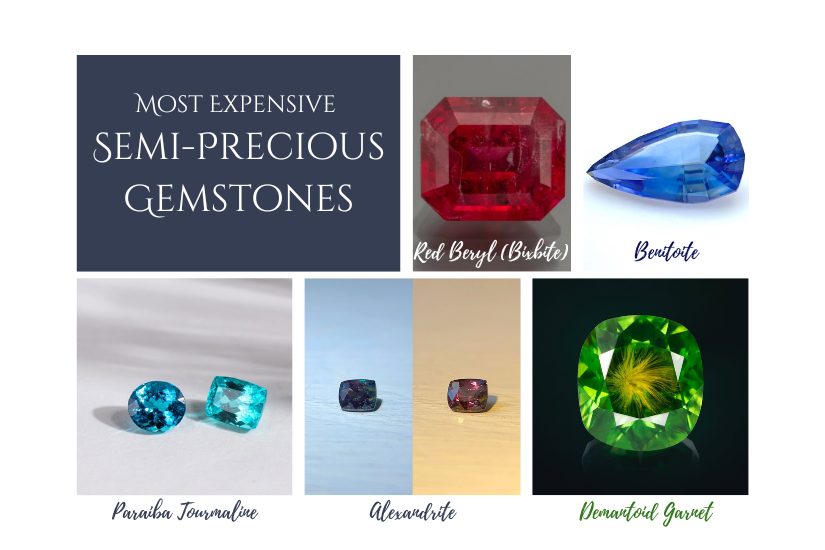
Some of the most expensive semi-precious gemstones include:
- Paraiba Tourmaline: Known for its electric neon blue-green colour caused by copper, fine specimens can exceed $10,000 per carat.
- Alexandrite: A colour-change chrysoberyl that appears green in daylight and red under incandescent light. High-quality stones are rarer than diamonds.
- Demantoid Garnet: A vivid green andradite garnet with exceptional brilliance. Russian demantoid with characteristic “horsetail” inclusions is especially prized.
- Red Beryl (Bixbite): One of the rarest minerals on Earth, found almost exclusively in Utah.
- Benitoite: A sapphire-blue mineral found commercially only in California, making it extraordinarily scarce.
Popular and widely recognised semi-precious stones include amethyst, aquamarine, citrine, garnet, opal, peridot, tanzanite, topaz, turquoise, and zircon.
How Gemstones Are Further Classified
Beyond the precious/semi-precious divide, gemologists group stones using several more precise frameworks.
By Mineral Family
Many gemstones are simply colour variations of the same underlying mineral:
- Beryl Group: Emerald, aquamarine, morganite, and heliodor all belong to this family.
- Quartz Group: Divided into macrocrystalline varieties (amethyst, citrine, rose quartz) and microcrystalline chalcedony (agate, jasper, onyx, carnelian).
- Garnet Group: A diverse family encompassing pyrope, almandine, spessartite, tsavorite (grossular), and demantoid (andradite).
- Feldspar Group: Includes moonstone, labradorite, amazonite, and sunstone.
By Origin
- Organic Gemstones: Formed by living organisms rather than geological processes. Examples include pearls (produced by mollusks), amber (fossilised tree resin), and coral.
- Mineraloids: Inorganic materials without a true crystalline structure, such as opal, obsidian, and moldavite.
- Rocks: Composed of two or more minerals, like lapis lazuli, charoite, and pietersite, fall into this category.
By Optical Phenomena (Phenomenal Stones)
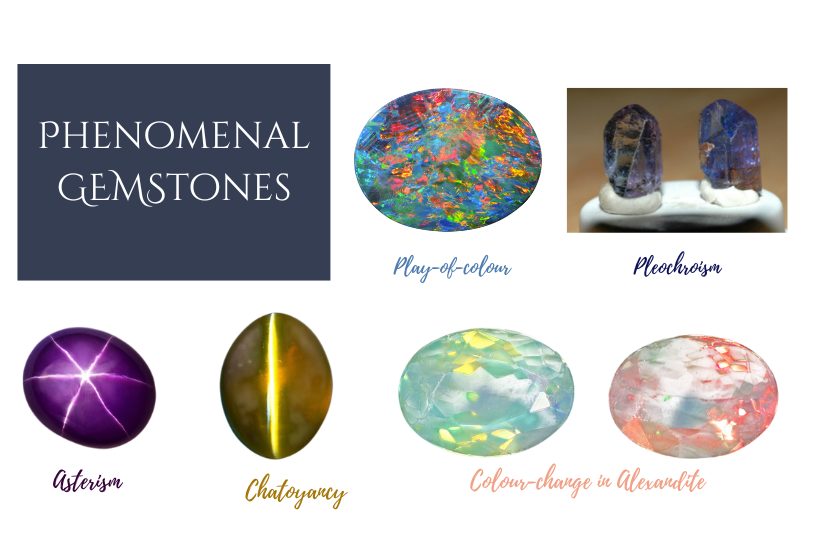
Some of the most fascinating gemstones are defined by the way they interact with light:
- Asterism: A star-like pattern visible on the surface, seen in star sapphires and star rubies.
- Chatoyancy: The silky “cat’s eye” effect, most notably found in chrysoberyl and tiger’s eye.
- Pleochroism: Displaying different colours when viewed from different angles. Tanzanite and Iolite are classic examples.
- Colour-change: Gems that shift colour under different light sources, such as Alexandrite and diaspore (also marketed as Zultanite).
- Play-of-colour: The spectral flashing unique to precious opal.
Notable phenomenal semi-precious gemstones include black star diopside, kornerupine, sillimanite, ulexite (nicknamed “television stone” for its ability to transmit images), pezzottaite, and enstatite.
What Actually Determines a Gemstone’s Value?
The precious/semi-precious label is a poor predictor of market value. A far more accurate picture comes from evaluating several key factors:
- Colour: Saturation, hue, and tone all contribute. A vivid, evenly-coloured stone is worth significantly more than a pale or uneven one.
- Clarity: The presence or absence of inclusions and surface blemishes.
- Optical phenomena: Colour-change, Asterism, and Chatoyancy can dramatically increase desirability.
- Origin: Certain mines carry a premium. Burmese Rubies, Colombian Emeralds, and Kashmir Sapphires consistently fetch higher prices.
- Treatment status: Untreated, natural stones are valued above those that have been heated, irradiated, or filled.
- Rarity: Stones rarer than diamond include colour-change alexandrite, demantoid garnet, tanzanite, black opal, Paraiba tourmaline, and natural pearls.
Two stones of the same species can differ dramatically in price based on these variables alone.
Market-Based Categories Worth Knowing
The gem trade has developed its own informal groupings beyond the standard classification:
- New Classics: High-demand stones that have gained widespread appeal in recent decades, such as tanzanite and tsavorite garnet.
- Collector Gems: Rare varieties with a niche but passionate following, including spinel, zircon, and sphene.
- Navaratna (Vedic) Gems: A culturally significant Indian grouping of nine gems representing celestial bodies, combining both precious stones (ruby, diamond) and semi-precious varieties (hessonite, cat’s eye chrysoberyl). IIG South offers a dedicated Navratnam course covering this important classification.
The Bottom Line
The precious/semi-precious distinction is a useful shorthand with real historical roots, but it should not be mistaken for a reliable guide to value, rarity, or quality. A fine alexandrite or Paraiba tourmaline will outprice most diamonds. A low-grade emerald may cost less than a well-cut amethyst.
When evaluating any gemstone, look beyond the label. Consider colour, clarity, origin, optical character, and treatment history. That’s where true value lives.
Ready to turn your passion for gemstones into a profession? Explore our full range of Gemology, Diamond, and Jewellery Design courses at IIG South or get in touch with us to find the right programme for you.