Gemstone carving is one of humanity’s oldest art forms, with origins stretching back to prehistoric times. Known formally as glyptic art from the Greek glyphein, meaning “to carve”, it encompasses the shaping, sculpting, and engraving of precious and semi-precious stones into works of beauty and utility.
Unlike faceted gemstones, which prioritise brilliance and sparkle, carved gems emphasise form, depth, and craftsmanship. Throughout history, carved gemstones have served as personal seals, marks of authority, religious talismans, and works of fine art. Today, the craft bridges ancient hand techniques with cutting-edge modern technology.
Interested in the world of gems? If this art form fascinates you, the Gemology Graduate course at IIG South is the perfect starting point, covering stone identification, properties, and the science behind every gem you see.
Historical Overview
Ancient Origins
The earliest known carved gems are cylinder seals from Mesopotamia (Sumer and Babylon), dating back approximately 5,000 years. Craftsmen incised these cylindrical stone beads with imagery and rolled them onto wet clay to produce raised impressions, using them both as personal identifiers and protective talismans. Common motifs included deities, animals, and agricultural scenes.
Ancient Egyptians carved lapis lazuli and carnelian into amulets and jewellery. Archaeologists have discovered early signet rings inscribed with hieroglyphs in Egyptian tombs, believing they functioned as wax seals on official documents.
Greek and Roman Periods
Historians trace gem engraving/carving in Europe back to Greece in the 6th century BC. Greek engravers began working on more durable stones using cutting wheels and bow-powered drills, a significant advance over earlier freehand gouging into soft stone. The cameo technique became particularly associated with this period, commonly used for signet rings.
The Romans adopted and refined these Greek techniques, using abrasive powders such as emery (low-grade corundum) to cut stones, including garnet, carnelian, and amethyst. Because an intricately carved seal was difficult to forge, intaglio seals were critical for validating official documents. Scholars widely regard the Romans as masters of intaglio carving, and many fine examples survive in museum collections today.
Medieval, Renaissance, and Beyond
The art of intaglio gem engraving largely declined with the fall of the Roman Empire, though it saw major revivals during the Middle Ages and the Renaissance. In 15th-century Italy, renewed admiration for Classical culture sparked a new school of gem engravers keen to revive the lost tradition.
During the Georgian and Victorian eras, demand for cameo jewellery surged, and shell cameos, typically carved from cowrie shells with a white profile against a pink or grey background, became widely popular.
Core Gemstone Carving and Engraving Techniques
Gemstone carving techniques fall into two fundamental categories: designs that are recessed into the stone, and designs that are raised above its surface. active voice
Intaglio
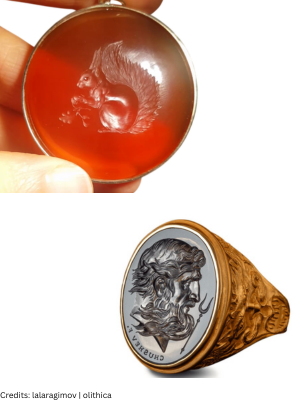
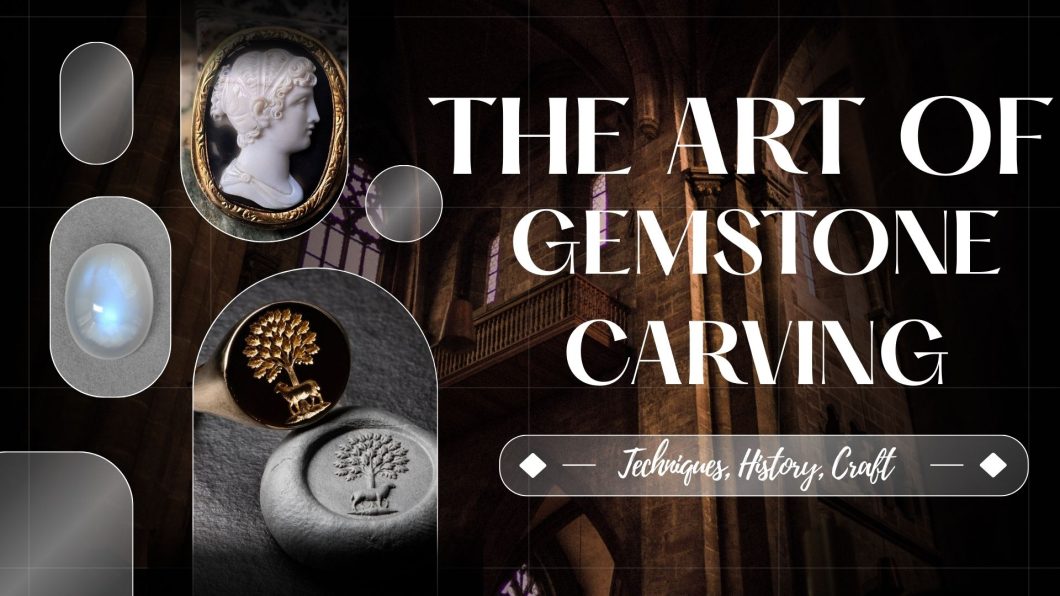
Intaglio is a reverse-carved technique in which the design is incised below the surface of the gemstone, creating a negative (recessed) impression. When pressed into a soft material such as heated wax or clay, the recessed design produces a raised, positive imprint, which is why intaglio was the preferred technique for seals and signet rings. Because the design sits below the surface, it is also more resistant to everyday wear.
A distinctive feature of intaglio is that the full design is revealed only in an impression. For this reason, museums typically display both the carved gem and a wax or clay impression alongside it.
Cameo
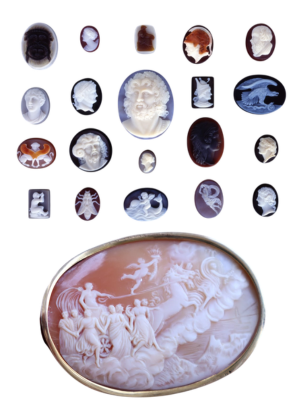
Cameo is the visual inverse of intaglio; the background material is removed to reveal a raised (relief) design, offering immediate visual clarity. The finest cameos are carved from banded or layered stones such as agate, onyx, or sardonyx, exploiting natural colour contrasts to distinguish the raised subject from the darker background. This requires exceptional precision, as cutting too deeply or encountering an irregular colour layer can undermine the entire effect.
Shell cameos, carved from cowrie shells, became the most common and affordable form from the 18th century onward. Cameos are most often used for portraits and historical scenes.
Relief Carving
A broader category in which a design stands raised from a flat background, but unlike a cameo, it does not necessarily rely on colour contrast from banded stone layers, commonly used in pendants and decorative plaques.
Cabochon and Freeform Carving
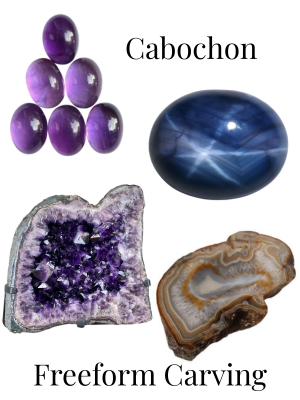
Cabochon cutting shapes a stone into a smooth, polished dome without faceting. Freeform carving goes further, producing organic, three-dimensional sculpted surfaces that highlight the stone’s natural colour play and patterning. Both are popular in contemporary jewellery, where artistic, natural shapes are preferred over standardised cuts.
Bead and Groove Carving
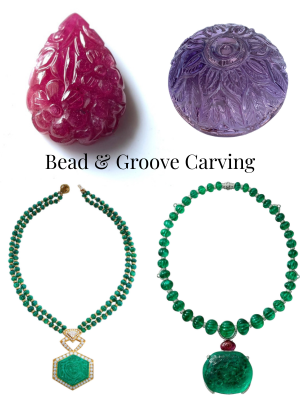
Stones can be shaped into uniform beads for use in necklaces, bracelets, and malas, or carved with channels and grooves for aesthetic detail or functional stringing. Precision is essential to prevent cracking, especially in stones with natural cleavage.
Want to translate this knowledge into jewellery design? Understanding how gemstones are carved is foundational to creating exceptional jewellery. The Jewellery Design Graduate course at IIG South teaches you to design pieces that beautifully complement and showcase carved and shaped gemstones.
Gemstone Carving Methods and Tools
The tools and methods used in gemstone carving have evolved from primitive bow drills to high-powered lasers. Most carving, regardless of era or technology, relies on abrasive materials, as gemstones are generally too hard for standard metal cutting tools.
Hand Carving is the oldest and most labour-intensive method. Skilled artisans use hand-held tools like chisels, gravers, and hammers, applying emery powder or diamond dust moistened with oil to abrade the stone. Hand carving can take days or weeks for complex designs and is highly prized for the craftsmanship it imparts. It is also the most expensive method.
Rotary Machine Engraving uses electric-powered machines driving rotating diamond-tipped burrs and wheels at high speeds. The process can be hand-guided for artistic work or computer-controlled for production consistency. One key limitation is that the friction generated produces heat, which can damage heat-sensitive gemstones.
Ultrasonic Carving uses ultrasonic sound waves to remove material with extreme precision, producing less mechanical stress on the stone and reducing the risk of cracking. Particularly effective for harder stones such as quartz or sapphire, it is well-suited to fine-detail production work.
Laser Carving uses a computer-guided, concentrated beam of light to mark or cut the stone with microscopic accuracy, capable of producing intricate designs, logos, or fine text impossible to achieve with traditional tools. The laser focuses energy precisely on the target area, avoiding thermal damage to surrounding material.
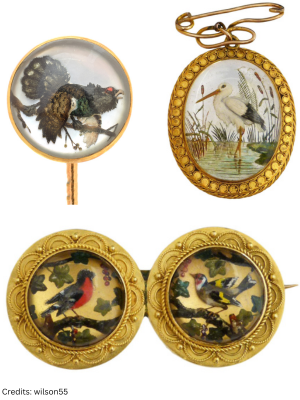
Reverse Painting (Essex Crystal) is a specialised decorative technique in which a design is carved as a reverse intaglio into the back of a translucent stone and then painted. Viewed through the front of the crystal, the painting appears luminous and three-dimensional.
Materials and Stone Selection during Gemstone Carving
The success of any carving depends heavily on the physical properties of the chosen stone. Hardness, measured on the Mohs scale, governs how easily a carver can work a stone. Softer stones like malachite or fluorite cut easily but break and wear down faster, while harder stones like quartz, sapphire, and ruby demand more effort. Structural integrity matters equally; a carver must identify natural inclusions and fractures before beginning, as cutting into these weak points can shatter the stone entirely. For cameos specifically, banded stones with distinct natural colour strata, such as agate, onyx, sardonyx, are ideal, as they enable built-in contrast between the raised subject and its background.
Historically favoured materials include carnelian, jasper, agate, lapis lazuli, sardonyx, and amethyst. Today, jade, chalcedony, quartz varieties, turquoise, and onyx remain among the most widely used, valued for their stability, colour richness, and ability to hold crisp details with a high polish.
Judging Quality in Carved Gems
High-quality gemstone carving is defined by crisp, clean edges, consistent depth across all carved elements, a smooth background free of accidental tool marks, and a design proportioned appropriately to the stone’s surface. For example, in intaglio work, the quality of the impression the gem produces in wax or clay is as important as the appearance of the gem itself.
Significance in Jewellery and Design
Carved gemstones offer qualities that faceted stones cannot replicate. A carved gem carries personal symbolism, cultural meaning, and individual artistic expression; no two hand-carved pieces are identical. Gemstone carving also allows artisans to work with stones that carry inclusions or uneven translucency, revealing the stone’s natural character rather than forcing high brilliance.
Contemporary jewellery lovers and collectors value carved gems for both their historical depth and their artistic uniqueness. Whether worn as a personal talisman, a family heirloom, or a statement piece, a carved gemstone connects its wearer to a craft tradition spanning thousands of years.
Ready to turn your passion for gems into a profession? IIG South offers India’s most comprehensive programmes in gemology and jewellery design. Check out our Courses.