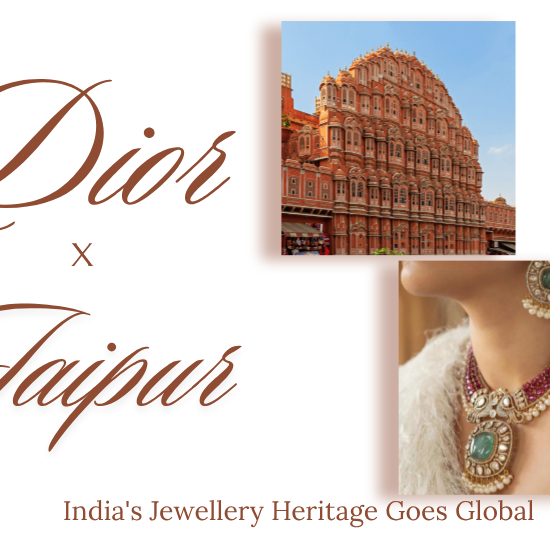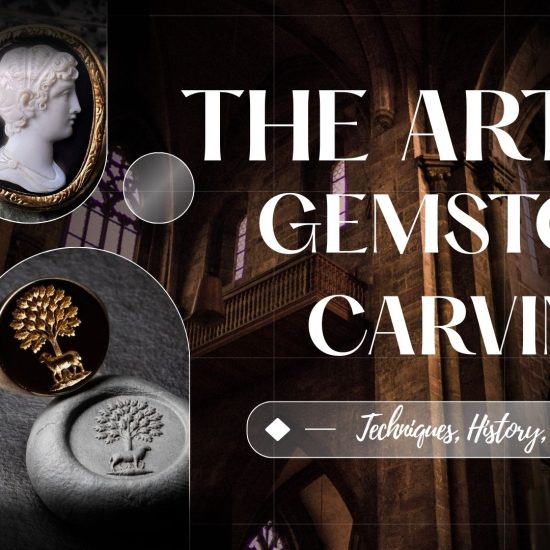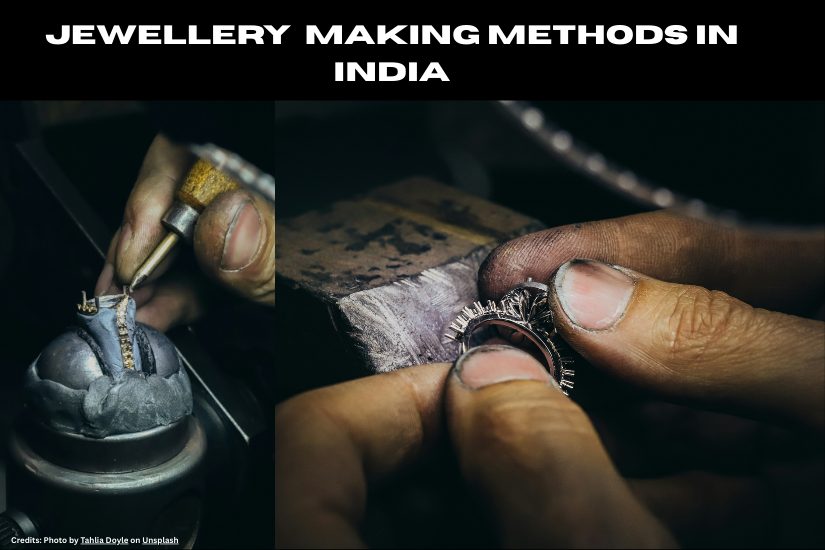
India has long been celebrated as a global hub for jewellery artistry, where rich cultural traditions meet timeless craftsmanship. The country’s jewellery-making methods are as diverse as its heritage, ranging from ancient handcrafted techniques passed down through generations to modern innovations like CAD design and 3D printing. From the intricate stone settings of Kundan and Meenakari to the advanced precision of laser engraving and CNC machining, Indian jewellery continues to blend artistry with technology. This rich tapestry of methods reflects the evolving story of Indian jewellery, where every piece tells a tale of tradition, innovation, and masterful skill.
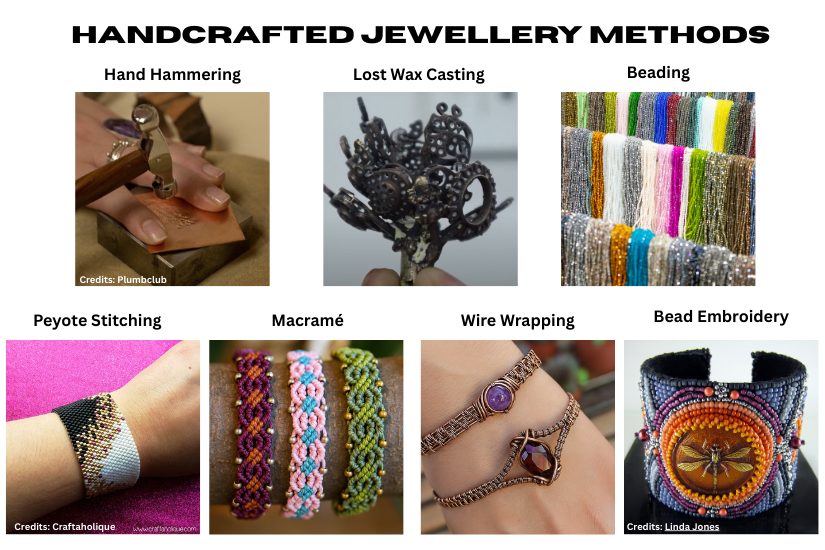
Handcrafted Jewellery Methods
Handcrafted jewellery is one of the most accessible and creative entry points into the world of jewellery making. It involves designing and crafting distinctive pieces by hand, using minimal machinery and basic tools. Known for its personal touch and artisanal charm, handmade jewellery celebrates originality, craftsmanship, and self-expression.
Traditional Tribal Jewellery Making Techniques
Indian tribal communities have perfected sophisticated jewellery-making methods using minimal machinery:
Hand-Hammering: Silver and brass sheets are shaped using hammers and anvils to create bangles, anklets, and arm cuffs. Predominantly practised in Rajasthan, Gujarat, and Odisha.
Lost Wax Casting (Dhokra): Ancient bell metal technique using wax moulds, creating intricate pendants and earrings. Mastered in Odisha, Chhattisgarh, and West Bengal.
Beadwork and Thread Jewellery
This vibrant category involves stringing, weaving, and stitching beads and threads into wearable art. While beadwork focuses on the intricate arrangement of beads, thread jewellery highlights the art of braiding, knotting, and weaving colourful threads into stunning pieces.
Rooted in tribal and folk traditions, these techniques include:
- Beading: Threading beads onto strings or wires
- Stitching Techniques: Peyote stitch, brick stitch, right-angle weave
- Knotting and Macramé: Square knots, half-hitch knots, lark’s head knots
- Weaving and Braiding: Threads or cords are interlaced using looms or by hand to create woven jewellery pieces.
- Wire Wrapping: Combining beadwork with metal wires
- Bead Embroidery: Stitching beads onto fabric backings
Traditional Indian Jewellery-Making Methods
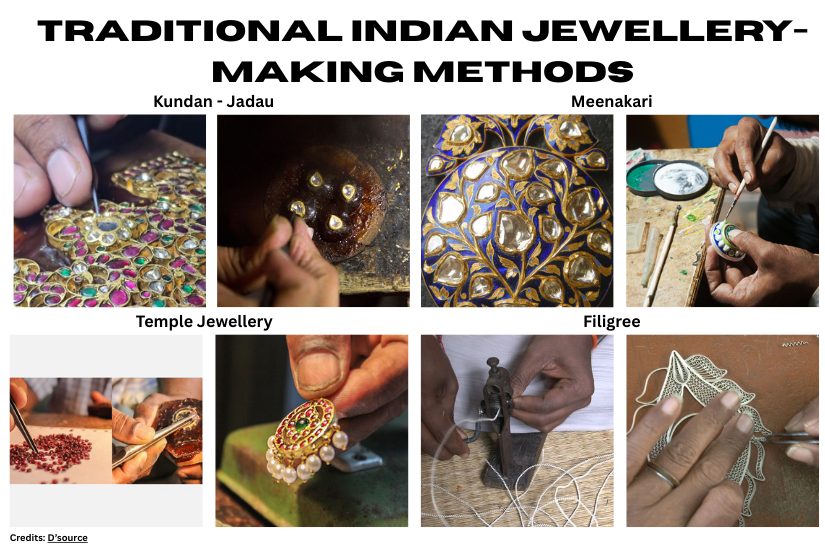
1. Kundan Jewellery – Royal Stone Setting
Origin: Rajasthan & Gujarat (2,500+ years heritage)
Method: Stone setting with 24K gold foil on lac base
Kundan represents India’s most luxurious jewellery-making tradition, involving the setting of uncut gemstones using highly refined gold foil. The word Kundan refers to the pure, refined gold used in the setting process. A hallmark of Kundan jewellery is its vibrant Meenakari(enamel work).
Key processes include:
- Ghaat Process: Base framework creation
- Kundan Setting: Stone placement with gold foil
- Paadh Process: Refining and detailing
- Meenakari: Optional enamel work
- Chilai Process: Final polishing
2. Meenakari Jewellery – Enamel Artistry
Origin: Persia → Rajasthan (Mughal era)
Method: Metal engraving with glass-like enamel fusion
The term “Meenakari” comes from the Persian word “Meena”, which means “heaven” or “paradise,” and refers to the vivid colours resembling the beauty of the heavens or celestial realm.
Meenakari refers to the art of decorating metal surfaces with colourful enamel. It involves fusing powdered glass or minerals onto metal through high-temperature firing, resulting in vibrant, glossy designs. This technique was introduced to India during the Mughal era, blending Persian artistry with Indian craftsmanship.
In essence, Meenakari means “to decorate with enamel” or “enamelling art”, symbolising beauty, colour, and intricate detail in jewellery and metalwork.
The process includes:
- Khudai Process: Metal engraving
- Meena Bharna: Enamel filling
- Meena Pakai: High-temperature firing
- Ghilai Process: Polishing and finishing
3. Jadau Jewellery – Stone Embedding Mastery
Origin: Mughal Era → Rajasthan, Gujarat, Kutch
Method: Direct stone embedding without adhesives
The term “Jadau” comes from the Hindi word “Jadna,” meaning “to embed” or “to set.” Jadau refers to the traditional technique of embedding precious stones, uncut diamonds (Polki), or gems directly into gold without the use of adhesives. The process involves softening the gold and carefully pressing or embedding the stones into the metal, followed by intricate detailing and finishing.
The technique includes:
- Ghaat Process: Gold Softening & Framework preparation
- Jadayi Process: Stone embedding
- Paadh Process: Refinement & Detailed finishing
4. Temple Jewellery – Sacred Ornamentation
Origin: Tamil Nadu, Karnataka, Andhra Pradesh (Chola & Pandya dynasties)
Method: Repoussé, granulation, and handcrafting
Temple jewellery is a traditional, handcrafted art form that originated in the temples of South India, particularly during the Chola and Pandya dynasties in regions such as Tamil Nadu, Karnataka, and Andhra Pradesh. Initially created to adorn Hindu deities and used in temple rituals, it gradually became an integral part of South Indian cultural heritage. Temple jewellery features elaborate motifs of Hindu deities and sacred symbols. Techniques include:
- Metal Crafting & Framework creation
- Nakshi Work: Detailing & embossing
- Gemstone Setting: Sacred stone placement
- Sculptural Detailing: Three-dimensional effects
5. Polki Jewellery – Raw Diamond Artistry
Origin: Ancient India (Pre-modern diamond cutting)
Method: Uncut diamond setting with Kundan technique
Polki celebrates natural, uncut diamonds in their raw form, typically set using traditional Kundan methods.
Polki Jewellery-Making Methods & Techniques include:
- Selection & Preparation of Polki Diamonds, Designing
- Framework Making (Ghaat Process),
- Kundan Setting (Paadh Process),
- Meenakari (Enamelling – Optional),
- Final Assembly & Polishing.
6. Filigree Work (Tarakasi) – Metal Lace Artistry
Origin: Cuttack (Odisha), Andhra Pradesh
Method: Twisting and weaving fine metal wires
Filigree, known as Tarakasi in India. The word “filigree” originates from the Latin terms “filum” (thread) and “granum” (grain), reflecting its core process of creating elaborate patterns from slender metal threads. Filigree creates lace-like patterns from precious metal threads.
Key processes include:
- Patli Kaam: Wire drawing
- Chowk Kaam: Frame construction
- Ghanti Kaam: Twisting and shaping
- Jhiki Kaam: Soldering
- Ghasai Kaam: Filing and finishing
7. Thewa Jewellery – Gold on Glass Fusion
Origin: Pratapgarh, Rajasthan (18th century)
Method: Hand-engraved gold sheets fused onto colored glass
Thewa is a rare and exquisite jewellery-making art form that masterfully fuses fine gold craftsmanship with vibrant coloured glass. Thewa involves meticulously hand-engraving intricate patterns onto thin sheets of gold, which are then fused onto coloured glass. This rare technique involves:
- Naqqashi: Intricate gold engraving
- Glass Preparation: Colored glass base creation
- Fusion Process: Gold-to-glass bonding
- Frame Setting: Final assembly
8. Pachchikam Jewellery – Vintage Rustic Charm
Origin: Gujarat and Kutch (16th-17th centuries)
Method: Raw stones set in silver frameworks
Pachchikam is a traditional, rustic jewellery-making art form. It blends Indian heritage with European aesthetics, featuring unpolished finishes and antique appeal. Pachchikam is known for its use of silver or low-carat gold instead of pure gold. It features raw, uncut stones such as Polki diamonds, semi-precious gemstones, or coloured glass, set within intricate handcrafted silver frameworks. The hallmark of Pachchikam lies in its unpolished finish, vintage appeal, and regal yet earthy charm.
Key processes include:
- Framework Creation,
- Stone Selection,
- Stone Setting,
- Soldering & Assembly
- Finishing.
Modern Jewellery-Making Technologies
Computer-Aided Design (CAD): Digital 3D jewellery modelling using software like RhinoGold, MatrixGold, and JewelCAD for precision design and customisation.
Computer-Aided Manufacturing (CAM): Converts CAD files for automated production using 3D printers or CNC machines.
3D Printing: Creates detailed wax or resin models layer by layer for casting using SLA and DLP printers.
Lost-Wax Casting: Traditional casting enhanced with 3D-printed wax models for intricate gold and silver designs using Wax injectors, burnout kilns, centrifugal/vacuum casting machines.
CNC Machining: Automated precision cutting, engraving, and carving in metals and wax using CNC routers, lathes, and CAD-CNC integration.
Laser Techniques: Laser cutting, engraving, and welding for fine details and seamless joins.
Electroforming & Gold Plating:
Electroforming creates lightweight, hollow jewellery by depositing metal onto forms through electrolysis. Electroplating adds thin layers of gold, silver, or rhodium to enhance finish and durability.
Surface Decoration Techniques
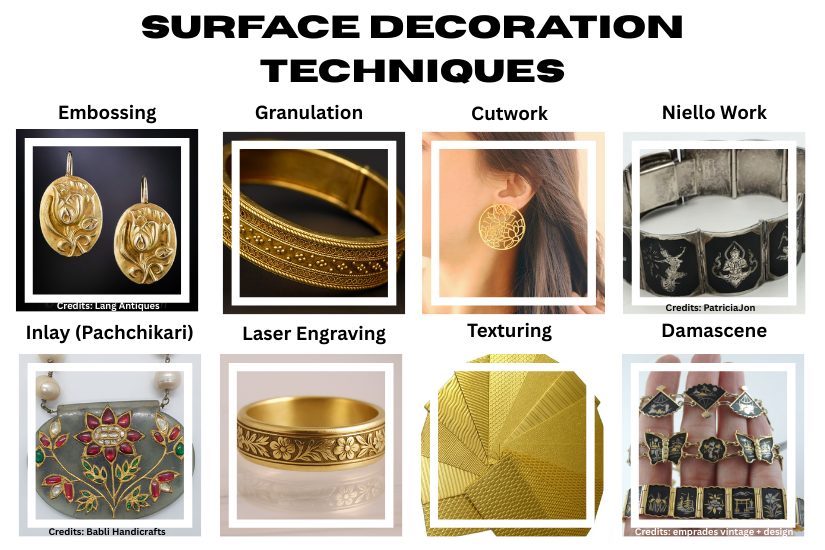
- Engraving (Nakkashi): Hand-carved designs using sharp tools
- Embossing & Repoussé: Raised relief designs created by hammering
- Granulation (Rava): Tiny metal beads fused onto jewellery surfaces
- Cutwork (Jali Work): Intricate cut-outs in metal sheets
- Niello Work: Black inlay technique on engraved silver
- Inlay (Pachchikari): Semi-precious stones inlaid into metal
- Laser Engraving: Precision pattern creation
- Texturing: Matte or patterned finishes using specialised tools
- Damascene: Inlay of contrasting metals (e.g., gold into steel) for ornamental designs.
- Anodising is a surface treatment mainly for aluminium or titanium, Anodising changes the metal’s colour and boosts tarnish resistance.
India’s jewellery-making methods offer a remarkable journey through time, from age-old traditions rooted in cultural rituals to pioneering technologies shaping the future of design. Whether through the delicate handcrafting of temple jewellery or the futuristic precision of digital fabrication, each technique highlights India’s unmatched creativity and craftsmanship. By preserving these traditional methods while embracing modern advancements, India continues to lead the world in jewellery innovation. For enthusiasts, collectors, and artisans alike, exploring these diverse jewellery-making methods is both an inspiring and enriching experience, celebrating India’s enduring legacy in jewellery artistry.
Learn professional jewellery-making methods with our expert-led Jewellery Manufacturing Techniques course.