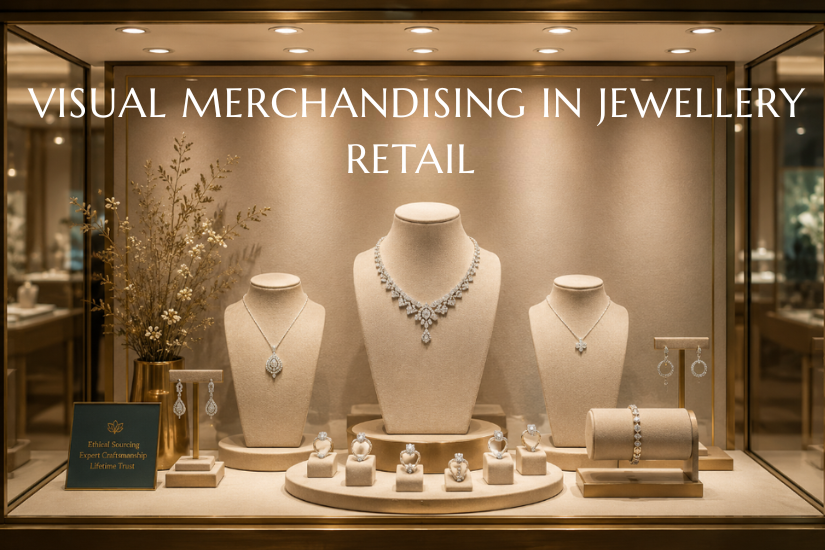
Walk past two jewellery stores on the same street. One window stops you mid-step, the lighting hits a diamond solitaire just right, the layout leads your eye from an entry-level pendant to a statement necklace, and you’re inside before you’ve decided to go in. The other window is crowded, flatly lit, and forgettable. You don’t even slow down.
That difference isn’t luck. It’s visual merchandising, and in jewellery retail, where the product is small, expensive, and entirely dependent on light to reveal its value, it may be the single highest-leverage skill in the store.
Retail data backs this up, shoppers form a definitive opinion about a store’s premium status within roughly three seconds of looking at it. In a category where trust and perceived value decide whether someone spends ₹20,000 or ₹2,00,000, those three seconds are doing a lot of work.
This guide breaks down what visual merchandising actually means for jewellery, the elements, the techniques, the mistakes to avoid, and the career path for anyone who wants to make this their profession.
What Is Visual Merchandising in Jewellery Retail?
Visual merchandising is the practice of presenting products through lighting, layout, colour, props, and spatial flow, in a way that attracts attention, communicates brand identity, and moves a customer toward a purchase decision. It sits at the intersection of design, psychology, and retail strategy.
For most retail categories, visual merchandising is about volume and lifestyle. Jewellery is different for three reasons:
| Factor | Fashion Retail | Jewellery Retail |
| Product size | Large, easily seen from a distance | Small; visibility depends entirely on lighting and placement |
| Purchase consideration | Often impulse | High-consideration; customers study, compare, and return |
| Perceived value driver | Styling and context | Sparkle, craftsmanship, and material honesty; lighting does the selling |
| Display lifespan | Changes weekly/seasonally | Core cases stay consistent; accents rotate |
Because jewellery is a high-consideration purchase, the visual environment has to build trust, not just attract a glance. A cluttered, poorly lit case doesn’t just look unappealing; it quietly signals that the store hasn’t invested in its own product, which erodes confidence before a customer has even asked a question.
Why Visual Merchandising Matters More Than Ever in 2026
A few numbers make the case clearly:
- Physical retail still leads. Offline stores account for roughly 65% of jewellery sales in major markets, because high-value purchases still depend on in-person evaluation, certification checks, and personal consultation.
- The display industry is investing accordingly. The global jewellery display stands market is projected to grow from around USD 685 million in 2026 to over USD 1.1 billion by 2036, as retailers upgrade lighting, showcases, and presentation systems.
- Engagement time is a merchandising signal. Because jewellery is a high-consideration category, industry benchmarks treat low average time-on-display or in-store dwell time as a red flag for merchandising, not just marketing.
- Digital and physical merchandising are converging. Retailers now need consistent visual standards; the same discipline that makes a display case work is what makes product photography convert online.
Visual merchandising isn’t a decorative add-on. It’s a measurable driver of dwell time, perceived value, and conversion both online and offline.
The Core Elements of Jewellery Visual Merchandising
1. Lighting
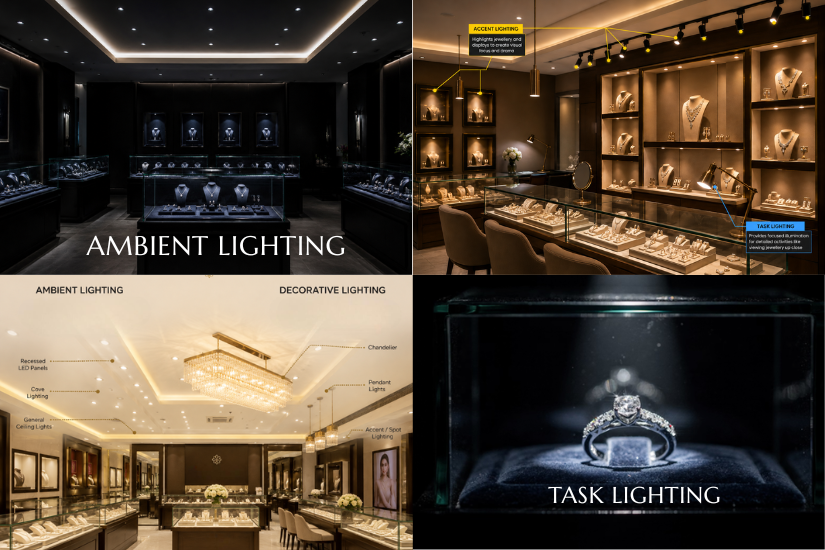
Lighting is arguably the single most important element in jewellery display, because it’s what makes gemstones and metals sparkle in the first place.
- Match colour temperature to metal. Warm white light (around 3000K) flatters gold, rose gold, and pearls. Cooler, neutral light suits platinum, white gold, and diamonds.
- Layer your lighting. Use ambient (general), accent (spotlight on hero pieces), and task lighting (inside the case) together rather than relying on one overhead source.
- Avoid flat, single-source light. It creates shadows that dull sparkle. LED strips at roughly a 45-degree angle inside cases eliminate shadow and keep the stone as the focal point.
2. Colour Psychology and Backgrounds
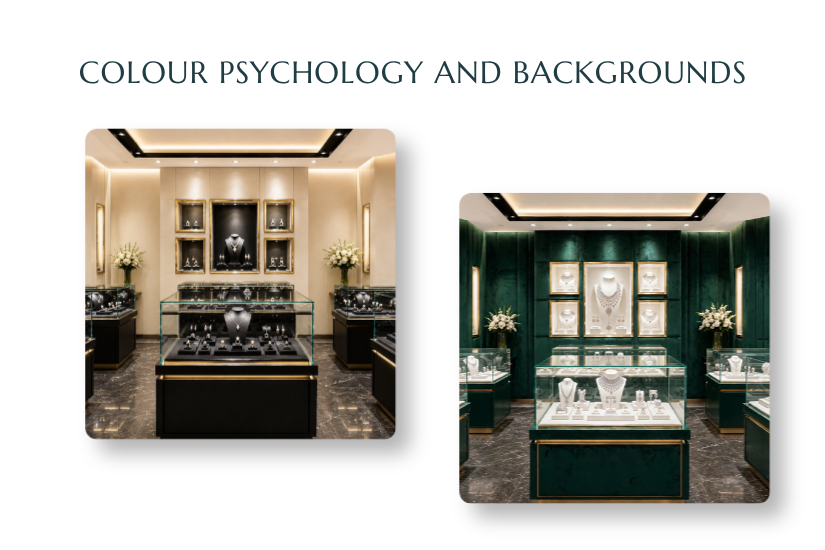
Background colour changes how a piece is perceived before a customer even looks at the price tag.
- Black signals luxury and exclusivity, ideal for diamonds and premium collections.
- White conveys purity and transparency, letting metal and stone colour read accurately, useful for bridal and fine jewellery.
- Jewel tones (emerald, sapphire, deep teal) suggest heritage and opulence, and pair especially well with gold and antique pieces.
- Metallics (champagne, rose gold) reinforce richness and work well for bridal or heritage-led collections.
The rule that matters most is consistency. A palette that shifts case-to-case or window-to-window dilutes brand recall.
3. Product Hierarchy and Placement
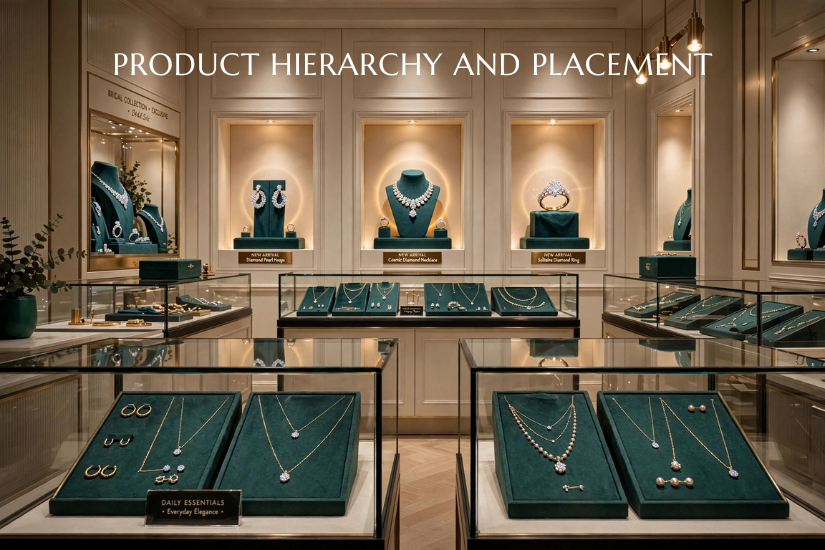
Not every piece deserves equal visual weight.
- Place premium or new-arrival pieces at eye level; this is where attention naturally lands first.
- Use a narrative flow, leading the eye from accessible, everyday pieces toward exclusive, high-value ones.
- Angle trays for small items. Slanted trays (around 45 degrees) meaningfully increase visibility for standing customers compared to flat layouts.
4. Window Displays
The window is the first message a passerby receives, often before they’ve even entered the store.
- Use high contrast, light jewellery against a dark background (or vice versa) to make pieces pop.
- Build a theme (seasonal, festival, bridal) rather than a generic assortment; themes give the eye a story to follow.
- Rotate regularly. A window that hasn’t changed in months reads as neglect, even if the merchandise inside is new.
5. Materials, Props, and Texture
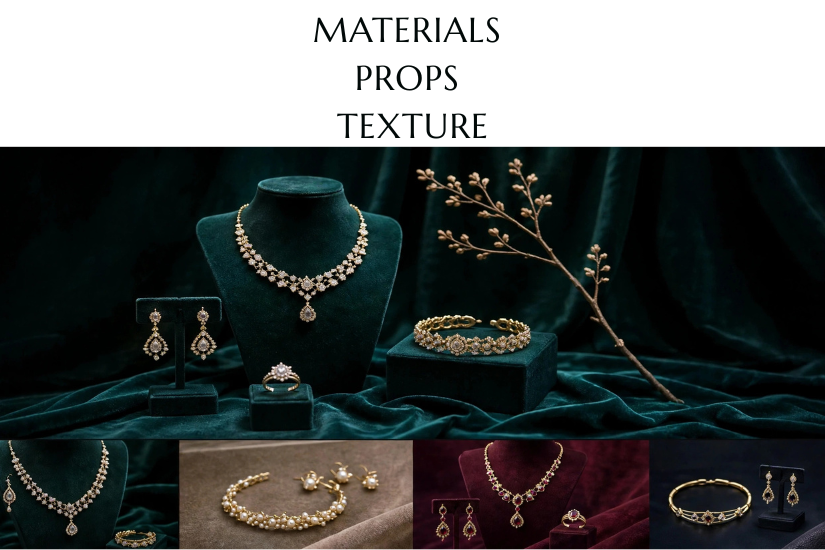
Velvet and fabric-covered displays remain the dominant material choice in jewellery retail, prized for the soft contrast they create against metal and stone. Props should support the product, never compete with it. A single well-placed prop (a branch, a textured stone, a fabric drape) can do more than a busy, over-styled scene.
6. Store Layout and Customer Flow
Visual merchandising doesn’t stop at the case. It extends to how customers move through the space, where bridal collections sit relative to the entrance, how consultation areas are positioned for privacy, and how sightlines guide movement from browsing to a seated, one-on-one sales conversation.
Visual Merchandising Techniques That Actually Convert
- Apply the three-second rule. Design your entrance display assuming you have three seconds to earn a second look.
- Light for the metal, not just the case. Mixed-metal displays need zoned lighting, not one blanket colour temperature.
- Angle for visibility. Use 45-degree trays for rings and small pieces viewed by standing customers.
- Rotate hero pieces monthly. A static “best piece” position eventually becomes visual wallpaper.
- Keep negative space around each item. Crowding pieces together to “show more” usually sells less; the eye needs room to isolate value.
- Match in-store and online visual standards. If your case lighting says premium but your product photography looks flat, the two channels contradict each other.
Common Visual Merchandising Mistakes in Jewellery Retail
| Mistake | Why It Hurts Sales | Fix |
| Overcrowded cases | Dilutes focus, makes every piece look less special | Edit ruthlessly, fewer pieces, more space |
| Single flat overhead light | Kills sparkle, flattens stones | Layer ambient, accent, and task lighting |
| Inconsistent colour palette | Weakens brand recall across cases/windows | Standardise backgrounds and prop colours |
| Ignoring customer sightlines | Confuses navigation, shortens dwell time | Map the walking path before placing fixtures |
| Static displays | Reads as neglect, reduces repeat-visit interest | Rotate windows and hero pieces on a fixed calendar |
| Disconnect between store and online visuals | Undermines trust across channels | Apply the same lighting/colour standards to product photography |
Career Opportunities in Jewellery Visual Merchandising
As jewellery brands compete harder for in-store attention, trained visual merchandising professionals are increasingly in demand, not just at large retail chains, but also across independent showrooms and D2C jewellery brands building a physical retail presence.
Career opportunities include:
- Visual Merchandiser – Designs window and in-store displays and plans seasonal visual rotations.
- Retail Display Designer – Develops fixtures, showcases, lighting concepts, and display solutions for new stores.
- Store Planner – Maps customer flow, zoning, layouts, and spatial experiences within retail environments.
- Brand Experience Executive – Ensures visual consistency and brand presentation across multiple retail outlets.
- Merchandising Manager – Oversees display strategies, budgets, vendor coordination, and execution at scale.
This skill set blends design sensibility, retail psychology, spatial thinking, and commercial awareness, making it a valuable career path for professionals who want to shape not just how jewellery is displayed, but how customers experience and connect with a jewellery brand.
How IIG South Trains the Next Generation of Jewellery Merchandisers
IIG South’s Jewellery Merchandising Professional course is built around this exact gap, training students in display design, retail psychology, product storytelling, and the commercial side of moving jewellery from showcase to sale. Students learn through practical, industry-aligned training rather than theory alone, preparing them for merchandising, retail, and brand roles across India’s jewellery sector.
| Want to build a career designing the displays that turn browsers into buyers? Explore IIG South’s Jewellery Merchandising Professional course and learn the retail, design, and brand skills the jewellery industry is hiring for. Enquire now at bengaluru@iigsouth.com |