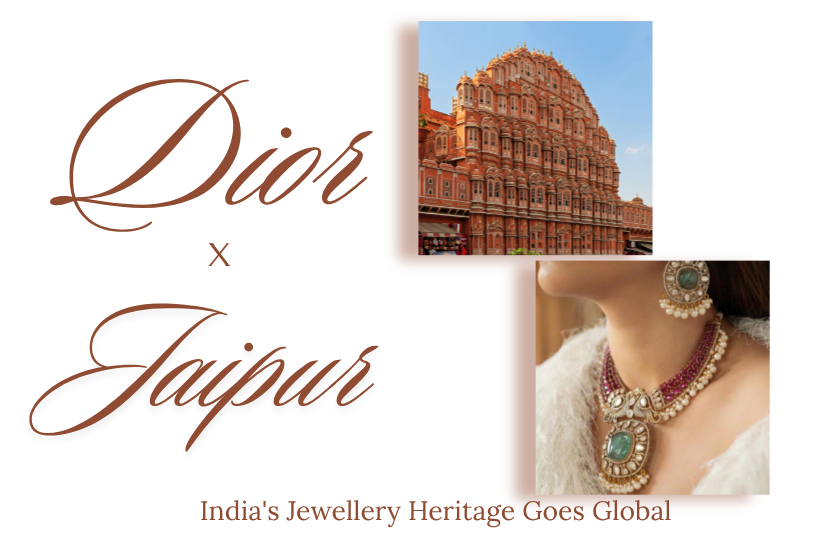
French luxury house Dior just did something that jewellery students and professionals across India have been waiting to see for a while: it named Jaipur as a direct source of inspiration for one of the biggest stages in fashion.
The Fall/Winter 2026–2027 Haute Couture collection carried unmistakable echoes of Jaipur’s jewellery traditions, and one piece in particular made the connection impossible to miss.
The Mughal Mirror Necklace Connection
The standout jewellery piece from the collection took its cue from the 17th-century Mughal Mirror Diamond Necklace, created during the reign of Emperor Shah Jahan. Dior’s design team referenced centuries-old Jaipur jewellery-making traditions to build a contemporary couture statement, proof that heritage craftsmanship doesn’t just survive on runways; it actively shapes them.
For a city whose jewellery legacy stretches back to the Mughal courts, this is more than a fashion moment. It’s a signal that Jaipur’s design language still has global creative currency in 2026.
Why Jaipur Is the World’s Coloured Gemstone Capital
Jaipur’s role in international jewellery goes far beyond inspiration boards. The city is one of the world’s most important hubs for coloured gemstone cutting, polishing and manufacturing, supplying jewellery houses, designers and retailers across international markets.
What makes Jaipur different is the depth of specialised craft knowledge concentrated in one place.
Technique – What It Is – Why It Matters?
- Kundan: Traditional gold foil gemstone setting, refined over centuries. A signature Rajasthani technique now referenced in global couture
- Meenakari: Enamelling on metal, often paired with kundan. Adds colour and artistry without cutting into the metal’s structural integrity.
- Jadau: Setting uncut, polished gemstones into gold with minimal metalwork. Prized for its handcrafted, one-of-a-kind character.
- Gemstone Carving & Cutting: Precision faceting and carving of coloured stones, positioning Jaipur as a technical, not just artistic, powerhouse.
This combination of artistry and technical skill is exactly why global houses keep looking to Jaipur, not for a single trend, but for a living craft ecosystem.
What This Means for India’s Jewellery Talent
Here’s the part that matters most if you’re a student, a working designer, or a gemology professional: when a maison like Dior references Jaipur, it validates every career built around these skills.
This isn’t an isolated moment. It reflects a broader, ongoing trend of luxury brands drawing on Indian craftsmanship and gemstone expertise for high jewellery and couture work. Jaipur’s artisan community is increasingly seen as both a source of creative inspiration and technical expertise, a combination that’s genuinely rare in global manufacturing.
For anyone building a career in this industry, that translates into real, practical relevance:
- Design students get contemporary proof that heritage techniques (kundan, jadau, meenakari) aren’t “traditionally” skills; they’re actively shaping current luxury design language.
- Gemology professionals see reinforced demand for coloured gemstone expertise, cutting knowledge and grading skills, as global sourcing continues to flow through Jaipur-linked supply chains.
- Aspiring jewellery entrepreneurs get a live case study in how heritage craft + contemporary design context = global relevance.
- International recognition like this doesn’t just make headlines; it shapes hiring, sourcing decisions, and design briefs across the luxury sector for years afterwards.
Building a Career at the Intersection of Heritage and Global Design
Moments like Dior’s Jaipur homage are exactly why a formal grounding in gemology, coloured gemstones and jewellery design matters. Understanding why kundan and jadau work technically, not just how they look, is what separates a craftsperson from a designer who can brief, adapt, and innovate on that foundation for a global audience.
That’s the gap structured education is built to close: pairing hands-on technique with the grading, sourcing, and design-thinking skills that let Indian craftsmanship travel onto runways, into ateliers, and across international markets.
Frequently Asked Questions
Dior’s Fall/Winter 2026–2027 collection referenced Jaipur’s centuries-old jewellery traditions, including a Look 10 piece inspired by the 17th-century Mughal Mirror Diamond Necklace, acknowledging the city’s craftsmanship and design legacy.
Jaipur is a leading global hub for coloured gemstone cutting, polishing and manufacturing, home to specialised techniques like kundan, meenakari and jadau, and a deep ecosystem of artisans and gem traders serving international markets.
It’s a jewellery piece created during the reign of Mughal Emperor Shah Jahan in the 17th century, referenced by Dior as inspiration for a standout look in its Fall/Winter 2026–2027 Haute Couture collection.
Kundan is a traditional gemstone-setting technique using gold foil, historically associated with Rajasthan and Jaipur, still widely used in both heritage and contemporary Indian jewellery design.
It reinforces demand for skilled designers, gemologists and craftspeople trained in coloured gemstones and traditional techniques, as international luxury brands continue sourcing inspiration and manufacturing expertise from Jaipur.
| Interested in building a career around India’s jewellery heritage? Explore IIG South’s Gemology, Jewellery Design and Coloured Gemstone programmes and see how heritage craft becomes a global career. |