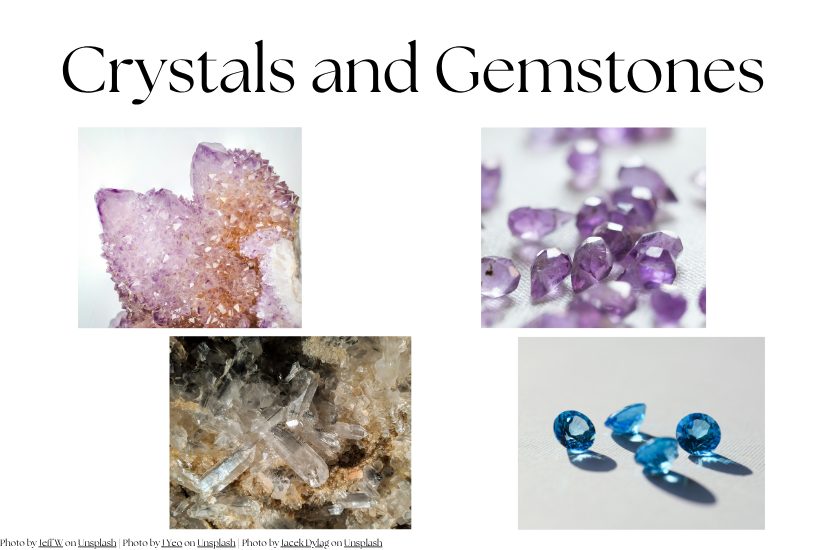
Walk into any jewellery store, and you will find rubies, sapphires, emeralds, and dozens of other stones that have been prized for centuries. Each one is beautiful on the surface, but beneath that beauty is a world of science, structure, and precision. Every gemstone is, at its core, a crystal, and understanding that crystal is the foundation of gemology.
Whether you are a jewellery professional, a student exploring a career in gemology, or simply someone curious about how these stones are formed, this guide covers the essentials of crystals and gemstones and what makes them so significant.
What Is a Crystal? And Why Does It Matter in Gemology?
A crystal is a solid material whose atoms are arranged in a highly ordered, repeating pattern called a crystal lattice. This internal structure is not visible to the naked eye, still, it determines almost every property that makes a gemstone valuable — its hardness, brilliance, colour, cleavage, and how it interacts with light.
When gemologists study a stone, they are essentially decoding its crystal structure. Two stones may look identical on the surface, but their crystal architecture can tell you which is natural, which is synthetic, and which is worth ten times more than the other.
This is precisely why gemology is not just about knowing what a gem looks like — it is about understanding what a gem is.
What Makes Something a Gemstone
A gemstone must meet three human-defined criteria:
- Beauty: Attractive colour, brilliance, optical phenomenon, or visual appeal
- Durability: Hard and stable enough to survive being worn or handled.
- Rarity: Scarce enough to be desirable and hold value
These are not scientific properties; they are market and aesthetic judgements. Tanzanite was worthless before 1967. Alexandrite was unknown before 1830.
The 7 Crystal Systems: The Framework of Every Gemstone
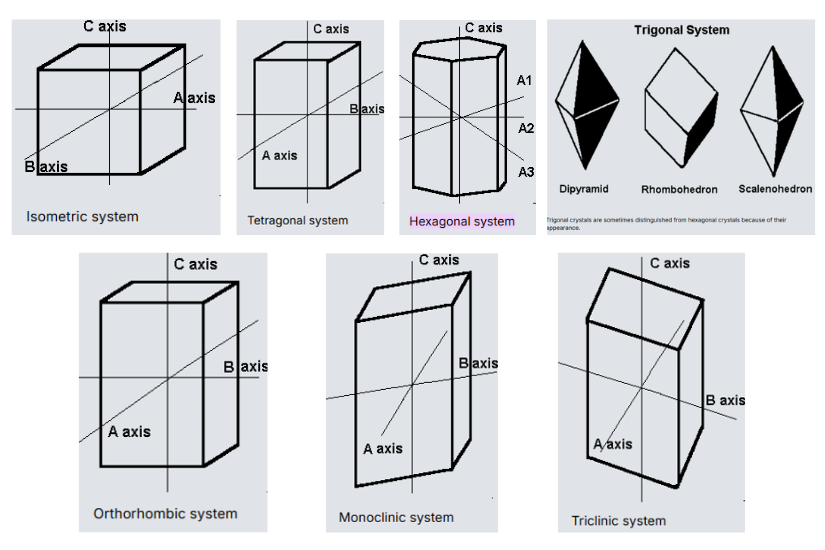
Every mineral that forms crystals, and that includes virtually every gemstone, falls into one of seven crystal systems. These systems are defined by the geometry of the crystal’s unit cell and the angles between its axes.
1. Cubic (Isometric) System
Symmetry: Highest of all systems — equal dimensions on all three axes.
Key gemstones: Diamond, Garnet, Spinel, Fluorite
The cubic system produces some of the most isotropic (uniform in all directions) gemstones. Diamond’s extraordinary brilliance and fire are, in part, a consequence of its cubic structure and the way light moves uniformly through it. Garnet’s deep, rich colour saturation is also tied to this system’s structural stability.
2. Tetragonal System
Symmetry: Two equal horizontal axes, one vertical axis of a different length.
Key gemstones: Zircon, Apophyllite, Idocrase
Zircon, one of Earth’s oldest minerals, forms in the tetragonal system and displays very high refractive indices, giving it a brilliance that rivals diamond.
3. Hexagonal System
Symmetry: Three equal horizontal axes at 60° to each other, plus one vertical axis.
Key gemstones: Emerald (Beryl), Aquamarine, Morganite, Apatite
The beryl family, which includes emerald, aquamarine, and the pink morganite, crystallises in the hexagonal system.
4. Trigonal System
Symmetry: A subset of hexagonal, with three-fold rotational symmetry.
Key gemstones: Ruby, Sapphire (Corundum), Tourmaline, Quartz, Calcite
This is perhaps the most important crystal system in coloured gemstone gemology. The entire corundum family, including ruby and sapphire, crystallises here.
5. Orthorhombic System
Symmetry: Three unequal axes all at right angles to each other.
Key gemstones: Topaz, Tanzanite, Alexandrite
Topaz forms in this system and has perfect basal cleavage, meaning it cleaves very cleanly in one direction. This is crucial knowledge for cutters and jewellers: a blow in the wrong direction can shatter an otherwise perfect topaz.
6. Monoclinic System
Symmetry: Three unequal axes; two at right angles, one inclined.
Key gemstones: Moonstone (Orthoclase Feldspar), Malachite, Jade (Jadeite is monoclinic), Spodumene (Kunzite)
Moonstone’s ethereal blue glow, known as adularescence, occurs because of the layered monoclinic structure of alternating orthoclase and albite feldspar. Light scatters between these layers, creating that floating, lunar shimmer.
7. Triclinic System
Symmetry: Lowest of all — three unequal axes, none at right angles.
Key gemstones: Labradorite, Amazonite, Kyanite
Labradorite belongs to this system and is known for its dramatic iridescent play of colour called labradorescence, caused by light interference between twinned crystal layers.
Key Properties That Define a Gemstone’s Value
Once a gemologist understands the crystal system, they assess a range of physical and optical properties that determine quality and authenticity.
1. Hardness: Measured on the Mohs scale (1–10), it indicates a mineral’s resistance to scratching. Diamond is the hardest natural substance (10), while talc is the softest (1). For jewellery use, a gem generally needs a Mohs rating of at least 7 to resist everyday wear.
2. Refractive Index (RI): When light enters a gemstone, it bends; this bending is called refraction. The degree of bending (the refractive index) affects how brilliant and scintillating a gem appears. Gemologists use a refractometer to measure RI, which is one of the most reliable tools for gem identification.
3. Specific Gravity (SG): This is the density of a gemstone relative to water. Each mineral species has a characteristic SG range. Comparing the SG of an unknown stone against known standards can help identify the species.
4. Cleavage and Fracture: Cleavage refers to a gem’s tendency to break along specific crystallographic planes. A diamond has perfect octahedral cleavage in four directions, which makes it possible to cleave a rough diamond into usable pieces, but also means a mounted diamond can chip if struck sharply. Fracture describes how a gem breaks in non-crystallographic directions. Quartz, for instance, has a characteristic conchoidal (shell-like) fracture.
5. Optical Phenomena:
- Asterism: Star effect in star rubies and star sapphires, caused by oriented needle-like inclusions (rutile silk) that reflect light as a six-rayed star.
- Chatoyancy: Cat’s eye effect in chrysoberyl, caused by parallel fibrous inclusions.
- Colour change: Alexandrite shifts from green in daylight to red/purplish-red in incandescent light, due to its unusual absorption spectrum.
- Adularescence: The glowing sheen in moonstone.
- Play of colour: The spectral flash seen in precious opal, caused by diffraction of light through a regular grid of silica spheres.
Colour in Gemstones: More Than Meets the Eye
Colour is the single most important factor in a coloured gemstone’s value, but its origin is more complex than most buyers realise.
Idiochromatic gemstones derive their colour from elements that are essential to their chemical composition. Peridot is always green because iron is part of its basic formula. Malachite is always green because copper is intrinsic to its structure.
Allochromatic gemstones are colourless in their pure state and derive their colour from trace impurities:
- Corundum (Al₂O₃) is colourless in its pure form. Chromium makes it ruby red. Iron and titanium together make it sapphire blue. Iron alone can produce yellow sapphire. Vanadium produces violet.
- Beryl is colourless in its pure form. Chromium makes it emerald. Iron makes it aquamarine. Manganese makes it morganite.
Understanding colour origin helps gemologists distinguish natural from treated stones and detect enhancements like heat treatment, beryllium diffusion, or fracture filling.
Career Opportunities
Understanding crystals and gemstones is not just an intellectual pursuit; it opens doors to a wide range of professional careers in India and internationally.
- Gemologist: Identification, grading, and certification of gemstones for laboratories, retailers, and auction houses.
- Diamond Grader: Specialised skill assessing diamonds for the 4Cs (cut, colour, clarity, carat weight), with demand from Indian diamond trading centres in Surat and Mumbai.
- Jewellery Designer: Knowledge of gemstone properties is essential for designing settings that protect and showcase stones correctly.
- Gem Dealer / Wholesale Buyer: Professional buyers for gem trading companies or auction houses need deep knowledge of the factors that determine the value.
- Quality Control in Manufacturing: Ensuring that gems set in jewellery meet stated quality specifications.
- Education and Research: Contributing to gemological knowledge through teaching, lab research, or documentation.
IIG South’s Gemology Courses are structured to give students both the theoretical foundation (crystal systems, optical properties, spectroscopy) and hands-on practical skills (using a refractometer, polariscope, spectroscope, and microscope) needed to enter these careers with confidence.
Whether your goal is to work in a gem laboratory, trade coloured stones, design jewellery with the knowledge to specify the right gem for the right setting, or enter the diamond industry, IIG South’s curriculum is built around real-world practice and industry standards. Enrol now to enhance your Gemology Knowledge.