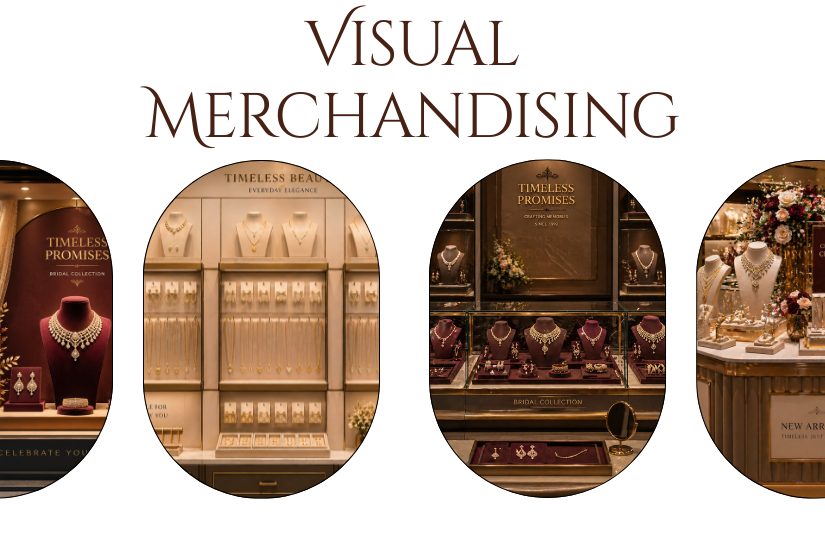
You have seven seconds.
That’s all the time a passerby takes to decide whether your jewellery store is worth stepping into. Before they read a single price tag, before a sales associate says hello, before they even see the product up close, they have already formed an opinion. And that opinion was shaped entirely by what they saw.
This is the power and the responsibility of visual merchandising in jewellery retail.
Visual merchandising is not about making a store look beautiful. It is a strategic, psychological, and deeply intentional discipline that bridges the gap between a piece of jewellery sitting in a showcase and that same piece sitting on a customer’s finger. Done right, it increases footfall, drives impulse decisions, elevates brand perception, and ultimately, sells more jewellery.
For students pursuing a career in jewellery merchandising, understanding visual merchandising is not optional; it is foundational. This guide walks you through everything: the principles, the techniques and the common mistakes usually made.
What Is Visual Merchandising in Jewellery Retail?
Visual merchandising (VM) is the practice of presenting products in a way that maximises their appeal and encourages purchase. In a general retail context, this includes clothing racks, product tables, and signage. In jewellery retail, it is a significantly more nuanced discipline.
Here is why jewellery VM is different from any other category:
- The products are small. A diamond solitaire ring is tiny. Without the right display, lighting, and framing, it can go completely unnoticed.
- The purchase is emotional. Jewellery is rarely a utilitarian buy. Customers are celebrating love, marking milestones, and expressing identity. The display must speak to that emotion.
- The price points are high. When a customer is spending tens of thousands of rupees, the environment must communicate trust, quality, and aspiration.
- The product range is wide. A single store may carry bridal gold, everyday silver, coloured gemstones, and diamond solitaires, each requiring a completely different visual language.
A visual merchandiser in a jewellery store is part designer, part psychologist, part marketer, and part storyteller. The role demands an understanding of consumer behaviour, brand positioning, lighting science, colour theory, and retail strategy — all skills that form the core of a comprehensive jewellery merchandising education.
The 5 Core Principles of Jewellery Visual Merchandising
Before you touch a single display stand or rearrange a showcase, you need to understand the principles that govern effective jewellery VM. These are not arbitrary rules; each one is rooted in how the human eye and brain process visual information.
1. Focal Points: Tell Them Where to Look
A focal point is the single element that immediately draws the eye, usually your most premium, most seasonal, or most story-worthy piece.
In a window display, the focal point might be a statement necklace set on a raised velvet bust. When it comes to a showcase, it could be a bridal set spotlit separately from the surrounding pieces. In a wall display, it is the piece at direct eye level, centre frame.
The rule: one focal point per display zone. Multiple focal points create visual confusion and cancel each other out.
2. The Rule of Odd Numbers: Why 3 Beats 4
This principle comes from design psychology. The human eye finds groups of odd numbers more natural, dynamic, and interesting than even groupings. Even numbers feel static and symmetrical, which is fine for formal settings, but not ideal for displays meant to engage and excite.
In practical terms: arrange your showcase pieces in groups of 3, 5, or 7. Cluster a set of three bangles together rather than four. Display earrings in a trio of styles rather than two pairs. This creates a rhythm in the display that the eye moves through naturally, increasing the chance that a customer pauses and engages.
3. Height and Levels: Create Visual Hierarchy
A flat display is a dead display. When every piece sits at the same height on the same surface, there is no hierarchy, no journey for the eye to travel, and no way to signal which pieces deserve more attention.
Use risers, velvet stands, neck forms, hand forms, and tiered trays to create varying heights within a single display. The tallest element should be your focal point. The eye naturally travels from high to low, so place your most important or highest-margin pieces at the top of the visual flow.
4. Colour and Contrast: Make the Jewellery Come Alive
The background of your display is not neutral; it is actively communicating something about your jewellery and your brand. The wrong background colour can make gold look cheap, make diamonds look dull, and make coloured gemstones disappear entirely.
General guidelines:
- Gold jewellery reads best against deep jewel tones like navy, forest green, burgundy, or warm neutrals like cream and camel.
- Diamond and white gold/platinum pops against black, charcoal, or deep navy backgrounds.
- Coloured gemstones, namely rubies, emeralds and sapphires, require neutral or complementary backgrounds that do not fight the stone for attention.
- Silver and oxidised pieces work beautifully against natural textures like raw linen, slate, and light wood.
5. Flow and Navigation: Guide the Customer Through the Store
Visual merchandising does not end at the showcase; it governs the entire store experience. How a customer moves through your store, what they see first, what they discover next, and where they end up, is all within your control as a visual merchandiser.
The goal is to create a natural, intuitive flow that:
- Draws customers past as many categories as possible
- Places high-margin or high-interest pieces along the natural walking path
- Avoids dead ends and bottlenecks that make customers feel trapped
This is where planograms, visual blueprints for store layout and display arrangement, become essential.
Jewellery Display Types and When to Use Each
There is no one-size-fits-all display solution in jewellery retail. Each type of display serves a different function, suits a different product category, and speaks to a different stage of the customer journey.
Window Display
This is your store’s first impression — the display that stops people on the street and makes them walk in. Window displays in jewellery retail are almost always thematic and story-driven. They work best when built around a single concept: a bridal collection launch, a festival campaign, a seasonal theme.
Window displays should be refreshed every 2 to 4 weeks at a minimum. A display that has not changed in two months signals to regular passersby that nothing is new and there is no reason to return.
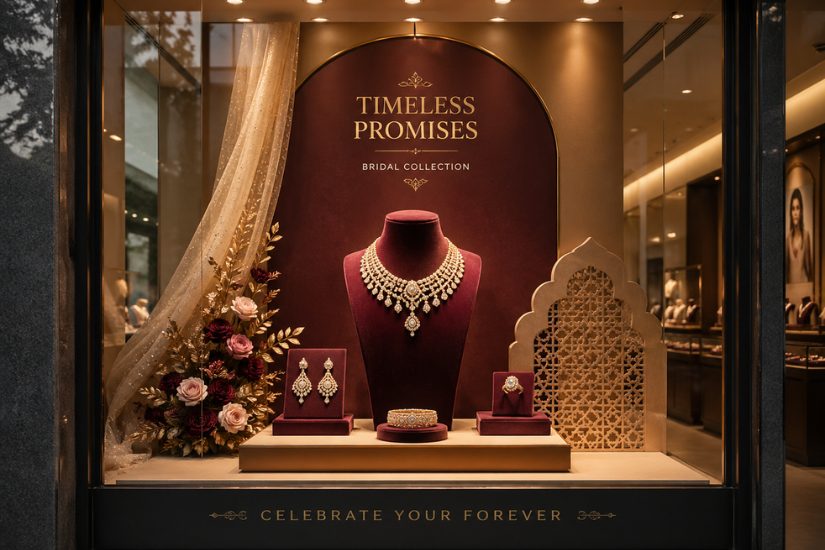
Key window display rules:
Check the display from outside, at street level, from both sides, not just from within the store
One clear theme, one clear hero piece
Maximum 5 to 7 pieces in the frame & never more
Props should support the story, not compete with the jewellery
Showcase / Counter Display
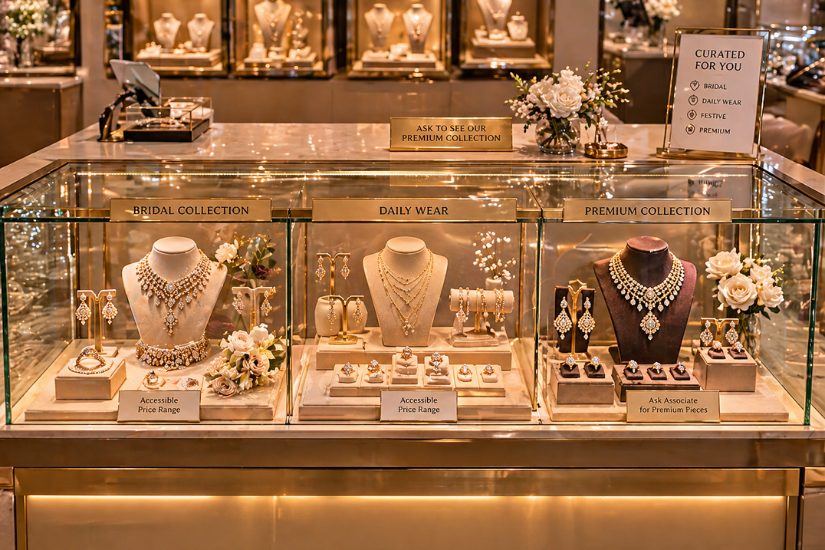
This is where most of the actual selling happens. Showcases allow customers to get close to pieces, and they are where sales associates guide the conversation. The VM challenge here is balancing security (pieces must be safely stored) with accessibility (customers must be able to see and desire what is inside).
Best practices:
The front row of a showcase (closest to the customer) should carry pieces at accessible price points; premium pieces can be in the centre or back, requiring the associate to bring them forward
Arrange by category, not randomly — bridal together, daily wear together, etc.
Keep the inside of the showcase clean — no price tags facing up, no scattered props
Use consistent display props within a single showcase for a cohesive look
Wall Display
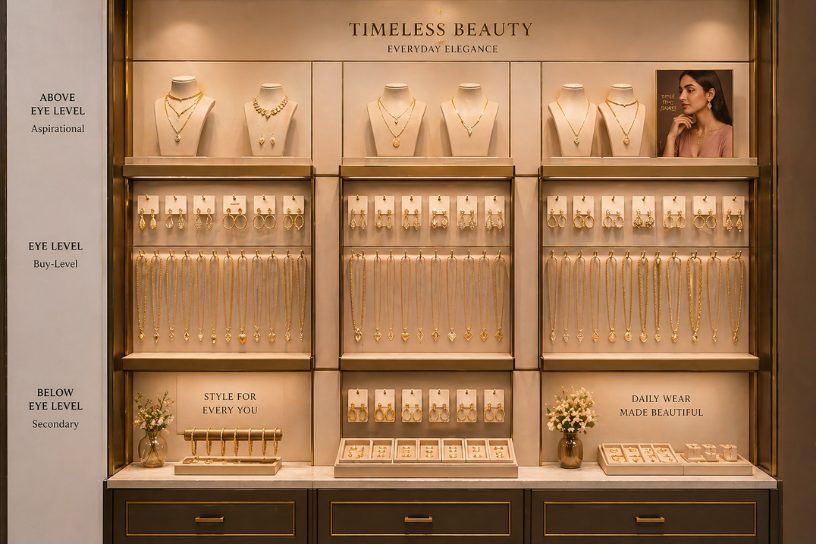
Best suited for fashion jewellery, everyday lightweight pieces, and accessories with strong visual impact. Wall displays maximise floor space and are ideal for stores that carry high volumes of product.
The key principle here is that eye-level is buy-level. The pieces at direct eye level should be your bestsellers or highest-margin items. Everything above eye level is aspirational; everything below is secondary.
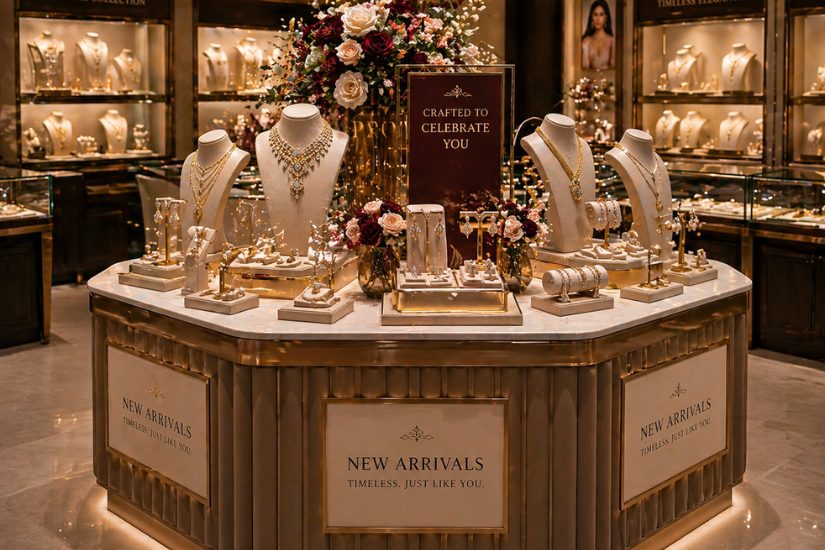
Feature Table or Island Display
Used for launches, promotions, or curated collections. An island display sits in the centre of the floor and is visible from all sides, meaning it must be beautifully merchandised on 360 degrees, not just from the front.
Feature tables work exceptionally well for festive season displays, bridal collections, and new arrival launches. Because they are unanchored and accessible, they invite customers to linger, so make sure the pieces here warrant that engagement.
Digital Screen Displays
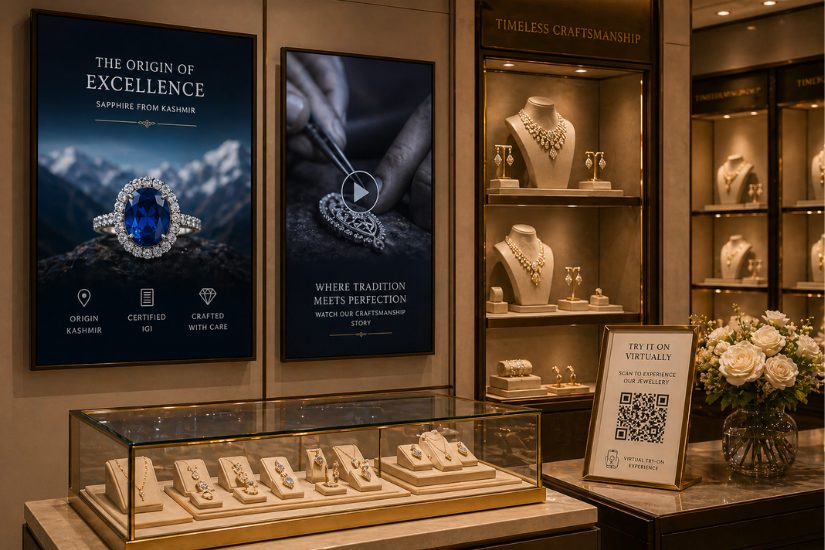
Digital screens inside showcases or on walls can display product certification details, gemstone origin stories, craftsmanship videos, or campaign imagery. They add depth to the customer experience without cluttering the physical display.
QR codes on display cards linking to a virtual try-on experience are becoming a standard tool in forward-thinking jewellery stores, an important trend for any aspiring jewellery merchandiser to understand.
Why Jewellery Merchandising Students Must Master VM
Visual merchandising is not a peripheral skill in jewellery retail; it sits at the intersection of everything: branding, consumer psychology, product knowledge, pricing strategy, and store operations.
Brands like Tanishq, Malabar Gold, Bluestone, and CaratLane invest significantly in VM because they understand the direct link between how a store looks and how much it sells. For a student entering this industry, VM proficiency opens doors to roles including:
- Visual Merchandiser at national and international jewellery brands
- Retail Manager responsible for store presentation and performance
- Brand Manager, ensuring consistent visual identity across locations
- Entrepreneur building your own jewellery retail or brand experience
The Jewellery Merchandising Professional course at IIG South covers visual merchandising as a hands-on, practical discipline, including store visits, live display exercises, and real-world case analyses. The goal is not just for you to understand VM in theory, but to be able to walk into any jewellery store and immediately see what is working, what is not, and exactly what needs to change.
The Display Is the First Salesperson
In jewellery retail, the display does not wait for the customer to ask a question. It speaks first. It sets expectations, communicates value, tells a story, and makes a promise, all before a single word is exchanged.
Mastering visual merchandising is mastering the art of that first conversation. It is understood that every riser height, every spotlight angle, every velvet colour, and every prop placement is a deliberate decision that either moves a customer closer to purchase or pushes them further away.
For those building a career in jewellery merchandising, VM is one of the most visible, measurable, and impactful skills you can bring to an employer or to your own business. It is where creativity meets commerce, and in jewellery retail, that is exactly where the most exciting work happens.
Ready to master jewellery visual merchandising hands-on? The Jewellery Merchandising Professional course at IIG South is an 8-week, industry-led programme that covers visual merchandising, consumer behaviour, branding, pricing strategy, digital marketing, and more, with real store exposure. Enrol now to learn from expert mentors.