Whether you’re a jewellery design student, a working professional in the gems and jewellery industry, or simply someone who loves beautiful ornaments, understanding the types of necklaces, their lengths, and their styles is foundational knowledge. Just as a fashion designer must know fabrics and silhouettes, a jewellery designer must know necklaces from collar to rope.
At IIG South, one of India’s most respected gems and jewellery design institutes, students are trained to understand not just how to craft jewellery, but also why specific designs exist, how they’ve evolved, and what makes each style commercially and aesthetically significant.
This guide is your complete guide to necklace types, a deep dive that serves both creative inspiration and professional knowledge.
Why Necklace Knowledge Matters for Jewellery Design Students
Before jumping into styles and lengths, let’s address the “why.”
In any jewellery design course, whether it’s a Master’s in Jewellery Design, a Jewellery Design Graduate programme, or a short-term professional course, understanding necklace anatomy, types, and wearability is critical. Here’s why:
- Client consultation: A designer who knows the difference between a matinee and an opera necklace can guide clients more effectively.
- Design briefs: Industry projects require precise terminology and measurement knowledge.
- Trend forecasting: Knowing historical styles helps predict and create modern trends.
Now, let’s get into the details.
Types of Necklaces by Length
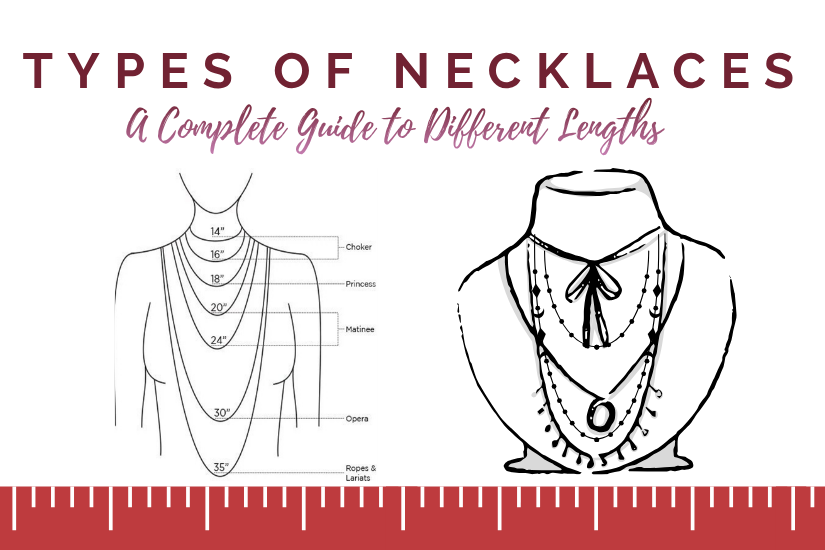
Necklace length is one of the most important variables in jewellery design. It determines how a piece sits on the body, what necklines it pairs with, and what occasions it suits. Lengths are typically measured in inches.
1. Collar Necklace (12–14 inches)
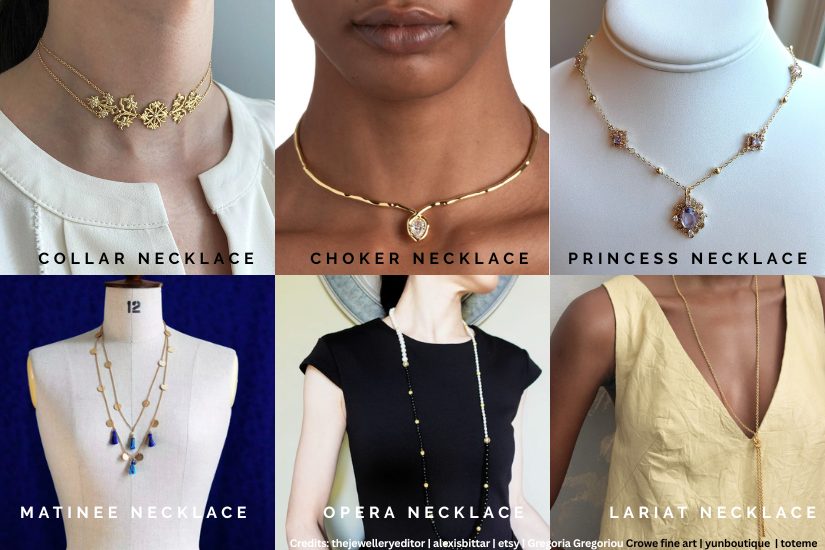
A collar necklace sits snugly at the base of the throat, just above the collarbone. Understanding collar necklaces introduces students to rigid setting techniques, metal forming, and the concept of “wearable sculpture.”
2. Choker Necklace (14-16 inches)
The choker necklace is worn close to the neck or rests on the collarbone. It is arguably the most versatile necklace length and has seen repeated waves of popularity from Victorian lace chokers to 1990s plastic tattoo chokers to today’s diamond and gemstone-encrusted versions.
3. Princess Necklace (16-18 inches)
The princess length is the single most popular and commercially successful necklace length in the global jewellery industry. It falls just below the collarbone, making it flattering on almost every body type and with almost every neckline. Understanding proportion, chain weight, and clasp design for this length is covered in courses like Jewellery Design Manual Professional at IIG South.
4. Matinee Necklace (20–24 inches)
The matinee sits just above or at the centre of the bust with an average length of 22 inches. It is a classic length associated with sophistication and semi-formal occasions.
Matinee length plays an important role in understanding how gravity and body movement affect necklace design, especially in multi-strand pearl pieces. Designers must carefully consider knotting between beads and clasp mechanics to ensure both structure and comfort.
5. Opera Necklace (28–36 inches)
The opera necklace falls below the bust and above the navel, making it one of the most dramatic and statement-making lengths.
Opera necklaces teach designers about multi-functionality in design, one piece worn multiple ways. This concept is increasingly important in modern jewellery design and is explored in the Master’s in Jewellery Design & Manufacturing programme at IIG South.
6. Rope / Lariat Necklace (37 inches and above)
At its longest, the rope necklace can be 45 inches or more. It is the most theatrical of all necklace lengths and can be styled in dozens of ways — looped, knotted, draped as a Y-shape, or worn doubled.
The lariat/rope length is relevant for studying clasp-free design solutions, bead threading, and the physics of drape, all of which are important technical skills.
Types of Necklaces by Style
While length determines where a necklace sits, style determines how it looks and what it communicates. Here are the most important necklace styles every jewellery design student should know.
1. Bib Necklace
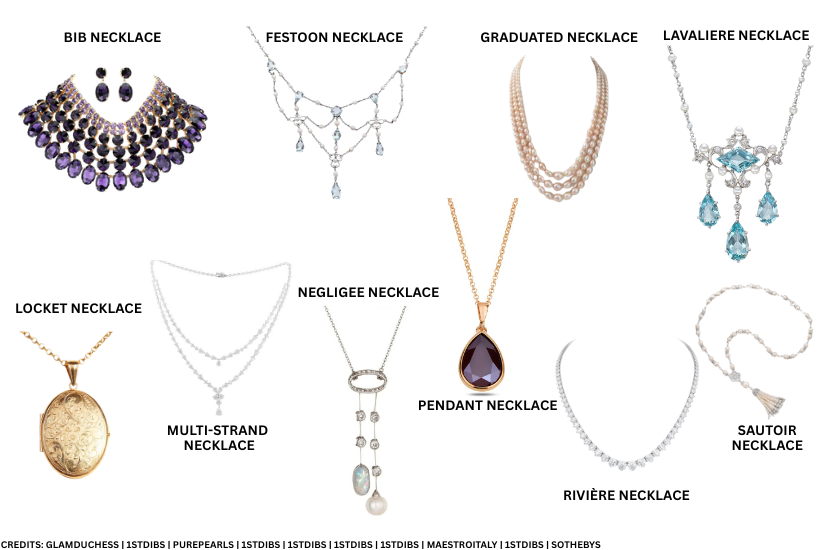
Named after a baby’s bib, this style features a bold, layered arrangement of stones, fabric, or metal that fans out across the upper chest. Bib necklaces are statement pieces, wide, dramatic, and designed to be the focal point of any outfit. They typically sit close to the collarbone and taper toward the back.
2. Festoon Necklace
A festoon necklace is defined by its looping, draped chains or strings of gems that hang in graceful swags between connecting points. The word “festoon” refers to a decorative chain or garland, and that’s exactly the effect this necklace creates. It’s an elegant, antique-inspired style often seen in Victorian and Edwardian jewellery, with multiple drops or pendants dangling from the loops.
3. Graduated Necklace
In a graduated necklace, the stones or beads are arranged in ascending order of size, smallest at the clasp, largest at the centre. This creates a natural, visually pleasing symmetry that draws the eye inward. Pearl graduated necklaces are the most iconic example, often associated with timeless, classic femininity.
4. Lavaliere Necklace
A lavaliere (also spelled “lavalier”) is a delicate necklace featuring a small, ornate pendant, often a drop-style design with a secondary, smaller drop hanging beneath the main stone. It originated in the late 19th century and was popularised during the Art Nouveau era.
5. Locket Necklace
A locket stands as one of the most sentimental necklace styles. It features a small hinged pendant that opens to reveal a hidden compartment, where people traditionally keep a miniature photograph, a lock of hair, or another cherished keepsake. Generations have treasured lockets as meaningful heirloom pieces for centuries. They come in round, oval, heart, and rectangular forms, crafted in gold, silver, or rose gold, and are as popular today as ever for their personal, meaningful quality.
6. Multi-Strand Necklace
As the name suggests, a multi-strand necklace consists of two or more strands of chains, beads, pearls, or gems worn simultaneously, held together by a shared clasp or connector. The strands may be uniform or vary in length, texture, and material, creating a layered, luxurious look. This style adds volume and richness to the neckline and is a favourite in both contemporary and traditional jewellery design.
7. Negligee Necklace
A négligée necklace features two pendants of unequal length hanging from a central chain, with one drop slightly longer than the other, creating an asymmetrical and casually elegant look. Designers introduced this style during the Edwardian era and considered it informally chic. The name comes from the French word meaning “carelessly worn.” The design stands out for its subtle yet distinctive appeal, offering an effortlessly stylish look rather than an overly formal one.
8. Pendant Necklace
The most versatile and widely worn necklace style, a pendant necklace consists of a chain with a single decorative element, the pendant, hanging at the centre. The pendant can be virtually anything: a gemstone, a symbol, a charm, a cross, an initial, or an abstract form. This style ranges from minimalist everyday wear to elaborate centrepiece jewellery, making it the most adaptable necklace style across all occasions and aesthetics.
9. Rivière Necklace
From the French word for “river,” a rivière necklace is a single, continuous strand of individually set gemstones, each stone the same cut, size, and type, flowing seamlessly around the neck. Diamonds are the classic choice, though sapphires, emeralds, and rubies are also used. The result is a glittering, uninterrupted line of brilliance with no metal links visible between stones.
10. Sautoir Necklace
A sautoir is an extra-long necklace, typically 90 cm (36 inches) or more, often ending in a tassel, pendant, or decorative clasp. It became fashionable during the Art Deco period of the 1920s, favoured by women who wore it doubled up, knotted, or left to swing freely. Pearls, crystals, and fine chains are all common materials.
Why Study Jewellery Design at IIG South?
Understanding the types of necklaces is just the beginning. In a professional jewellery design programme, you go much further by learning how to sketch, draft, prototype, manufacture, and grade the pieces you’ve studied theoretically.
IIG South — the Best Gems & Jewellery Design Institute in Bangalore — has been shaping careers in the jewellery industry since 1965. With industry-backed courses across Jewellery Design, Gemology, and Diamond Grading, IIG South provides the practical, real-world training that the gems and jewellery industry demands.
If you’re ready to turn this knowledge into a career, explore the courses at IIG South — where industry expertise meets world-class education.
Frequently Asked Questions(FAQ)
The main necklace lengths are: Collar (12–13″), Choker (14–16″), Princess (17–19″), Matinee (20–24″), Opera (28–36″), and Rope/Lariat (37″+).
The Princess length (17–19 inches) is the most popular necklace length globally, as it suits most necklines and body types and is ideal for pendant necklaces.
A collar necklace (12–13″) sits at the very base of the throat, while a choker (14–16″) sits slightly below it. Collar necklaces are often rigid, while chokers can be flexible chains, ribbons, or bands.
A lariat necklace is a long necklace with no clasp, designed to be looped, knotted, or draped freely. It typically forms a Y-shape and is highly versatile in styling.
Understanding necklace types, lengths, and styles is essential for client consultation, design briefs, trend forecasting, and professional communication in the gems and jewellery industry.