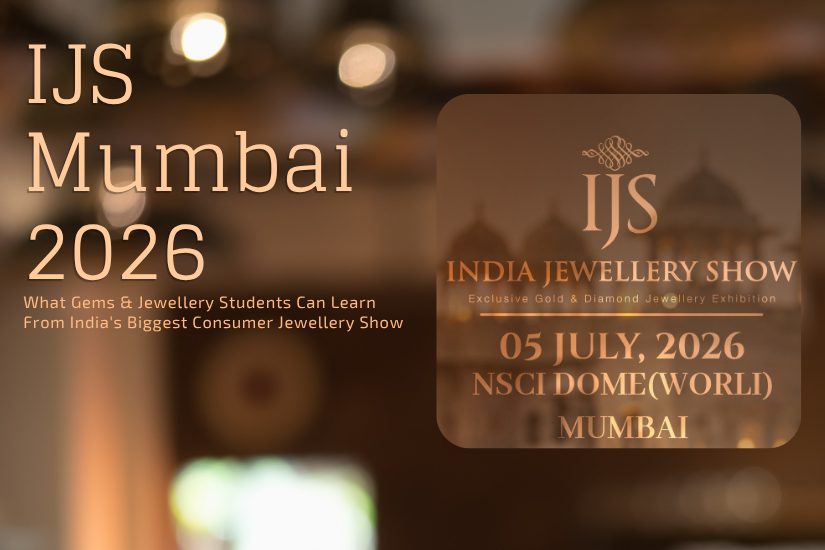
On 4 and 5 July 2026, NSCI Dome in Worli, Mumbai, hosted the latest edition of IJS, the India Jewellery Show — one of the country’s best-known business-to-consumer jewellery exhibitions. For anyone building a career in gems and jewellery, shows like IJS are worth watching closely, not because they replace trade fairs or classroom learning, but because they show, in real time, how the pieces you’ll one day grade, design, or manufacture actually meet the people who buy them.
What Is the India Jewellery Show (IJS)?
IJS is positioned as one of India’s most-loved B2C jewellery exhibitions. It differs in character from trade-only events such as GJEPC’s IIJS Bharat-Signature; instead of restricting entry to registered trade buyers, IJS opens its doors directly to consumers — brides, families shopping for weddings, and jewellery enthusiasts. At the same time, jewellers from across the country showcase gold, diamond, platinum, and antique collections under one roof.
Inside the Mumbai Edition
The July 2026 Mumbai leg followed IJS’s usual format: a two-day showcase bringing jewellers from across India together under one roof, with a mix of gold, diamond, and antique jewellery aimed largely at a retail and bridal-shopping audience. As in earlier Mumbai editions, the show also served as a networking hub for designers, retailers, and students keen to see what buyers are responding to this season.
If you weren’t in the room, the useful takeaway isn’t the exhibitor list, it’s what a purely consumer-facing show like this reveals about the market you’re training to enter.
Why a Consumer Show Belongs in Your Industry Education
Most gemology and jewellery education rightly focuses on the technical and commercial foundations of the industry, including grading, certification, sourcing, manufacturing, and design. Trade shows such as IJS represent the other end of the value chain, where all of that knowledge is ultimately tested against real-world buyer behaviour and market demand.
Exhibitions give students and aspiring professionals a valuable opportunity to observe how trends translate into commercial success, understand how buyers make purchasing decisions, and identify the products that attract the greatest attention. By experiencing the market firsthand, learners gain practical insights in a low-risk environment, preparing them to interpret market signals and make informed business decisions with confidence in their professional careers.
What Gemology & Diamond Students Should Take Away
- Buyer literacy varies widely. At a B2C show, you’ll meet buyers who can discuss clarity grades fluently and others who’ve never seen a certificate. Learning to explain the same fact at different levels of technical depth is a skill that diploma and B.Sc. programmes test on paper, and shows like this test in conversation.
- Certification as a trust signal. For most consumers, a lab report isn’t really about the 4Cs; it’s reassurance. Watching how jewellers use certification to build confidence on the show floor previews how you’ll eventually need to communicate grading results to non-specialists.
- Natural and lab-grown side by side. Consumer shows are increasingly where buyers first encounter lab-grown diamonds next to natural stones. Explaining the distinction clearly, without bias, is now a baseline expectation for anyone entering diamond retail or appraisal.
What Jewellery Design Students Should Take Away
- Bridal and festive demand still drives design language. Shows built around weddings, like IJS, are a fast way to see which motifs, stone combinations, and metal-weight preferences are actually selling this season, rather than which ones trended online.
- Regional taste is not uniform. A show’s Mumbai edition draws a different audience and often a different design mix than Ahmedabad or Rajkot does. Designers who understand these regional differences have a real advantage when briefs come from national or export-facing clients.
- Traditional-contemporary crossover pieces get the most attention. Watch for pieces that bridge classic templates (temple jewellery, kundan, antique finishes) with lighter, more wearable modern settings, that crossover is where a lot of current design demand sits.
What Manufacturing & Merchandising Students Should Take Away
- Exhibitions are a distinct sales channel. A multi-city show like IJS runs on a completely different logistics and merchandising rhythm than a showroom or e-commerce catalogue; stock has to travel, insure, and sell within a two-day window. Understanding the cycle is directly useful to anyone entering retail operations or merchandising.
- The show circuit doubles as market research. IJS runs in 12+ cities a year, and each stop works like a small test. A design that sells well in one city gets scaled up; one that doesn’t gets reworked before bulk production begins. In short, the circuit helps manufacturers learn what to make before they overmake it.
How IIG South Prepares You for Shows Like This
Reading a show like a professional, not just admiring the display cases, is exactly what we train into our curriculum. Through our B.Sc. in Gems & Jewellery, Gemology, Diamond, and Jewellery Designing courses, backed by real industrial visits and exhibitions, the show floor feels familiar long before graduation.
Explore our courses and start building the skills to read shows like IJS the way an industry insider does.