
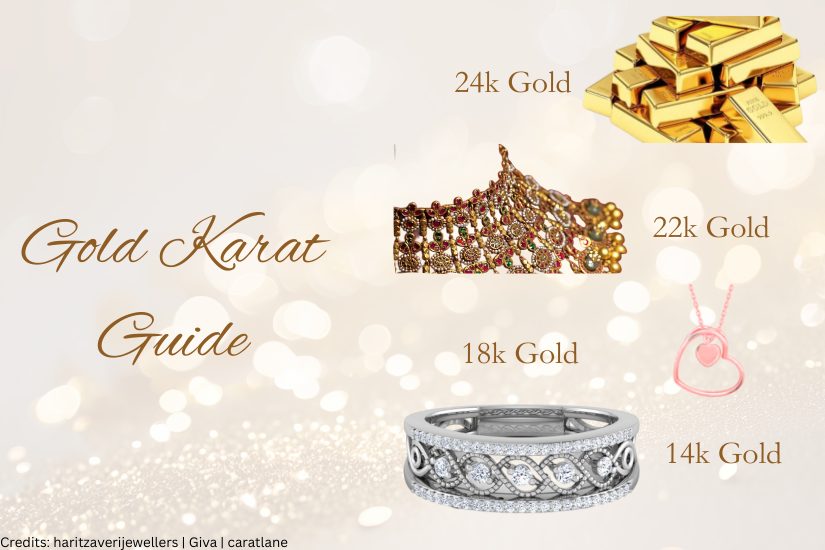
Gold purity is measured in karats (K), a standard that indicates the percentage of pure gold present in a gold alloy. The karat system is based on a 24-point scale, where 24K represents pure gold.
Understanding Karat
24K gold means 24 parts out of 24 are pure gold. Lower karat values indicate that gold has been alloyed with other metals, such as copper, silver, zinc, or nickel, to enhance its strength, durability, and workability. The higher the karat, the greater the gold purity, colour richness, and intrinsic value.
Gold is used in various forms like coins, bars, and fine jewellery, and although it can technically be alloyed to many purity levels, only a few karatages are commonly used in the jewellery industry due to practical design and durability requirements.
The most widely used karat types in fine jewellery are 10K, 14K, 18K, 22K, and 24K, each serving a distinct purpose based on strength, appearance, and application.
24K Gold Purity – 99.9% Pure Gold
24K gold represents the purest form of gold, containing 99.9% gold with virtually no alloying metals. It is the highest quality and most valuable grade of gold available. Visually, 24K gold is distinguished by its intense, rich yellow, almost orange hue and exceptional natural luster.
Key Characteristics
- Purity: 99.9%
- Colour: Deep, rich yellow
- Luster: Very high
- Softness: Extremely soft and malleable
Because of its high purity, 24K gold is relatively soft and can be easily scratched, dented, or bent. This softness makes it impractical for regular jewellery use, especially for pieces intended for daily wear.
Applications of 24K Gold
Although rarely used in fine jewellery, 24K gold plays an important role in other areas:
- Investment-grade items such as gold coins and bars
- Collector’s and ceremonial pieces
- Display and heirloom items
- Medical and electronic applications, where gold’s conductivity and resistance to corrosion are valuable
Design & Wearability Insight: 24K gold’s lower structural strength compared to lower-karat alloys makes it unsuitable for intricate designs, stone settings, or wearable jewellery that faces frequent handling.
22K Gold Purity – 91.67% Gold
22K gold is a high-purity gold alloy composed of 22 parts pure gold and 2 parts alloying metals, typically copper and silver. With 91.67% pure gold, it offers an excellent balance between rich colour and improved durability, making it one of the most widely used karatages in fine traditional jewellery.
Key Characteristics
- Purity: 91.67%
- Composition: 22 parts gold, 2 parts alloy metals
- Colour: Rich, deep yellow (very close to pure gold’s natural hue)
- Texture: Soft and malleable compared to lower karats
The presence of alloying metals gives 22K gold greater strength than 24K gold, making it more resistant to scratches and wear. However, it remains softer than 18K and 14K gold, which limits its use in certain modern jewellery applications.
Applications of 22K Gold
- Traditional and bridal jewellery
- Ceremonial and religious ornaments
- Bangles, chains, necklaces, and earrings
- Investment jewellery
- Common Markets
Design & Wearability Considerations: While 22K gold is ideal for handcrafted and traditional designs, it is not recommended for heavily stone-studded jewellery, especially pieces set with diamonds or heavy gemstones. Due to its softness, 22K gold may struggle to hold stones securely under daily wear, increasing the risk of deformation.
18K Gold Purity – 75% Gold
18K gold is a premium gold alloy composed of 18 parts pure gold and 6 parts alloying metals, typically copper, silver, and zinc. With 75% pure gold, it offers an ideal balance between luxury, durability, and design flexibility, making it one of the most popular choices in fine jewellery worldwide.
Key Characteristics
- Purity: 75%
- Composition: 18 parts gold, 6 parts alloy metals
- Colour: Warm yellow; also available in white and rose gold
- Durability: Stronger than 22K and 24K gold
Compared to higher-karat gold, 18K gold is more resistant to scratches and daily wear, while still retaining a rich gold appearance. Its strength allows jewellers to create intricate designs and secure stone settings, especially for diamonds and precious gemstones.
Design & Wearability Considerations: 18K gold is highly suitable for studded and diamond jewellery, as it can firmly hold gemstones without deformation. It is commonly used in Engagement and wedding rings, Fine gemstone jewellery, Luxury watches and designer pieces.
14K Gold Purity – 58.3% Gold
14K gold is a durable gold alloy composed of 14 parts pure gold and 10 parts alloying metals, such as copper, zinc, silver, and sometimes nickel. With 58.3% pure gold, it offers an excellent balance between strength, affordability, and aesthetic appeal, making it one of the most popular choices for everyday jewellery.
Key Characteristics
- Purity: 58.3%
- Composition: 14 parts gold, 10 parts alloy metals
- Colour: Lighter yellow; also widely used in white and rose gold
- Durability: Highly resistant to scratching and bending
Design & Wearability Considerations: 14K gold maintains its shape well and securely holds gemstones, making it especially suitable for Engagement and wedding rings, Earrings, bracelets, and pendants, Modern and minimalist jewellery designs.
10K Gold Purity – 41.7% Gold
10K gold is a gold alloy containing 10 parts pure gold and 14 parts alloying metals, such as silver, copper, nickel, or zinc. With 41.7% pure gold, it has the lowest gold content among commonly used jewellery karats but offers maximum durability and affordability.
Key Characteristics
- Purity: 41.7%
- Composition: 10 parts gold, 14 parts alloy metals
- Colour: Pale yellow; often used in white gold
- Durability: Extremely strong, resistant to scratching and bending
Due to its high alloy content (58.3%), 10K gold is harder and more wear-resistant than higher-karat gold, making it suitable for jewellery exposed to daily stress.
Design & Wearability Considerations: 10K gold’s strength allows for Thin and delicate designs, Simple chains and rings, Lightweight jewellery for active lifestyles.However, its lower gold content results in a less vibrant gold colour and a higher likelihood of skin sensitivity for individuals allergic to certain metals like nickel.
What Alloys Are Mixed with Gold?
Gold is rarely used in pure form because it’s very soft. Here are the main alloying metals added to gold and their purposes:
- Copper – The most common alloying metal. It adds hardness and durability, gives gold a reddish tint (used in rose gold), and is relatively inexpensive. It can cause tarnishing over time if used in high percentages.
- Silver – Adds strength and durability, creates a greenish or yellowish tint depending on the ratio, and is commonly used in yellow and white gold alloys.
- Zinc – Improves workability and malleability, acts as a deoxidiser during the melting process, and helps create a brighter finish. Often used in small amounts with other metals.
- Palladium – A premium choice for white gold that’s hypoallergenic, creates a naturally white colour (reducing the need for rhodium plating), and adds durability. It’s more expensive than nickel.
- Platinum – Sometimes used in small amounts in white gold alloys for strength and whiteness, though it’s expensive.
The specific combination and percentages determine the karat (purity), color, and properties of the final gold alloy.
Explore our blog section for more informative reads.
