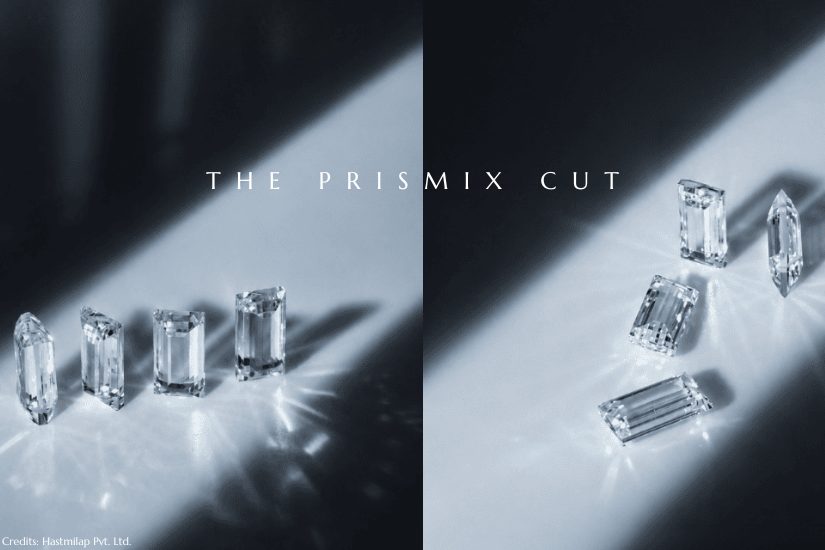
A Surat-based manufacturer just secured a patent for a diamond-cutting technique that most grading textbooks don’t yet have a category for, and that’s exactly why it’s worth studying.
In July 2026, Hastmilap Pvt. Ltd. secured a patent for its proprietary Prismix Cut Technique, a method that fuses two baguette diamonds into a single, unified visual form. For diamond-grading and jewellery-design students, this isn’t just industry trivia. It’s a live case study in how cutting innovation, intellectual property, and grading science intersect in the real world.
What Is the Prismix Cut Technique?
The Prismix Cut takes two baguette diamonds, normally set independently in step-cut jewellery and positions them in mirror-image opposition, facing each other across a central axis. Together, they form one continuous shape rather than two separate stones.
Key technical points
- The combined form carries 38 facets working across both stones as a single optical unit.
- Both diamonds function as active, table-facing surfaces rather than one dominant stone with a supporting piece.
- Light entering the form is refracted and reflected from two directions simultaneously, rather than through a single pavilion.
- The result is described as a continuous bilateral glow, rather than the single-point brilliance of a standard step cut.
According to Hastmilap, the idea originated from a real design constraint: a bespoke client project where conventional baguettes weren’t delivering enough visual impact in a structured setting. Instead of redesigning the jewellery around the diamond’s limitations, founder Vishal Dholiya’s team asked a different question: could the diamond itself be reimagined? That process of trial and observation eventually produced the patented technique.
Why This Matters for Diamond Grading Students
Grading Beyond the Round Brilliant
Most grading education starts and often stays with the round brilliant, because it’s the industry benchmark for cut-grade systems. But the Prismix Cut is a useful reminder that a large share of real-world diamonds in the trade are fancy, step, or composite cuts that don’t map neatly onto that framework.
A two-stone, mirror-fused form raises questions that are genuinely useful to think through as a student:
- How do you assess proportion and symmetry when the “stone” being evaluated is actually two coordinated stones?
- How does light performance get measured across a shared axis rather than a single culet-to-table path?
- At what point does a cutting technique become a cutting style that labs need a consistent way to describe?
There’s no settled answer yet — Prismix is too new for grading labs to have published a position on it. That’s the point: this is what it looks like when the trade moves faster than the textbook, and it’s a skill in itself to reason through a new cut using first principles rather than a memorised chart.
Understanding IP in Gemology: Can a Cut Be Patented?
Here’s something most 4Cs-focused courses never cover: a cutting technique can be legally protected, separately from the diamond itself. This happens in two main ways:
| Protection type | What it covers | Example |
| Design patent | Protects the ornamental appearance or visual design of a diamond cut, not its function. | Tiffany’s Lucida cut |
| Utility patent | Protects the functional invention, such as a novel facet arrangement or cutting method that improves optical performance, brilliance, or manufacturing. | Multifacet arrangements aimed at optical performance |
What This Means for Designers and Manufacturers
Beyond the classroom, the Prismix Cut is a practical case study in design-led problem solving:
- For CAD and jewellery design students, it demonstrates that a design limitation can sometimes be solved by rethinking the material itself, not just the setting.
- For manufacturing students, it’s a reminder that precision facet coordination across two stones (not just one) is a differentiated, patentable manufacturing skill.
The Prismix Cut won’t replace the round brilliant, and it isn’t meant to. What it does offer to students, designers, and retailers alike is a live example of how a real design problem, patient trial and error, and a working knowledge of diamond optics can turn into protectable intellectual property. For anyone training in gemology or jewellery design today, that’s a more useful lesson than the patent itself.
FAQ
It’s a patented diamond-cutting technique developed by Hastmilap Pvt. Ltd. that positions two baguette diamonds in mirror-image opposition to form one unified, 38-facet visual unit.
After a bespoke client project exposed the limitations of conventional baguette settings, Vishal Dholiya, Founder and Managing Director of Surat-based Hastmilap Pvt. Ltd., developed the Prismix Cut Technique.
Yes. Cutting techniques can be protected through design patents (covering appearance) or utility patents (covering the functional method).
| Want to understand how modern cuts like Prismix are graded, designed, and brought to market? Explore IIG South’s Diamond Grading and Gemology courses and build the technical foundation the industry’s next innovations will need. |