Every breathtaking piece of jewellery, from a Mughal-inspired polki pendant to a sleek platinum solitaire, begins not with metal or stone, but with design. Before a craftsman lifts a hammer, a designer speaks a visual language. That language is built on seven timeless Elements of Design.
At IIG South, we believe that understanding the elements of design is the single most transformative step a jewellery professional can take. These foundational principles are the difference between a piece that catches the eye and one that captures the heart.
In this complete guide, we break down all 7 elements, exactly how they work, why they matter, and how they directly apply to jewellery design in today’s competitive market. Ready to go further? Explore the Top 10 Skills Jewellery Designers Must Master in 2026.
What Are the Elements of Design?
The elements of design are the basic visual building blocks that artists, designers, and creators use to construct any composition, whether it is a painting, a logo, a piece of architecture, or a ring. Think of them as the alphabet of visual language. Just as you cannot write a sentence without letters, you cannot create a meaningful design without these elements.
The seven core elements of design are: Line, Shape, Form, Colour, Value, Texture, and Space. Every designer consciously or intuitively works with all seven in every creation.
1. Line — The Most Powerful Element of Design
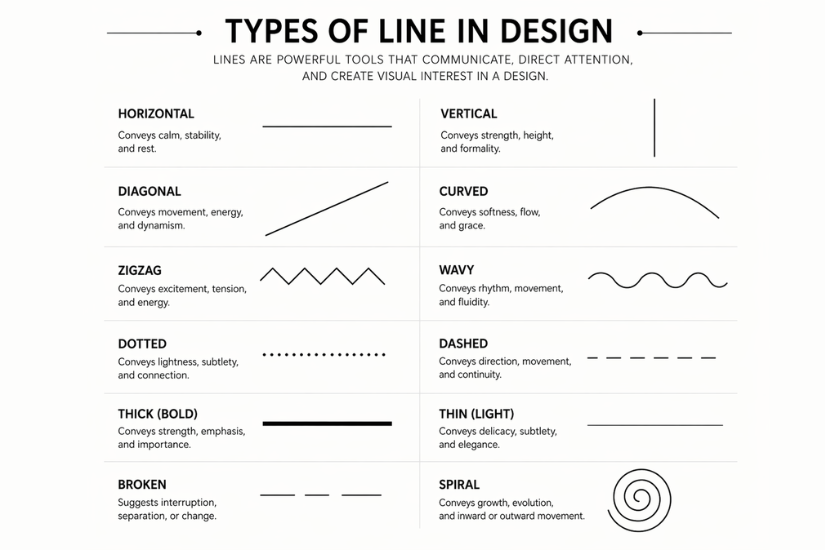
A line is a mark that connects two points. It has length but very little width. Before shape, before form — there is line. It is the starting point of every drawing, every design, every jewellery sketch.
In jewellery design, lines appear everywhere: in the engraved motifs on a bangle, in the flowing curves of a filigree earring, in the bold edges of a geometric ring. Line defines boundaries, creates structure, suggests movement, and expresses emotion.
2. Shape — The Soul of Visual Structure
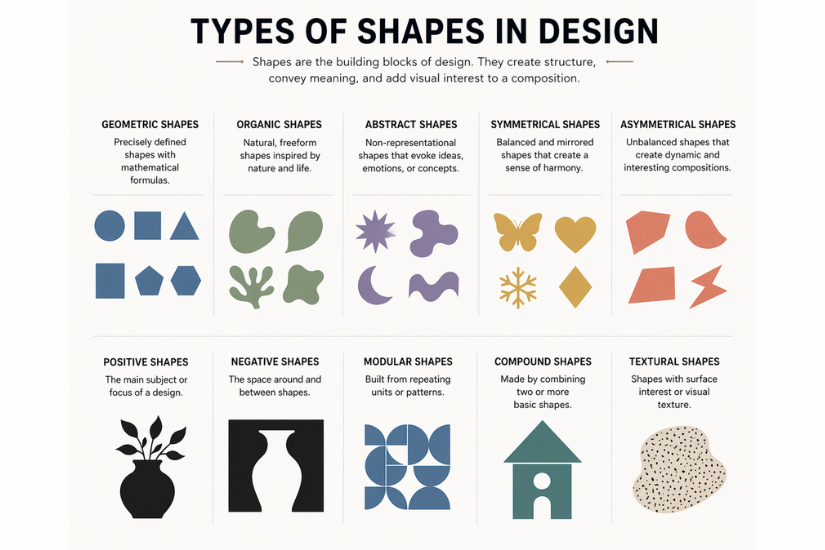
A shape is a two-dimensional enclosed area formed by a line connecting back to itself. It has height and width, but no depth. If the line is the beginning of the design, shape is the first form of identity. Without shape, a drawing is only wandering lines.
a) Geometric Shapes
Regular, mathematical, precise. They evoke order, stability, strength, and logic. Circle, Square, Triangle, Rectangle, Hexagon, and Octagon are a few examples. Mostly used in solitaire settings, geometric pendants, and modern architectural jewellery.
b) Organic Shapes
Irregular, natural, flowing. They evoke softness, life, movement, and femininity. Leaves, Flowers, Clouds, Waves, Peacock feather, Paisley motif are a few examples. Mostly used in nature-inspired collections & traditional Indian jewellery.
3. Form — Giving Shape, Depth & Life
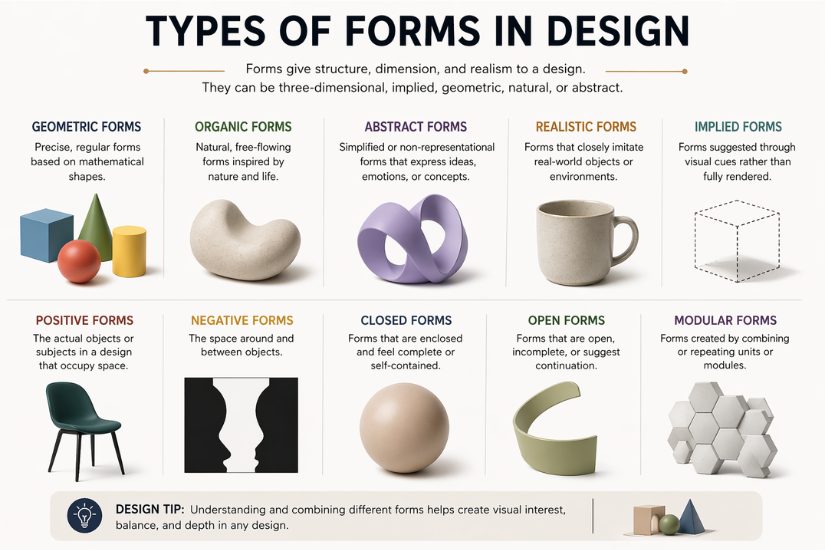
Form is a three-dimensional (3D) element of design that has height, width, and depth. It refers to the volume and mass of an object, making it appear solid and real. When a flat shape is given depth, it becomes a form.
In jewellery, form is everything, because jewellery exists in 3D space. It must look beautiful from every angle, sit well on the body, and convey its design intent even when worn, not just when photographed flat.
Design forms in jewellery fall into three categories:
- Geometric Forms: Sphere, cube, cylinder, cone, pyramid. Precise and mathematically constructed.
- Organic Forms: Free-flowing, inspired by nature, like flower buds, shells, pebbles, and human body curves.
- Abstract Forms: Simplified, stylised, or distorted versions of real objects that suggest an idea or feeling, like twisted volumes, flowing biomorphic shapes, or symbolic sculptural forms. These are the signature of contemporary fine jewellery design and art jewellery movements.
4. Colour — The Emotional Language of Design
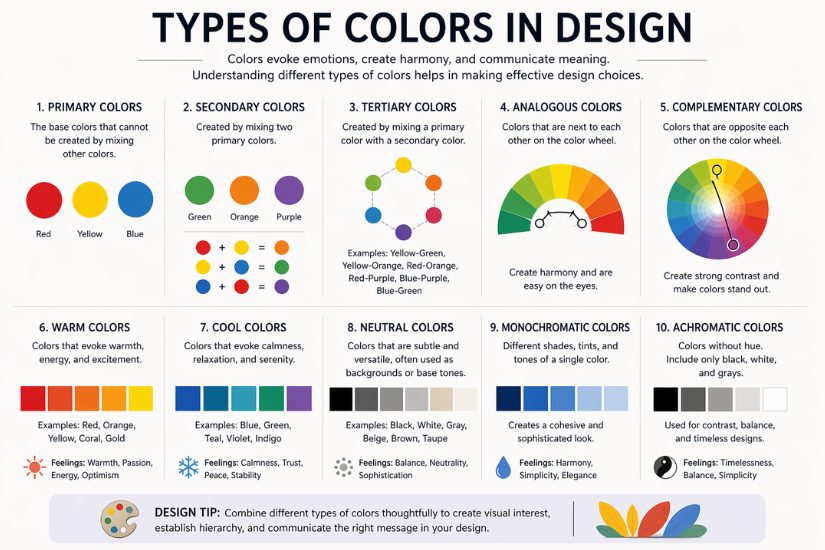
Colour is an element of design that comes from light and is perceived by the eye. It has the power to create mood, convey emotion, attract attention, and communicate meaning.
The Colour Wheel and Jewellery
The colour wheel organises colours into three families:
- Primary Colours: Red, Blue, Yellow
- Secondary Colours: Orange, Green, Violet (fire opal, emerald, tanzanite)
- Tertiary Colours: Mixes like Red-Orange, Blue-Green (padparadscha sapphire, alexandrite, teal tourmaline)
Colour Harmonies Every Jewellery Designer Should Know
- Monochromatic: One colour in many tints, tones, shades — elegant, sophisticated.
- Analogous: Neighbouring colours on the wheel — harmonious, natural.
- Complementary: Opposite colours — high contrast, bold.
- Triadic: Three evenly spaced colours — vibrant, playful.
In 2025-26, the jewellery industry has seen a major surge in demand for vibrant gemstones. Coloured gemstones like emeralds, sapphires, and rubies are increasingly preferred by customers seeking individuality and self-expression over traditional white diamond looks.
5. Value — Light and Dark in Design
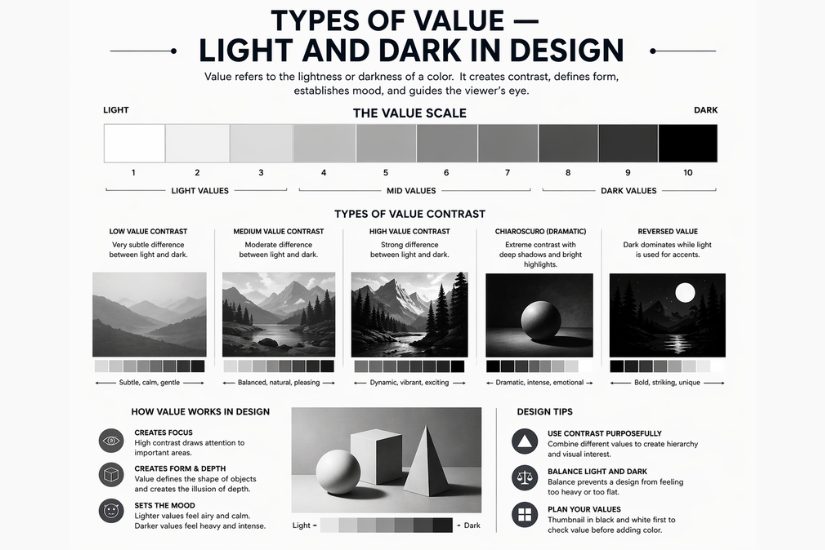
Value is the lightness or darkness of a colour. It shows how light or dark something appears, even without colour. Value is the range between white, grey, and black.
Value in jewellery manifests as:
- High-polish mirror finish (high value / bright)
- Brushed or satin finish (mid value)
- Oxidised or blackened metal (low value/dark)
Understanding value is what allows a jewellery designer to create the illusion of 3D form on a flat sketch, using tint (adding white), shade (adding black), and tone (adding grey) to show where light hits and shadows fall. Without value, everything looks flat.
6. Texture — The Surface Quality of Design
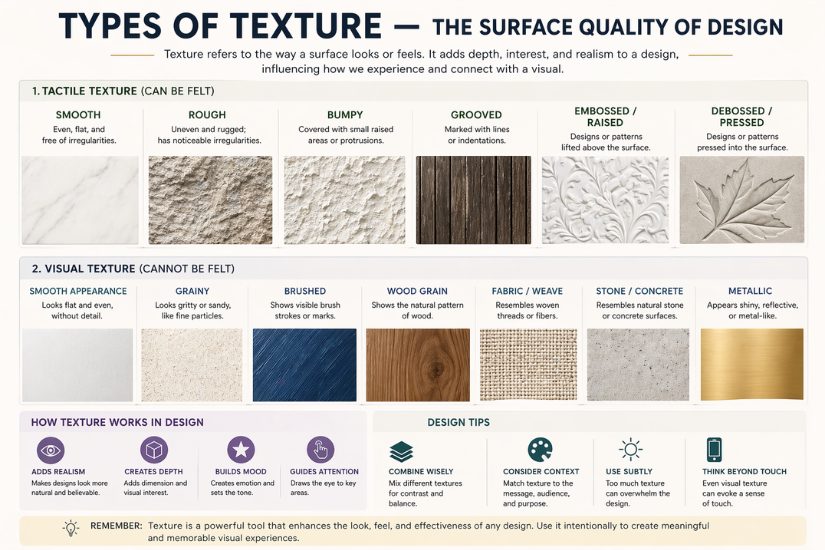
Texture is the surface quality of an object, how something feels or appears to feel. It is one of the most powerful differentiating elements in jewellery design because two rings can share the same shape and form, yet feel completely different in the hand and to the eye because of texture.
Common textures in jewellery and their emotional effect:
- Smooth / High-Polish
- Rough / Hammered
- Shiny / Reflective
- Matte / Brushed
- Granulated / Filigree
- Engraved / Carved
Today’s jewellery designers are pushing textural innovation even further by using bio-resins, recycled metals with unique surface treatments, and 3D-printed components that create textures simply impossible by hand.
7. Space — The Breathing Room of Design
Space is the area around, between, and within objects in a design. It defines where things are placed and how much room they have. Space is both the empty and the filled areas that give structure and clarity to a composition.
- Positive Space: The actual object — the metal, the stones, the form itself. This is what your eye is drawn to first.
- Negative Space: The empty area around and within the jewellery. Used masterfully, negative space becomes the design like open metalwork, pierced motifs, windows in a cuff.
In jewellery, space also governs proportion and wearability. A piece too dense in positive space feels heavy and oppressive on the body. Generous negative space creates lightness — a ring that looks airy and delicate despite using the same metal weight. The Japanese concept of ma (meaningful emptiness) is deeply relevant here: the empty space within a jewel is not wasted — it is active.
Why Elements of Design Matter to the Gems & Jewellery Industry
The global jewellery market in 2026 is a dynamic blend of tradition and innovation. Jewellery trends in 2026 emphasise individuality, heritage revival, and timeless luxury. Designers who understand the elements of design can respond to these trends with intention, rather than chasing them blindly.
Ready to Speak the Language of Design? IIG South offers a Jewellery Design Manual Professional course that teaches you to apply every element of design — from the first sketch to the final piece. Enrol now to excel in these concepts.
Frequently Asked Questions
The 7 elements of design are: Line, Shape, Form, Colour, Value, Texture, and Space. These are the fundamental visual building blocks used in every creative discipline.
Every element maps directly to jewellery craft. Line appears in filigree and engraving. Shape governs motif design and gemstone cuts. Form is the 3D volume of the jewel itself. Colour is expressed through gem selection, enamel, and metal alloys. Value controls finish quality and light reflection. Texture defines surface treatment. Space determines proportion and the relationship between open metalwork and solid form.
Form is arguably the most jewellery-specific element, since jewellery is inherently three-dimensional and must work from every angle. However, colour is often the most commercially powerful, it is the element customers respond to most instinctively when viewing a piece in a display case or online.
While you can begin learning from resources like this blog, a structured jewellery design programme, such as those offered at IIG South, gives you hands-on practice applying these elements in real sketching, CAD, and production contexts, with expert feedback at every stage.
Elements of design are the raw visual ingredients, the “what” of design (line, colour, form, etc.). Principles of design are the rules for combining those elements effectively. The “how” includes balance, contrast, emphasis, rhythm, proportion, unity, and variety. Both are essential for professional-level design.