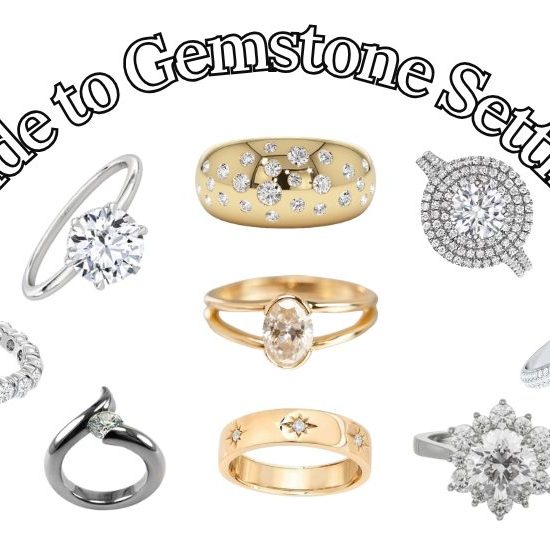
Whether you’re just starting in jewelry making or aiming to strengthen your foundational skills, mastering essential jewelry designs & the core principles is vital for long-term success. These classic design styles go beyond simple projects; they lay the groundwork for every complex piece you’ll create throughout your career. By working with these time-tested jewelry designs, jewellers develop a deeper understanding of proportion, gemstone settings, structural integrity, comfort, wearability, and customer preferences. This strong foundation not only hones technical craftsmanship but also equips you with the confidence and precision needed to innovate and evolve as a designer.
Why Master the Basics?
Before exploring complex custom creations, every accomplished jeweller must internalise the core principles that transform raw materials into jewelry that is both visually captivating and functionally sound. These foundational jewelry designs serve as a vital technical training ground, teaching critical skills that define professional craftsmanship, such as achieving harmonious proportions, engineering for durability, ensuring comfort for everyday wear, and making aesthetic choices that enhance functionality.
But mastering the basics goes beyond technical skill; It establishes your professional fluency, the shared design language that allows you to communicate clearly and confidently. Whether articulating a client’s vision, specifying materials with suppliers, or collaborating with fellow artisans, your grasp of classic settings, traditional proportions, and time-tested techniques signals expertise and builds trust.
Here’s a comprehensive list of essential jewelry designs every jeweller should know:
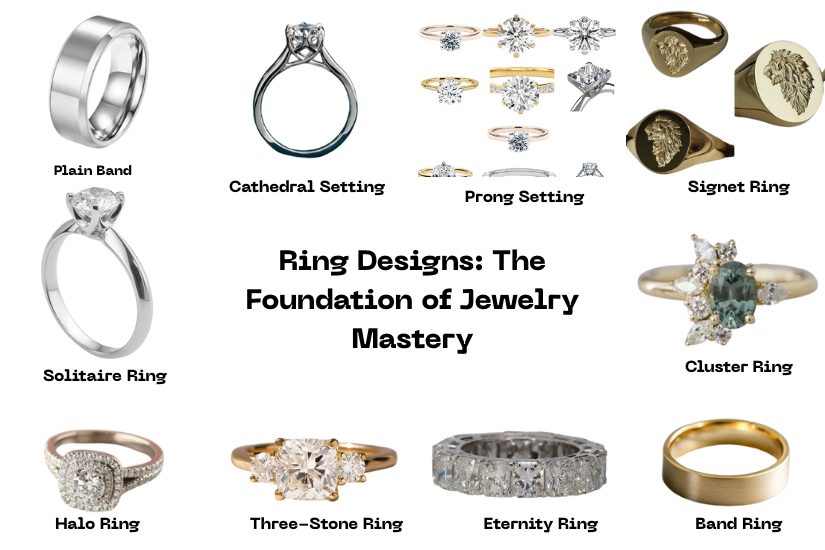
Ring Designs: The Foundation of Jewelry Mastery
Among all jewelry forms, the ring holds a unique place as the most intimate and frequently worn piece. Its circular form, constant contact with the hand, and symbolic value make it a cornerstone of jewelry craftsmanship. Mastering ring design not only builds technical skill but also develops a jeweller’s understanding of proportion, structure, and wearability principles that carry into every other jewelry form.
Core Ring Designs and Their Learning Outcomes
1. The Plain Band
The plain band is the starting point of all ring-making. It teaches essential skills such as: accurate sizing and consistent thickness, seamless soldering and smooth finishing, understanding metal behaviour under stress and achieving ergonomic curvature for comfort.
2. Cathedral Setting
The cathedral setting elevates a central gemstone using graceful, arched supports, blending elegance with engineering. Key lessons include: balancing visual height with structural stability, distributing weight evenly through architectural design and understanding proportion and the relationship between metal and gemstone.
3. Classic Prong Setting
Prong setting is foundational in teaching the delicate balance between protection and presentation, a concept central to all gemstone jewelry.
Essential Ring Variations:
- Solitaire Ring – A single-stone ring that emphasizes gemstone quality, symmetry, and proportion.
- Halo Ring – A central gem encircled by smaller stones, ideal for practicing micro-settings and perfect symmetry.
- Three-Stone Ring – Symbolizing past, present, and future, this design teaches balanced composition and narrative through layout.
- Eternity Ring – Features continuous stone setting around the band, demanding precise alignment and spacing throughout.
- Band Ring – Can be plain or textured, engraved, or embellished, excellent for exploring surface techniques and creative finishes.
- Cluster Ring – Multiple stones arranged in decorative groupings, developing skills in layout planning and harmonious design.
- Signet Ring – Traditionally engraved with initials or symbols, it offers lessons in flat-surface finishing, engraving, and carving techniques.
Earring Designs: Balancing Structure, Comfort & Aesthetics
Successful earring design lies at the intersection of structural integrity, comfort, and aesthetic appeal. Each earring type presents unique design and engineering challenges that must be mastered to create jewelry that enhances the wearer, without compromising comfort or practicality.
1. Stud Earrings
Studs are the foundation of all earring design. Simple in appearance, they teach core principles such as Post and backing construction, Weight distribution for comfort and Interaction with the human body for everyday wearability.
2. Drop and Dangle Earrings
Drop and dangle earrings introduce movement and spatial dynamics into earring design. These styles develop a deeper understanding of Gravity and center-of-mass alignment, Joint construction and articulation for graceful motion and Layering and length control for dynamic but balanced designs.
3. Hoop Earrings
Hoops represent a technical evolution in earring design. Circular or oval in form, they require mastery over Metal memory(understanding how metals retain their shape under stress), Stress point analysis(particularly at closure points) and Lightweight yet durable construction for extended wear.
Closure systems pose their own design challenges like Hinged clasps demand tight mechanical tolerances, and Endless hoops require careful calibration of gap spacing and spring tension.
The result is a design that seamlessly blends form, function, and minimalism.
Contemporary Earring Styles
- Studs – Emphasise a central focal point, ideal for showcasing gemstones or detailed metalwork.
- Hoops – Range from petite huggies (12–15 mm) to bold statement pieces.
- Linear Drops – Elongated vertical forms that draw attention and create elegant motion.
- Ear Cuffs – Clip-on or wrap-around styles that require spring-tension engineering for a secure fit without piercings

Traditional Earring Forms
- Jhumkas – Bell-shaped Indian earrings with an internal framework that supports movement while maintaining shape.
- Chandbalis – Crescent-shaped earrings where weight must be evenly distributed across the curve.
- Cascading Designs – Multi-tiered earrings requiring precise weight calculations at each level to maintain balance.
Modern Innovations
- Threader Earrings – Minimalist designs that pass through the ear using fine chains or wires.
- Jacket Earrings – Two-part systems that allow for front and back customisation.
- Convertible Earrings – Multi-functional pieces that transform from studs to drops or other configurations, offering versatility.
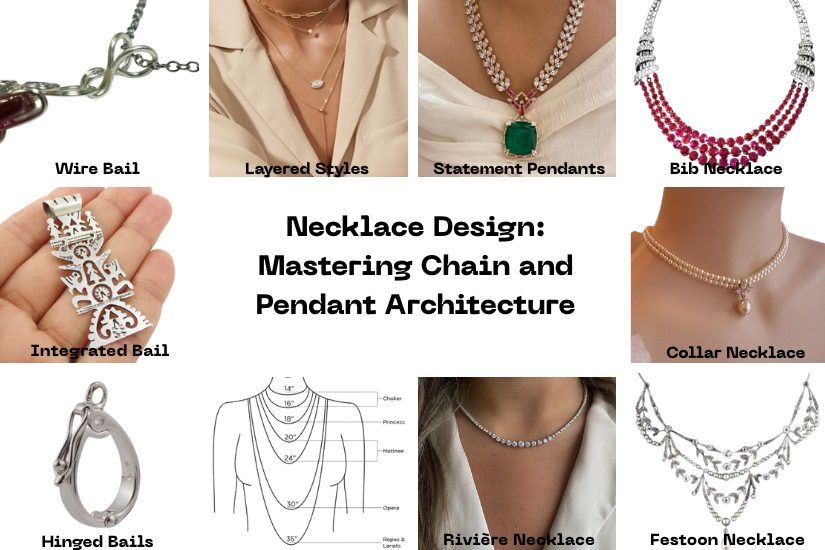
Necklace Designs: Mastering Chain and Pendant Architecture
Necklace construction is one of the most complex aspects of jewelry design. It involves creating a flexible, wearable piece that gracefully follows the curves of the human body while ensuring structural integrity and aesthetic harmony. Success in this domain demands a deep understanding of proportion theory, mechanical engineering, and how jewelry behaves on the neck and torso during movement.
Necklace & Pendant Fundamentals
A well-designed necklace is more than a string of components; it’s a dynamic, harmonious structure.
- Pendant and Chain Composition:
- Simple bail construction for secure and seamless attachment.
- Appropriate chain selection based on weight, scale, and wearability.
- Visual harmony between pendant and chain for cohesive aesthetics.
Bail Construction: The Hidden Hero
The bail, a small but vital connector, determines how the pendant hangs and performs under wear. It ensures secure pendant suspension, distributing weight and stress evenly and maintaining aesthetic balance.
Types of Bail Constructions:
- Simple Wire Bails – Teach basic metal forming and stress management.
- Integrated Bails – Combine function with form, becoming part of the design.
- Hinged Bails – Allow pendant removal and introduce mechanical complexity.
Necklace Length and Proportion
Necklace length significantly influences both the visual appeal and comfort of the piece. Designers must consider body type, neckline, and intended use.
Standard Length Categories:
- Choker (14–16″) – Accentuates the neck and jawline; must prioritize comfort at tight fittings.
- Princess (17–19″) – Most versatile; sits near the collarbone, flattering for all body types.
- Matinee (20–24″) – Offers elegance, ideal for professional or formal wear.
- Opera (28–34″) – Long and dramatic; can be doubled or knotted.
- Rope (36″+) – High-impact fashion length; often styled in multiple configurations.
Designers must also factor in pendant weight vs chain strength, front-heavy balance adjustments and draping behavior during movement.
Specialised Necklace Categories
Classical Forms:
- Rivière Necklaces – Graduated gemstones requiring precision in size transition and setting.
- Festoon Necklaces – Feature swags and drops; depend on understanding catenary curves.
- Collar Necklaces – Rigid yet comfortable, requiring internal armatures.
Contemporary Styles:
- Bib Necklaces – Bold, layered designs needing thoughtful weight distribution.
- Statement Pendants – Demand strong bail and chain engineering.
- Layered Styles – Multiple strands with strategic length staggering to avoid tangling.
Innovative Constructions:
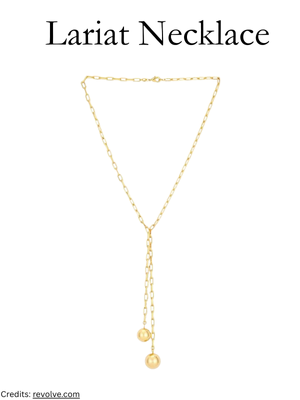
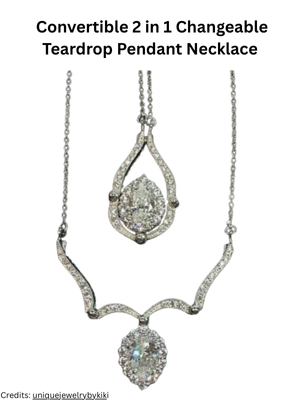
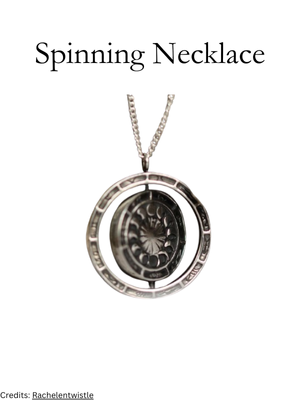
- Lariat – Clasp-free designs relying on gravity and calculated length.
- Convertible Necklaces – Multi-use pieces offering flexibility of form.
- Kinetic Elements – Involve moving parts; require articulated joints and balance.
Chain Architecture and Engineering
Chains must combine flexibility, strength, and fluid movement. Each link’s shape and connection determine how the necklace drapes, moves, and wears over time.
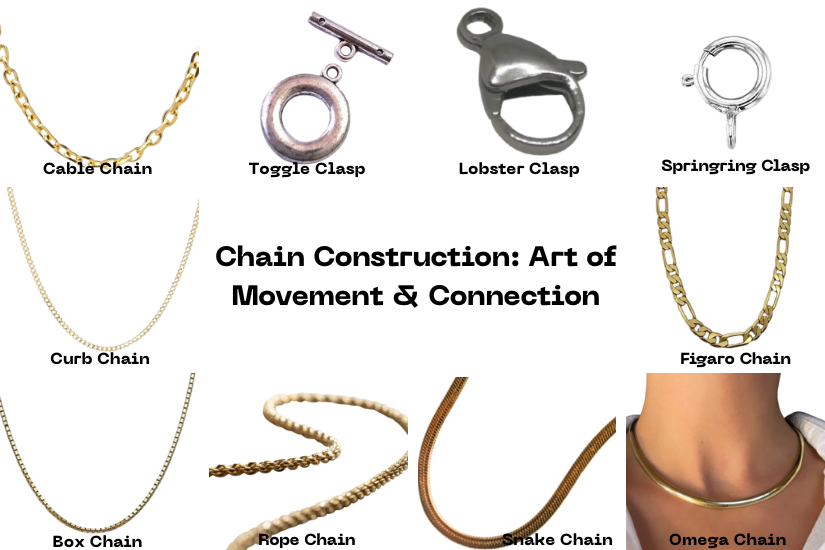
Structural Chain Types:
- Cable Chain – Oval links, excellent strength-to-weight ratio, versatile.
- Curb Chain – Flattened links that lie flat, comfortable on the skin.
- Box Chain – Square-shaped links offering a clean, modern look.
- Rope Chain – Twisted construction with excellent flexibility and volume.
Speciality Chains:
- Snake Chain – Seamless and smooth, ideal for slide pendants.
- Omega Chain – Flat, wide; suitable for bold statement pieces.
- Figaro Chain – Repeating pattern (3 short, 1 long link), adding rhythm.
Technical Considerations in Chain Construction
Closure Systems:
- Spring Ring Clasps – Simple and effective for lightweight chains.
- Lobster Clasps – Strong and secure for heavier designs.
- Toggle Clasps – Functional and decorative but require careful proportioning.
Weight Distribution:
- Balance pendant weight with chain strength to avoid strain.
- Ensure pressure points don’t affect wearer comfort, especially in heavy or long designs.
Articulation and Movement:
- Link connections should allow 3D flexibility without binding.
- Each link must move independently while preserving the chain’s overall shape.
Material Durability:
- Consider:
- Metal behavior under tension and skin contact.
- Link thickness, karat purity, and surface treatments.
- Use of alternative metals (stainless steel, titanium) for specialized needs.
Chain Construction: Art of Movement & Connection
Chain-making is a foundational discipline combining precision engineering and artistic flow. It teaches the jeweller how individual units function together to create flexibility, drape, and resilience.
Mastering Basics: The Cable Chain
Often a jeweller’s first chain, the cable chain may appear simple but is rich with learning:
- Proportional link sizing for balanced drape
- Uniform link formation for visual and mechanical consistency
Advancing Skills: Curb and Rope Chains
- Curb Chain – Flattened interlocking links, teaches advanced link shaping and spacing control
- Rope Chain – Twisted appearance with interwoven structure, demands uniform tension and pattern accuracy.
Box and Figaro Chains: Precision Meets Style
- Box Chains – Square links, sharp aesthetics and high durability, Ideal for showcasing geometric skill
- Figaro Chains – Rhythmic pattern (3 short, 1 long), Italian origin, visually dynamic
Key Construction Principles and Quality Standards
- Movement & Flexibility: Ensure each link supports the natural drape.
- Durability & Strength: Balance weight with stress management and material resilience.
- Professional Precision: Consistency in link size, soldering, alignment, and finishing.
Bracelets & Bangles
- Tennis Bracelet – Line of uniform diamonds/gemstones.
- Cuff Bracelet – Open-ended, rigid and wide.
- Charm Bracelet – Chain with attached charms.
- Bangle (solid) – Traditional rigid circle, can be plain or decorated.
- Flexible Bangle – Hinged or jointed, often used for gemstone settings.
- Kada – Thick Indian-style bangle, often worn in pairs or sets.
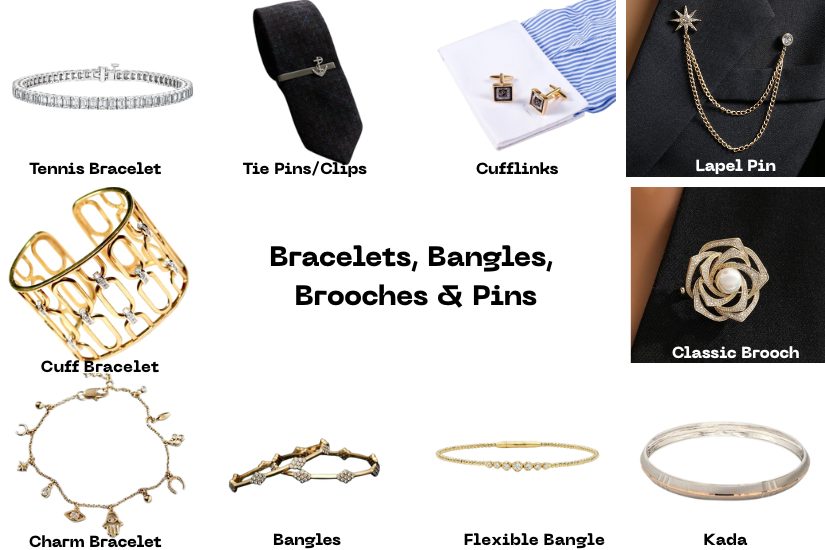
Brooches & Pins
- Classic Brooch – Decorative pin for garments.
- Lapel Pin – Smaller version used on suits or jackets.
- Hair Pins / Maang Tikka – Traditional Indian head jewellery.
Nose Pins & Nose Rings
- Stud Nose Pin – Simple and classic.
- Nath/Nose Ring – Traditional Indian design, often bridal.
- Septum Ring – Modern and traditional fusion.
Anklets & Toe Rings
- Anklet (Payal) – Chain around the ankle, plain or with charms.
- Toe Rings (Bichiya) – Worn traditionally by married women in India.
Men’s Jewellery Basics
- Cufflinks – Functional and decorative shirt fasteners.
- Tie Pins/Clips – A Formal wear accessory.
- Bracelets – Leather, chain, or metal styles.
- Chains – Generally thicker and longer styles.
- Rings – Signet, gemstone, or wedding bands.
Gemstone Setting Types (Design Features Every Jeweller Must Know)
Prong settings are essential for showcasing stones while allowing maximum light entry. Bezel settings provide security and a clean aesthetic. Learning these two settings gives jewellers the skills to adapt to most stone-setting scenarios.
Bezel Settings
The bezel setting surrounds stones with a continuous metal rim, offering maximum security. This technique teaches metal manipulation, precise measurement, and how to work with the natural properties of different gemstones. Creating a proper bezel requires understanding how much metal is needed and how it will behave when pushed over a stone.
Channel Settings
Channel settings, where stones sit in a continuous groove with no metal between them, introduce concepts of precision spacing and uniform height. This technique demands perfect measurement and teaches how multiple stones can work together as a unified design element.
Some other stone settings include Prong Setting, Pavé Setting, Bar Setting, Flush Setting, and Tension Setting.
Technical Foundation: The Skills That Support Every Design
Traditional Techniques like soldering, filing, polishing, and basic metalworking form the technical foundation. Understanding how different metals behave, expand, and connect is crucial for any design execution.
Soldering Mastery: Clean, strong solder joints are invisible in finished pieces but essential for durability. Learning to control heat, choose appropriate solder, and create seamless connections is fundamental to every jewelry technique.
Filing and Finishing: The difference between amateur and professional work often lies in the finishing. Proper filing techniques create smooth surfaces and crisp edges, while understanding different polishing compounds and methods brings out the full beauty of precious metals.
Metalworking Basics: Understanding how different metals behave, their melting points, hardness, and working properties, informs every design decision. Gold behaves differently from silver, and platinum requires different techniques from copper alloys.
Jewelry Design Principles That Transcend Technique
Proportion and Scale
Learning how size relationships affect wearability and visual appeal applies to every piece. This includes understanding how jewelry interacts with the human body and complements different physical features.
- Clasp, hinge, and joint design mechanisms
- Accurate sizing (ring, chain lengths, bangle diameters)
- Understanding of materials (gold, platinum, silver, alloys)
- Metal weights and gemstone carat planning
Wearability Considerations
Beautiful jewelry that’s uncomfortable to wear won’t be worn. Understanding how pieces interact with the human body, like weight distribution, catch points, and movement, is essential for creating pieces people will treasure and wear regularly.
Durability and Function
Jewelry must withstand daily wear while maintaining its beauty. Learning to identify stress points, choose appropriate construction methods, and balance delicate appearance with practical durability is a skill that distinguishes professional jewellers.
Technical Skills Every Designer Should Have
Sketching & Conceptualization
- Hand sketching (Orthographic + Perspective views)
- Shading and rendering gemstones, textures, metals
- Colour rendering (Markers, Watercolours, Digital)
CAD Design
- MatrixGold / Rhino / ZBrush / JewelCAD, etc.
- Understanding 3D printing constraints
- CAM/CNC compatibility
- Render-ready files for client presentation
Master the Essentials, Master the Craft
These fundamental jewelry designs aren’t just exercises; they’re the vocabulary of jewelry making. Every complex custom piece incorporates elements from these basics. An elaborate engagement ring might combine cathedral architecture with prong settings and decorative metalwork, but it all builds on these foundational skills.
Master the design basics thoroughly, and you’ll have the confidence and competence to tackle any design challenge. Rush past them, and you’ll find yourself struggling with techniques that could have been learned systematically and completely.
The journey of a thousand miles begins with a single step, and in jewelry making, that step is mastering these essential jewelry designs & techniques.
Begin your jewelry design journey with the Master’s in Jewellery Design course, where creativity transforms into a profession.